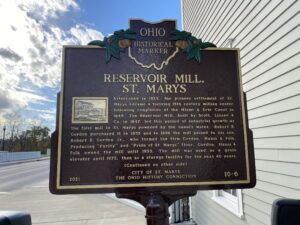
Established in 1823, the pioneer settlement of St. Marys became a thriving 19th century milling center following completion of the Miami & Erie Canal in 1845. The Reservoir Mill, built by Scott, Linzee & Co. in 1847, led this period of industrial growth as the first mill in St. Marys powered by the canal’s water. Robert B. Gordon purchased it in 1855 and in 1896 the mill passed to his son, Robert B. Gordon Jr., who formed the firm Gordon, Hauss & Folk. Producing “Purity” and “Pride of St. Marys” flour, Gordon, Hauss & Folk owned the mill until 1955. The mill was used as a grain elevator until 1972, then as a storage facility for the next 40 years. (Continued on other side)
In recognition of its noteworthy representation of the history, culture, and architecture of the Western Reserve, Burton Village’s Historic District was placed on the National Register of Historic Places in 1974. The Historic District, an area of approximately 20 acres surrounding the Village Green and along streets at the north end of the Green, includes 15 buildings of historical significance built between 1815 and 1891. Preserved within the District are commercial and public buildings and private dwellings that reflect the cultural and architectural development of a village of the Western Reserve of Ohio during the 19th century. Buildings in the predominant architectural styles of the 19th century are all represented in the Historic District, including Western Reserve, Greek Revival, Second Empire, Italianate, and Queen Anne. [Continued on other side]
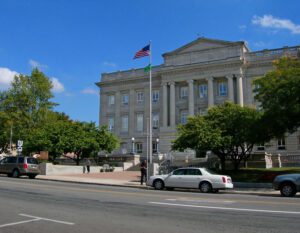
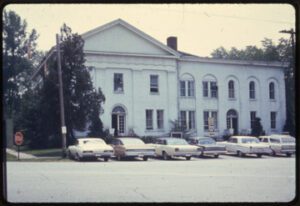
One of Ohio’s larger courthouses, this structure, completed in 1915 at a cost of $275,000, is the third courthouse to be built in this vicinity. The building, designed by the architectural firm, Richards, McCarty, and Bulford, is an excellent example of Neoclassical Revival architecture. The courthouse interior is notable for its outstanding leaded stained glass skylight, brass chandeliers, and murals. The twelve large exterior light standards are made of solid brass. The exterior walls and terrace railings are made of Indiana Gray Limestone, while the steps and surrounding curbs consist of granite.
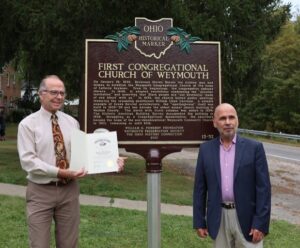
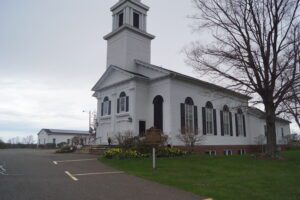
On January 19, 1835, Reverend Steven Barnes led sixteen men and women to establish the Weymouth Congregational Church at the home of Lathrop Seymour. From its beginnings, the congregation opposed slavery. In 1848, it adopted resolutions condemning the “peculiar institution” and asserting that Black people are “our brother[s] ‘made one blood’ with us.” In 1853, the church hosted public meetings featuring the crusading abolitionist William Lloyd Garrison. A notable example of Greek Revival architecture, the “meetinghouse” itself was built in 1835-’36 and has become the oldest extant church building in Medina County. The porch with Doric columns was added in 1854. The Historical American Building Survey documented the building in 1936. Struggling as a Congregational denomination, the sactuary became the home of the non-denominational Weymouth Community Church in 1920, remaining so until 2018.
Mahoning County was created in 1846 by combining townships from southern Trumbull and northern Columbiana counties. Canfield engaged in competition with several surrounding communities for the new county seat, and its success was attributed to its central location along with the state and local political influence of Judge Eben Newton and Elisha Whittlesey, Esq., Comptroller of the United States Treasury from 1849-1857. To become the county seat, the State of Ohio required “a suitable lot and $5,000 toward public buildings” Judge Newton donated the land and spearheaded the subscription of the state required bond. Once attained, construction progressed rapidly on the Classical Revival style courthouse, completed in June 1848. The Italianate style West wing was added in 1862, but its government status was challenged when in the early 1870s, Youngstown, by now a city, resumed its earlier challenge for the county seat. (continued on other side)
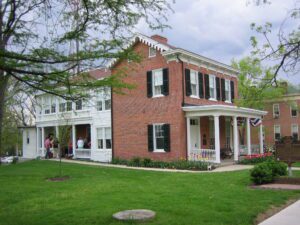
William Holmes McGuffey (1800-1873) was a Miami University faculty member in 1836 when he compiled the first edition of the McGuffey Eclectic Reader in this house. His Reader taught lessons in reading, spelling, and civic education by using memorable stories of honesty, hard work, thrift, personal respect, and moral and ethical standards alongside illustrative selections from literary works. The six-edition series increased in difficulty and was developed with the help of his brother Alexander Hamilton McGuffey. After the Civil War the Readers were the basic schoolbooks in thirty-seven states and by 1920 sold an estimated 122 million copies, reshaping American public school curriculum and becoming one of the nation’s most influential publications. (Continued on other side)
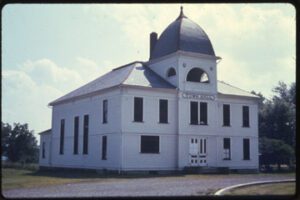
Major buildings dating from 1832 to 1898 surround the village green, the geographic center of Gustavus Township. Built in 1832 on the northwest quadrant, the George Hezlep House features Federal-Greek Revival architecture and has a closet reputedly used on the Underground Railroad. Built in 1840, the Farmers’ Exchange Store was originally a double entrance Greek Revival structure. The Storekeeper’s House, also a Greek Revival structure, was built next to the exchange store in 1840. South of this house is the Fraternal Hall, built in 1870. There were once four churches in Gustavus including the Methodist Church, built in 1856 with a temple front and a belfry, and the Congregational Church, built east of the center in 1854. The eclectic Town Hall was built in 1890 and fronts the southeast quadrant. The Gustavus Centralized School, reported as the first centralized school in the United States, was built in 1898 and was replaced by the current building in 1928.
The First Congregational Church of Claridon has served the community since it was dedicated in the summer of 1832. Twenty-seven souls from the Burton Congregational Church petitioned to form their own church in Claridon in November 1827, and their request was granted the following month. In 1830, a committee made up of Cotton Kellogg, Chester Treat, and Asa Cowles contracted with John Talbot and Rufus Hurlburt to build the church. When “sledding” came during the winter of 1831, logs were hauled to Cotton Kellogg’s sawmill to be cut into lumber. (Continued on other side)