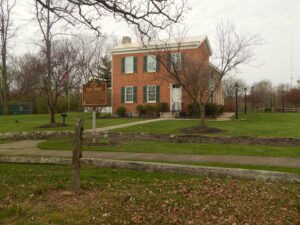
Elisha Morgan purchased 48.6 acres in Fairfield Township, part of the Symmes Purchase, in 1817. The Farm Mansion was built shortly after he settled the land. The house incorporates two prevalent architectural styles in southwest Ohio in the nineteenth century. The original front portion is an example of Federal style architecture while the 1858 rear addition represents the Greek Revival style. Built earlier than most farmsteads in the township, the Mansion is a rare example of an early farmhouse that has survived despite suburban development. The Mansion is listed on the National Register of Historic Places.
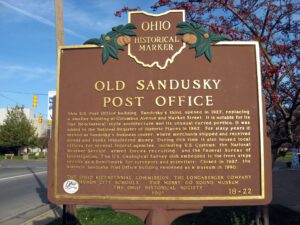
This U.S. Post Office building, Sandusky’s third, opened in 1927, replacing a smaller building at Columbus Avenue and Market Street. It is notable for its fine Neoclassical-style architecture and its unusual curved portico. It was added to the National Register of Historic Places in 1982. For sixty years it served as Sandusky’s business center, where merchants shipped and received goods and banks transferred money. During this time it also housed local offices for several federal agencies, including U.S. Customs, the National Weather Service, armed forces recruiting, and the Federal Bureau of Investigation. The U.S. Geological Survey disk embedded in the front steps serves as a benchmark for surveyors and scientists. Closed in 1987, the historic Sandusky Post Office building reopened as a museum in 1990.
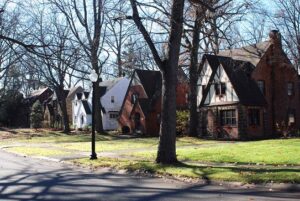
Situated in the township of Boardman and developed in the 1920s, Newport Village was one of Youngstown’s earliest automobile accessible suburban developments. The twenty four and a half acre district is comprised of Jennette Drive, Chester Drive, seven lots on Overhill Road, and a majority of the area on Market Street’s west side. Gently curving streets with both Tudor and Colonial architecture blend into the natural landscape of the area and Mill Creek Park. Newport Village became part of the National Register of Historic Places in 2006.
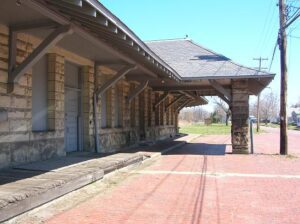
On February 8, 1848, the Ohio Legislature incorporated the Cleveland, Painesville, and Ashtabula Railroad Company, which reached Painesville in 1851, with track and a depot. President-elect Abraham Lincoln arrived in Painesville on February 16, 1861, on his way to his inauguration in Washington, DC. The Lake Shore Railroad Company replaced the Cleveland, Painesville, and Ashtabula Railroad Company in March 1869 followed by consolidation with the Lake Shore and Michigan Southern Railway Company in June of that year. The Lake Shore and Michigan Southern Railway, replacing the original 1851 depot, built the present station in 1893. With its Richardson Romanesque style architecture, sandstone walls, slate roof, red oak and marble interior, and its hanging chandeliers, it was considered the jewel of Painesville. In 1914, Lake Shore merged with ten others to form the New York Central System. In 1971, the last passenger train left the Painesville yard, ending nearly 100 years of passenger rail service.
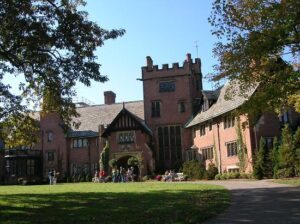
The former “country estate” of the Frank A. Seiberling family, Stan Hywet Hall is one of the finest examples of Tudor Revival architecture in the United States. “F.A.” Seiberling (1859-1955) co-founded the Goodyear Tire & Rubber Company in 1898 and later the Seiberling Rubber Company, thus greatly contributing to Akron’s distinction as “The Rubber Capital of the World.” Built between 1912 and 1915, The 65-room Manor House and service buildings are situated on more than 70 acres of restored historic gardens and wooded landscapes, all reflecting the Seiberlings’ tastes in the decorative and cultural arts. Stan Hywet Hall and Gardens was listed on the National Register of Historic Places in 1975 and designated a National Historic Landmark in 1982.
This area of western Hancock County is a part of the Maumee River Watershed known as “Indian Green.” Wyandot Indians chose this area for hunting and ceremonial grounds along the Blanchard River in the 1700s because it was next to the river, yet high enough to avoid frequent flooding. One-half mile east of this location is a Liberty Township cemetery. It is located upon a sand ridge once used as a burial ground by Indians, hence the name “Indian Green.”
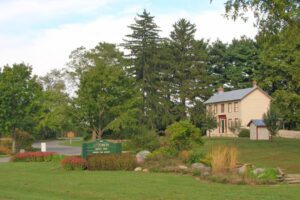
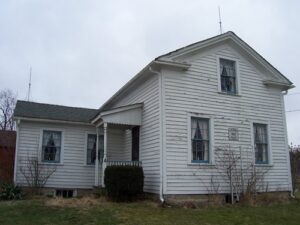
This 48-acre farm is the last remnant of an agricultural way of life that characterized Parma Township well into the 20th century. The farmhouse, built circa 1855 by Western Reserve settler Lyman Stearns, is representative of the Greek Revival style of architecture popular in this region prior to the Civil War. The “Yankee” style barn predates the house. Suburban development following World War II engulfed virtually all of this area by the 1950s. The Stearns Homestead was added to the National Register of Historic Places in 1981. (continued on other side)
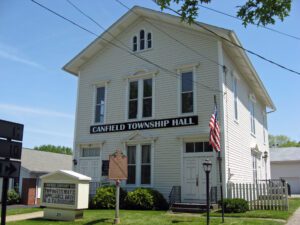
The Canfield Township Hall was erected in 1884. It served as the first public building in which the Canfield citizens could conduct town business, elections, and public meetings. An example of Renaissance Revival or “Italianate” architecture, the building is typical of late Victorian commercial buildings, but constructed of wood rather than of the customary brick. Drafted by Colonel S. Kinney, it was originally constructed for the sum of $2,389 by G.W. Strock at the corner of South Broad and East Main streets, on a lot purchased for $500. In 1936, R.J. Neff moved the hall several hundred feet south to its present location. In addition to official township meetings, the second floor has been used for a variety of activities, including social meetings, lectures, contests, dances, and roller-skating. The building served as an early home of the Canfield Historical Society and operated continuously for over one hundred and twenty-five years.