Fout Hall was one of three original buildings on the Bonebrake Theological Seminary campus. Constructed 1920-1923, it was named for Dr. J. E. Fout, who managed campus construction. Bonebrake Seminary was founded in 1871 by Dayton’s United Brethren in Christ Church and became co-educational in 1873. Generous cash and land gifts (1909-1911) enabled the construction of a new campus. Fout Hall, the administration building, and a powerhouse were designed by Dayton architect Frederick J. Hughes in the Jacobethan Revival style. The three-story buff-brick dormitory was the largest of the buildings and cost $250,000. As well as dining hall, laundry, and storage facilities, it featured 12 single rooms, 54 two-room suites, and 6 three-room suites. Fout Hall was an integral part of the National Register listing of the Dayton View Triangle Historic District in 2022.
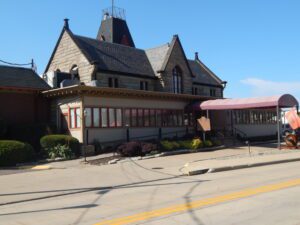
The Berea Union Depot, a significant hub in the railroad networks of northeast Ohio from the time of its construction in 1876 until its closing in 1958, is an unusual, but well-designed example of Victorian Gothic Architecture. With the development of an expanding stone quarry industry in the area, Berea and its railroad facilities grew rapidly and by the early 1870s developers and townspeople alike called for construction of a new passenger and freight station. When this Berea sandstone station was completed and then dedicated on May 3, 1876, the Cleveland Plain Dealer called the building “the finest facility outside the big cities.” From 1958 until 1980, the building remained closed until it began a second life, restored as a restaurant and gathering place.
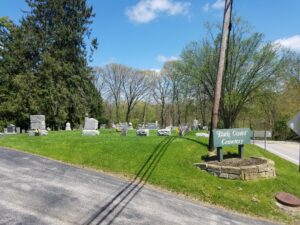
Settlers from New England purchased this land in 1817 for use as a burying ground and to build a meeting house. Located in the center of Bath Township, a part of the Connecticut Western Reserve, the site provided a convenient place for public and religious gatherings and for a cemetery. Out of need, the cemetery was established before the township was founded in 1818. Many of Bath Township’s farming families, as well as both owners and operators of businesses of Bath, are interred in the cemetery. In a tradition originating with Civil War veteran Perry Alexander, the graves of all veterans are marked with an American flag on Memorial Day as a tribute to their service.
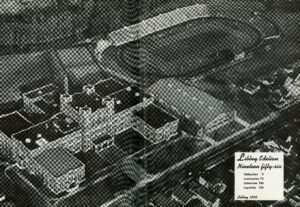
Edward Drummond Libbey High School . Edward Drummond Libbey High School – “the castle on the hill” – opened in 1923 to serve the growing number of students in Toledo Public Schools. The school offered a curriculum of manual and academic training, reflecting a progressive movement during the late 19th and early 20th centuries to democratize education. Libbey High School was named for Edward D. Libbey (1854-1925), a local businessman, civic leader, and philanthropist who founded the Libbey Glass Company and Toledo Museum of Art. Libbey’s successful business ventures earned Toledo the nickname “The Glass Capital of the World.” Much of his fortune was spent on providing cultural and educational institutions that still serve the public as of 2018. (Continued on other side)
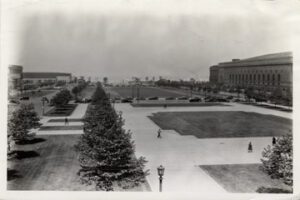
In August 1903, architects Daniel H. Burnham, John M. Carrere, and Arnold W. Brunner presented Mayor Tom L. Johnson and the City of Cleveland a plan that epitomized the City Beautiful Movement in America. The Group Plan envisioned a grand landscaped mall surrounded by public buildings in the Beaux-Arts style. The plan would create a monumental civic center, influence the design of buildings throughout the city, and lay the foundation for a city planning commission. The first of its kind in the nation, the Group Plan, as built, was the most completely realized of Burnham’s city planning efforts. In its green space and architecture, the Mall remains an enduring and vital element of Cleveland’s civic culture. (continued on other side)
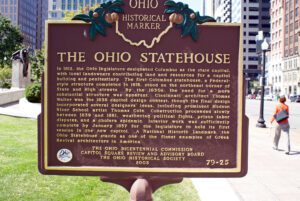
Along E. Broad Street. – Near Statehouse Parking Garage
Columbus
, OH
In 1812, the Ohio legislature designated Columbus as the state capital, with local landowners contributing land and resources for a capitol building and penitentiary. The first Columbus statehouse, a Federal-style structure completed in 1816, stood on the northeast corner of State and High streets. By the 1830s, the need for a more substantial structure was apparent. Cincinnati architect Thomas Walter won the 1838 capitol design contest, though the final design incorporated several designers’ ideas, including prominent Hudson River School artist Thomas Cole. Construction proceeded slowly between 1839 and 1861, weathering political fights, prison labor disputes, and a cholera epidemic. Interior work was sufficiently complete by January 1857 for the legislature to hold its first session in the new capitol. A National Historic Landmark, the Ohio Statehouse stands as one of the finest examples of Greek Revival architecture in America.
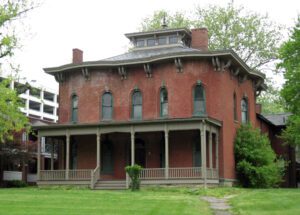
The Cozad-Bates House is one of the oldest remaining structures in Cleveland’s University Circle. The original section, built circa 1853, is the only pre-Civil War residential structure left in the neighborhood. Built by Samuel and Jane Cozad’s son, Andrew Cozad, the first section used locally made brick to form a simple two-story, one-room-deep, vernacular English-I house. The family owned a large portion of the land which is now occupied by University Circle. Justus Cozad, Andrew’s son, returning from the west where he worked as a railroad superintendent and civil engineer, built the later section on Mayfield Road for his larger family in 1872. It is a rare surviving example of Italianate-influenced residential architecture, including a hipped roof, curved bay windows, paired eave brackets, and prominent belvedere. The house was listed on the National Register of Historic Places in 1974 and designated as a Cleveland Landmark in 2006.
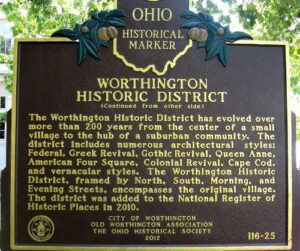
Worthington was founded in 1803 by the Scioto Company, settlers from Connecticut, and named after Thomas Worthington, a major proponent of Ohio statehood. The original plat included a 3-1/2 acre village green bounded on the east by 1-1/2 acre school and church lots. The green was surrounded by 160 residential and commercial lots, each measuring 3/4 of an acre. By 1812, Worthington was a finalist for designation as the capital of Ohio. (Continued on the other side.)