

, OH
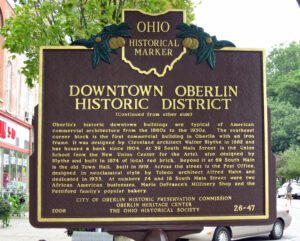
The intersection of Main and College streets has been the center of Oberlin since the town and college were founded in 1833. The first downtown buildings were made of wood and were destroyed by a series of spectacular fires. The first college building, Oberlin Hall, stood on the southwest corner of College and Main and included recitation rooms, a dining hall, chapel, offices, and lodging. In 1887, Akron architect Frank Weary designed the large brick building at numbers 5 to 13 West College. Number 23 West College (Gibson Block) once housed a silent movie theater on the second floor. East College Street’s historic buildings include the Apollo Theater, which showed Oberlin’s first talking movie on May 11, 1928. From 1897 to 1929, an interurban streetcar line connected Oberlin’s downtown to Cleveland. Oberlin’s downtown historic district was placed on the National Register of Historic Places in 2003.
, OH
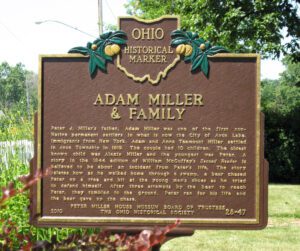
The Peter J. Miller House was constructed around 1830 and is one of the last remaining pre-Civil War lakefront houses in Lorain County. The architecture is Greek Revival. Peter Miller married Ruth Houseworth in 1828. They had five children. In 1851 Peter Miller died and it’s believed that his family continued to reside on the property until 1925. The City of Avon Lake purchased the property in 1962. The house was opened for tours, and restoration proceeded, as funds were available. In 1975 the water heating system burst and caused extensive damage. In 1985 a new committee took over and was successful in restoring the house. Volunteer trustees have overseen the operation of the house as a museum since September 1989.
, OH
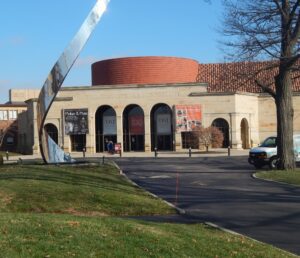
The Dayton Art Institute, one of the region’s premier fine arts museums, was founded in 1919 as the Dayton Museum of Arts. Founding patrons included Orville Wright, members of the Patterson family, and philanthropist Julia Shaw Patterson Carnell, who donated a mansion for the museum’s first home. In 1923, the museum changed its name to The Dayton Art Institute to reflect the growing importance of its art school, which operated until 1974. After outgrowing its first home, Carnell contributed $2 million for a new building designed by architect Edward B. Green. Completed in 1930 and modeled after two sixteenth century Italian Renaissance villas, the building was added to the National Register of Historic Places in 1974 as a preeminent example of Second Renaissance Revival architecture. As it commemorates its centennial, The Dayton Art Institute continues to serve the community with exhibitions, educational programs, and events.
, OH
Born in Jefferson, Ohio, Theodore E. Burton graduated from Oberlin College and became a prominent Cleveland attorney. He was elected to Congress in 1888 and served from 1889-91, 1895-1909, and 1921-28. He was elected U.S. Senator in 1908 and 1928 and was a leading contender for the U.S. Presidency in 1916. Due to his work in saving Niagara Falls from development and his opposition to wasteful waterways projects, President Theodore Roosevelt appointed Burton chairman of the Inland Waterways Commission in 1907 and the National Waterways Commission in 1909. Burton is credited with pushing legislation through Congress that authorized the construction of the Panama Canal and negotiating agreements to ensure its neutrality. He lobbied to fight wasteful spending and influence of big business and sponsored the Sherman Anti-Trust Act of 1890. As president of the American Peace Society, Burton hosted the First World Conference on International Justice in Cleveland in 1928, attended by 13,000, including world leaders.
, OH
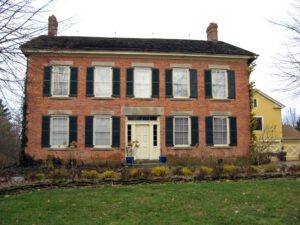
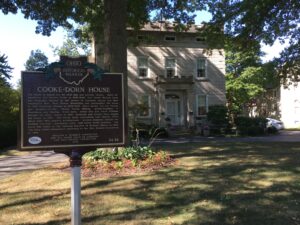
Eleutheros Cooke. The Cooke-Dorn house was the last home of attorney Eleutheros Cooke (1787-1864) who served four years in the Ohio legislature and one term in the 22nd Congress of the United States. An early proponent of railroads, Cooke received one of the first charters granted to a railroad west of the Alleghany Mountains, for the Mad River & Lake Erie line. He and wife Martha had six children, four of whom lived to adulthood. Two rose to prominence in the Civil War era. Jay was a successful banker and became known as the “financier of the Civil War” for his efforts to secure loans from Northern banks to support the Union’s war effort. Henry was appointed as the first governor of the short-lived Territory of the District of Columbia in 1871 (which was replaced in 1874).
, OH
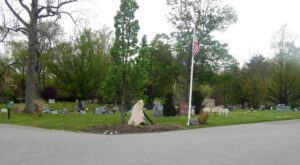
Founded in 1876 by a group of Toledo businessmen, Woodlawn Cemetery was designed in the tradition of the country’s “rural cemetery” movement, which was first popularized in Europe in the 1830s. This movement reflects the change in American burial practices in the nineteenth century as attitudes of death changed from grim to sentimental. The cemetery’s landscape emphasizes nature and art. Besides being a burial place, the cemetery is an arboretum, bird sanctuary, outdoor museum, and historical archive. Woodlawn also became a fashionable park for Toledo’s residents to escape the commotion of the city. The cemetery chronicles the growth of Toledo and northwest Ohio, and is an important cultural and historic landmark in regards to community planning and development, and landscape and building architecture. Historic Woodlawn Cemetery was listed on the National Register of Historic Places in 1998.
, OH
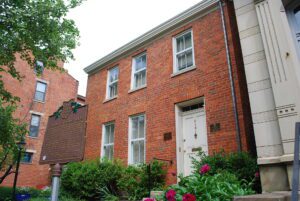
The oldest building in Cincinnati’s basin area, the Betts House exemplifies a national trend on the expanding frontier of impermanent log and frame structures giving way to more permanent brick architecture. It is the earliest surviving brick building in the city. During Cincinnati’s period of settlement in the early 1800s, the William and Phebe Betts family established a brickyard here that supplied building materials for the rapidly growing frontier city. The Betts House lends its name to the Betts-Longworth Historic District. Established in 1983, the district represents the last nineteenth century remnant of Cincinnati’s lower West End and surrounds the older Betts House with tall, narrow mid-and late-nineteenth century buildings. The Betts house is oriented to the cardinal directions, rather than to the city’s slightly skewed grid.
, OH
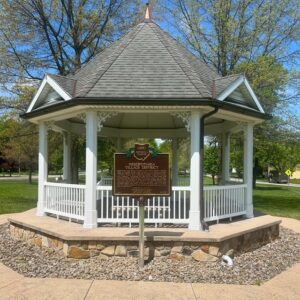
Mesopotamia Village District was listed in the National Register of Historic Places on December 24, 1974. Many consider it to be “the most unspoiled nineteenth century central green type of village in northeastern Ohio.” The district includes houses, commercial buildings, a town hall, churches, and a cemetery. Surrounding the 1600-foot-long public green these structures represent Greek Revival, Gothic Revival, Queen Anne, Italianate, and vernacular architectural styles constructed between 1820 and 1902. One of the oldest buildings in the district is the colonnaded Greek Revival commercial building at the southwest end of the green. Built in the 1820s for early resident Isaac Clark, it was operated as a store by F.C. Peck. Over the ensuing centuries it has served as a barber shop, post office, and an undertakers. (Continued on other side)