In 1795, the Connecticut Land Company auctioned twenty-five square miles of land known as Plum Creek Township. Aaron Olmsted, a sea captain, purchased almost half of the property. Although Olmsted died before ever seeing his land, in 1829, his son Charles offered to donate books to the area in exchange for changing the settlement’s name from Lenox to Olmsted. In 1815, shoemaker James Geer and his family became the first permanent American residents to settle in the southern end of the area. Geer’s farm was on what is now Columbia Road.
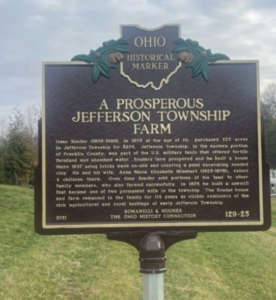
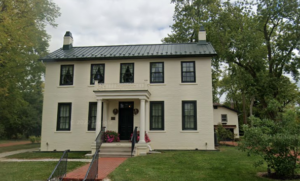
Isaac Souder (1809-1889), in 1835 at the age of 26, purchased 225 acres in Jefferson Township for $674. Jefferson Township, in the eastern portion of Franklin County, was part of the U.S. military lands that offered fertile farmland and abundant water. Souder’s farm prospered and he built a house there 1837 using bricks made on-site and creating a pond excavating needed clay. He and his wife, Anna Maria Elizabeth Minehart (1825-1878), raised 4 children there. Over time Souder sold portions of his land to other family members, who also farmed successfully. In 1874 he built a sawmill that became one of two permanent mills in the township. The Souder house and farm remained in the family for 114 years as visible reminders of the rich agricultural and rural heritage of early Jefferson Township.
Iuka Ravine, developed on land from the “Indianola Farm” that belonged to the Neil Family, is significant for its early 20th century architecture. The ravine’s natural beauty influenced architects to design homes for the upper middle class that incorporated “features of the old oak forest and glacial boulders.” Several ravine homes were designed by Frank Packard and Charles Inscho. Two classically-designed bridges built in 1912 insulated the area from traffic to create what became known during the 1920s-1950s as a “quiet professor enclave.” Iuka’s curvilinear street, one of the first in Columbus, as well as its stone walls, glacial erratics, and mature hardwoods created a “unique urban experience.” The Iuka Ravine Historic District was listed in The National Register of Historic Places in 1986 and added to the Columbus Register of Historic Properties in 1985.
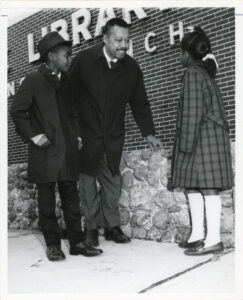
On November 19, 1968, the Columbus Metropolitan Library dedicated the first public library in the nation named after Dr. Martin Luther King Jr. After King’s assassination on April 4, 1968, the East Side Community Council requested that the new library being planned for the King-Lincoln Bronzeville community bear his name. The King family had both family and civic ties to Columbus and were honored by the tribute. More than 1,000 people gathered outside 1600 E. Long Street to hear Martin Luther King Sr. deliver the November dedication speech. Continuing the King family tradition, Martin Luther King III cut the ribbon to open a new branch building at 1487 E. Long Street on October 18, 2018. The Martin Luther King Branch was the first Columbus public library to bear an individual’s name.
Hugh Grant Sr. (1769-1806) owned a gristmill and land in Pittsburgh, Pennsylvania, during the 1790s. He married Catharine Barr Grant (unknown-1836) and they had 6 children: Alexander, Jacob, Isabella, Nancy, Mary, and Hugh Grant Jr. (born posthumously). In 1804 Grant purchased 450 acres of federal land at the Chillicothe land office. In 1805 he and his family moved to Jackson Township, Ohio. Uncertain of the location of his tracts, he settled his family in a log structure along the Scioto River. During the winter of 1806-1807, Grant died in a freak accident climbing a honeybee tree. Catharine Barr Grant realized they were on the wrong land and moved her family to the right property holdings where the Grant Homestead remains. She died August 17, 1836, and is buried in Union Methodist Cemetery.
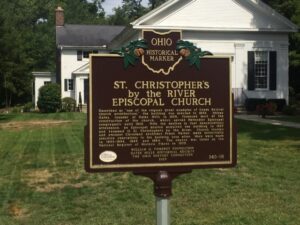
Described as “one of the region’s great examples of Greek Revival church architecture,” the building was erected in 1853. Holsey Gates, founder of Gates Mills in 1826, financed most of the construction of the church, which served Methodist Episcopal congregants until 1926. With the decline in that denomination’s attendance, an Episcopal mission acquired the building in 1927 and renamed it St. Christopher’s by the River. Church trustee and eminent Cleveland architect Frank Walker made historically sensitive renovations to the building soon after. More were made in 1953-1954, 1965, and 1984. The church was listed on the National Register of Historic Places in 1975.