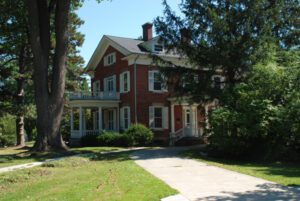
Jabez Lyman Burrell (1806-1900), originally from Massachusetts, built this house in 1852. Burrell made his living as a cattleman and farmer, but devoted much of his time serving the cause of abolitionism, helping slaves, who had escaped the South, get to Sheffield and from there to Lorain and across Lake Erie to Canada. He was also devoted to equal education for all, providing funding to a freedmen’s school in Selma, Alabama, and serving as a trustee of the Oberlin Collegiate Institute, well known for educating African Americans and women. From 1884 to 1934, this was the home of Henry Churchill King (1858-1934), who was the president of Oberlin College from 1902-1927. The Kings added the porches and rear wing and made their home a social center for the college and community. The house is listed on the National Register of Historic Places and is a City of Oberlin Historic Landmark.
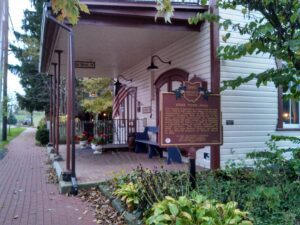
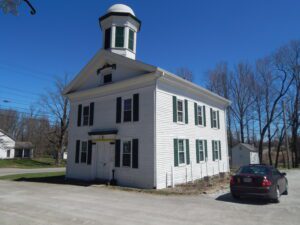
The Society of Separatists of Zoar built the Zoar Town Hall in 1887 when the village was formally incorporated. Established in 1817 by German religious dissidents, Zoar became one of the most successful experiments in communal living during the 19th century. Early hardships encouraged the Zoarites, in 1819, to establish a communal system to ensure economic and social security. The Society disbanded in 1898. The Zoar Historic District was added to the National Register of Historic Places in 1969.
The most notable feature of Mantua Center is the “Village Green,” which harkens back to the New England heritage of Mantua Center’s early settlers. The Green sets upon land donated by Hezekiah Nooney Sr. and was important to both the social and commercial interests of the town. The businesses located here were a furniture and cabinet maker’s shop, harness shop, blacksmith shop, post office, tannery, ashery, dry goods store, and distillery. The Methodist Episcopal Church, now the Mantua Civic Center, stands at the southwest corner of the green. Eastlawn cemetery, with a burial that dates to 1816, sits along the south border. The cemetery serves as the final resting place for soldiers of several wars, including the American Revolution, as well as many other early citizens. In 1835 Horace Sizer constructed the stone wall around the cemetery adjacent to Mantua Center Road. [continued on other side]
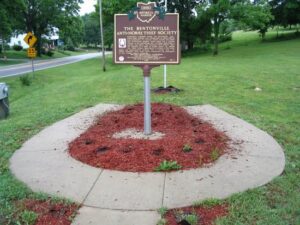
Originally a vigilante group, the Bentonville Anti-Horse Thief Society was formed here in March 1853 by area landowners to recover stolen horses and mules and to prosecute thieves. Horse theft was a serious offense in the antebellum era. Trustees nominated a captain and riders, who received a $10 reward upon the capture of a thief or stolen horse. As horses lost their former importance in society in the early 1900s, the organization evolved into a social club. Its annual banquet, held each April, celebrates the continuity of this Adams County tradition.
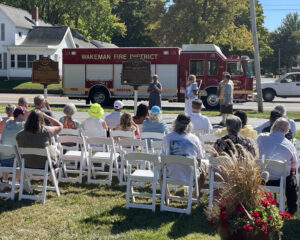
When inventor and entrepreneur Garrett Augustus Morgan sold his Traffic Signal patent to General Electric in 1923, he used the $40,000 to purchase a 121-acre farm in Huron County in 1924. Advertising “a village of our own,” Morgan established the Wakeman Country Club — one of Ohio’s early African American recreation clubs — and offered 247 lots for $60 each in “Wakeman Heights.” Located near the intersection of State Route 60 and Chenango Road, the development provided country pleasures to Blacks excluded from the Country Club lifestyle. Club membership, included in the purchase of a lot, offered fishing, hunting, swimming, and horseback riding. A restaurant, dance hall, and amphitheater provided cultural and boxing events. The club waned during World War II and no buildings from the once-thriving Wakeman Country Club remain.
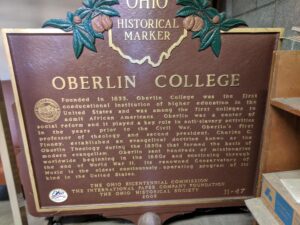
Founded in 1833, Oberlin College was the first coeducational institution of higher education in the United States and was among the first colleges to admit African Americans. Oberlin was a center of social reform and it played a key role in anti-slavery activities in the years prior to the Civil War. Oberlin’s first professor of theology and second president, Charles G. Finney, established an evangelical doctrine known as the Oberlin Theology during the 1850s that formed the basis of modern evangelism. Oberlin sent hundreds of missionaries worldwide beginning in the 1880s and continuing through the end of World War II. Its renowned Conservatory of Music is the oldest continuously operating program of its kind in the United States.
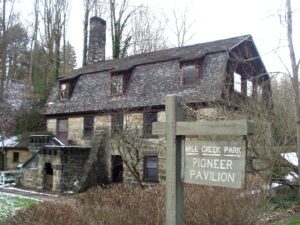
Pioneer Pavilion, one of the oldest structures in Youngstown, is a rare surviving example of early nineteenth-century industry. James Heaton constructed this sandstone building in 1821 as a mill for carding and fulling wool. A millrace from Mill Creek and a waterwheel on the west side supplied the power. In the 1830s and 1840s, the woolen mill was converted to a storage facility for the nearby Mill Creek Furnace and later served as a cattle barn. In 1891, Youngstown attorney Volney Rogers purchased the property for Mill Creek Park, renovating the building in 1893 as a dining and dancing facility, and naming it Pioneer Pavilion. Generations of area residents spanning three centuries have celebrated social events in this historic landmark.
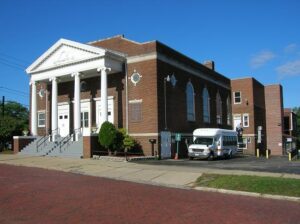
This church, founded in 1866, is the oldest Black congregation in Akron. After worshiping in several locations, the congregation held a fund-raiser to help finance the construction of a permanent home. The person collecting the most money had the privilege of renaming the church. That honor went to Mrs. Belle (Smith) Wesley. Completed in 1928, the current structure is a Neo-Classical Revival style building, featuring a classical pedimented portico, or porch, and four distinctive ionic columns. An education wing was added in 1963 by the late Rev. Dr. E. E. Morgan, Jr. Akron Black architects Herbert L. Wardner and John O. Somerville designed the church, and then a Black contractor, Samuel Plato, completed the structure. The church has long been a vital religious and social focal point for Akron’s Black community. The local chapter of the National Association for the Advancement of Colored People (NAACP) was organized at Wesley Temple. Placed on the National Register of Historic Places 3/19/94.