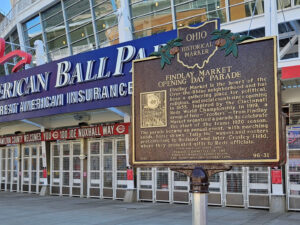
Findlay Market is the heart of the Over-the-Rhine neighborhood and has been a gathering place for political, religious, and social events since opening in 1855. Inspired by the Cincinnati Reds World Championship in 1919, a group of fans – “Rooters” – from Findlay Market organized a parade to celebrate the state of the team’s 1920 season. The parade became an annual event, with marching bands, horse-drawn “Tally-Ho” wagons and rooters processioning to Redland and later Crosley Field, where they presented gifts to Reds officials. (Continued on other side)
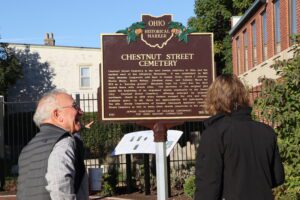
Chestnut Street Cemetery is the first Jewish cemetery in Ohio and the earliest west of the Allegheny Mountains. It was established in 1821 when Nicholas Longworth sold land to Joseph Jonas, David I. Johnson, Morris Moses, Moses Nathan, Abraham Jonas, and Solomon Moses for $75 as a “burying ground.” Benjamin Lape (or Leib) was the first buried there with Jewish rites. The purchase of the original plot marks the beginning of an organized Jewish community in the Queen City. Chestnut Street Cemetery, although enlarged by adjacent purchases, closed in 1849 when cholera ravaged the city and filled available space. In all, there are approximately 100 interments on the site. Jewish Cemeteries of Greater Cincinnati maintains Chestnut Street Cemetery as well as many other Jewish cemeteries in the region.
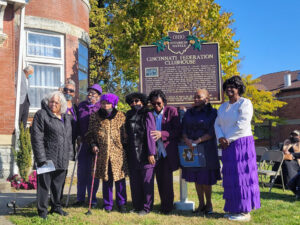
“Lifting As We Climb”: The Cincinnati Federation of Colored Women’s Clubs (CFCWC) was organized May 6, 1904, during a meeting called by Mary Fletcher Ross at the Allen Temple A.M.E. Church. Gathering together eight existing African-American women’s clubs, the CFCWC sought to unite in their work promoting “the betterment of the community.” At a time when both government and private philanthropies overlooked the needs of Black Americans, CFCWC members helped to organize the city’s first kindergartens for Black children, taught in Cincinnati African-American public schools –including the Walnut Hills Douglass and Stowe schools—and raised money for the Home of Aged Colored Women. Since 1904, the Cincinnati Federation of Colored Women’s Clubs has ensured the civic and constitutional rights of all African Americans while meeting the needs of their city.
In 1911 local doctors founded the St. Clair Hospital. The home adjacent to the hospital served as a residence home and training school for nurses. In 1940, the hospital was converted into a convalescent home. In 1948, Mr. and Mrs. William J. Garrett, an African-American couple, transformed the facility into a hotel. The Hotel St. Clair, which closed in 1976, accommodated African Americans who were not permitted to stay in white hotels. It also served as a social gathering place for members of Columbus’ black community.
James W. Rankin served four consecutive terms (1971-1978) in the Ohio House of Representatives. Born and raised in Cincinnati, he graduated from Withrow High School and The Ohio State University’s School of Social Work. While working in Cincinnati’s Seven Hills neighborhood, he ran for office to “involve the disadvantaged in the governmental processes that affected their lives.” He won his first bid and served the next seven years as a state representative for the 69th House district, later the reapportioned 25th district. Representative Rankin fought passionately for civil and human rights in education and public policy. He served on the Reference, Human Resources, and Finance committees. When Rankin died of pneumonia, aged 52, the Cincinnati Enquirer proclaimed him a “Friend of the Poor.”
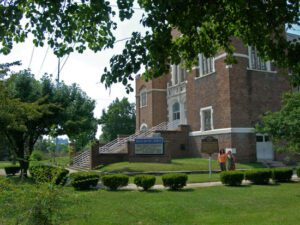
The Shiloh Baptist Church was completed in 1923. Founded in 1869, Shiloh is the third oldest African-American church in Columbus and is a descendent of the Second Baptist Church. The church is located in the Mt. Vernon neighborhood, which is adjacent to the central businesses of Columbus and Interstate 71. The dominant physical presence of Shiloh Baptist Church shows its importance as a religious and social institution for more than one hundred years in the Mt. Vernon area.
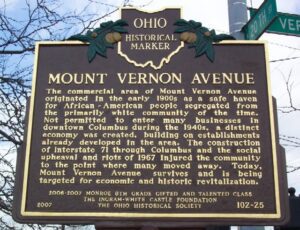
The commercial area of Mount Vernon Avenue originated in the early 1900s as a safe haven for African-American people segregated from the primarily white community of the time. Not permitted to enter many businesses in downtown Columbus during the 1940s, a distinct economy was created, building on establishments already developed in the area. The construction of Interstate 71 through Columbus and the social upheaval and riots of 1967 injured the community to the point where many moved away. Today, Mount Vernon Avenue survives and is being targeted for economic and historic revitalization.
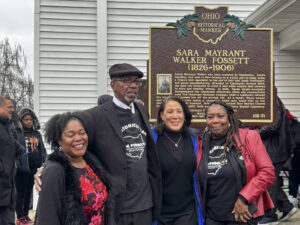
Sarah Mayrant Walker was born enslaved in Charleston, South Carolina, and sent to New Orleans as a young girl to study under a French hair specialist in the art of hair and scalp treatment, and goods manufacturing. Brought to Cincinnati around 1840, she used her networks to build a hair salon empire that catered to elite and wealthy women. In 1859, Sarah single-handedly desegregated the Cincinnati streetcars when she successfully sued The Passenger Railroad Company after a conductor refused her passage and pushed her off the moving car. As a result, Black women and children could ride inside a streetcar while men could ride on the platform. She and her husband, Peter Fossett, founded First Baptist Church of Cumminsville circa 1870. Both are buried in the Union Baptist Cemetery.