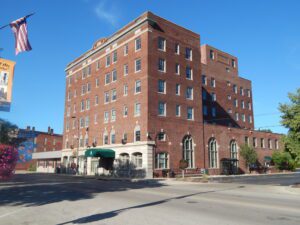
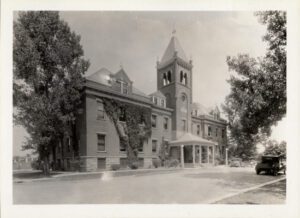
The Hotel Ashtabula was built in 1920 during an economic boom that lasted most of that decade. Architecturally, it represents a combination of Second Renaissance Revival and Georgian Revival styles. The H.L. Stevens and Company of Chicago and New York designed and built the hotel and others like it in Cleveland, Dayton, and Warren, Ohio and throughout the Midwest. The building included a ball room accommodating 300, a dining room that could seat 125, and club meeting and social rooms. A prominent structure of this downtown street, the Hotel Ashtabula was a hub for social activity. (Continued other side)
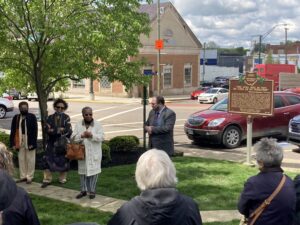
Ellamae Simmons, born and raised in Mount Vernon, became the first African American woman physician to specialize in asthma, allergy, and immunology in the country. Graduating in the top of her high school class, she dreamed of attending Ohio State University to become a nurse but was rejected as that program “did not have the facilities for training” the young black girl. Whenever Simmons encountered a barrier in life she refused to accept rejection, tenaciously steered the course of her own life, and blazed new trails for others. She ultimately earned degrees in nursing (Hampton, 1940), pre-med biological sciences (OSU, 1948), social work (OSU, 1950), and medicine (Howard University, 1959). Dr. Simmons again broke gender and racial barriers when hired by Kaiser Permanente in 1965. She practiced there until retiring in 1989. Simmons died aged 101.
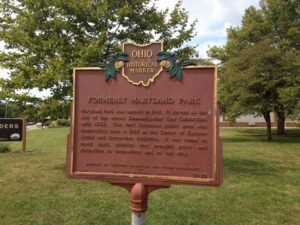
Maryland Park was opened in 1921. It served as the site of the annual Emancipation Day Celebration until 1933. The first Columbus public pool was constructed here in 1929 as the Center of Eastside Social and Recreation Activities. It was home to many black athletes who brought pride and distinction to themselves and to the city.
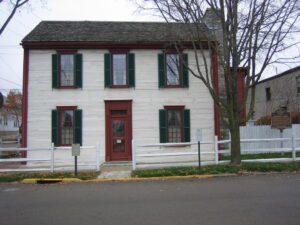
Benjamin Overfield (1774-1831), son of a Revolutionary War soldier, opened his tavern in this log house on September 13, 1808. Never moved, it is the oldest surviving building in Troy. The tavern provided food, lodging and space for business and social gatherings. Overfield agreed to let the county use a room on the second floor of the building as a temporary courtroom. Behind the tavern, Benjamin built a small log cabin that was home to his family. He prospered here until 1825 when he moved to the Public Square. Today’s structure includes the tavern, the cabin, and later additions. Used as a dwelling from 1825 until 1948, the building now houses the Overfield Tavern Museum. Benjamin Overfield and his first wife Mary are buried in Rose Hill Cemetery.
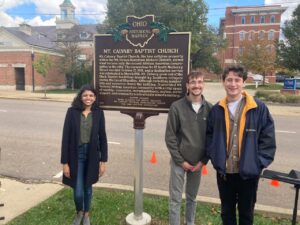
Mt. Calvary Baptist Church, the lone religious property within the Mt. Vernon Downtown Historic District, served what became only the second African American congregation in the city. The cornerstone for 13 South Mulberry Street was laid October 17, 1915, and a dedication service was celebrated in March 1916. Mt. Calvary grew out of the Black Baptist traditions brought by Southern refugees during the Great Migration. Although dwindling membership and resources closed the building, it provided Mt. Vernon’s African American community with a vital space of worship, communion, mutual assistance, asylum, social support, and community celebration for almost a century.
Central State University originated on March 19, 1887, when the Ohio General Assembly passed an act establishing a Combined Normal and Industrial (CN&I) Department at Wilberforce University. Through various transitional changes, it emerged as an independent, state university. In 1941, the General Assembly expanded the CN&I, which offered two-year courses, into the College of Education and Industrial Arts, with four-year programs. In 1947, it separated from Wilberforce University. The history of Central State University tells the history of higher education and advancement for African Americans in Ohio. It is within the walls of these structures, and others unfortunately demolished or destroyed by the 1974 tornado, that thousands of African Americans received valuable training for successful and rewarding careers. Thus, many of the contributions of African Americans to the promotion and betterment of education, medicine, law, social justice, technology, and the arts in Ohio have their roots here on the campus of Central State University.
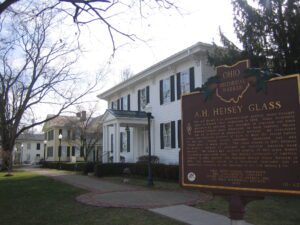
The A.H. Heisey & Co. produced high quality, hand-wrought glass in Newark, Ohio beginning in 1896. Glass originally produced by pressing was intended to simulate cut glass making elegant glass affordable to more families. Heisey was an innovator in production methods. He introduced colors and different patterns of glass to meet the social habits of the era. Highly skilled craftsmen produced, cut, and etched glass in many styles. The plant closed in 1957 because of Heisey’s refusal to produce an inferior machine-made product. The beauty and superior quality of this glass makes it a highly collectable item. The Heisey Collectors of America, founded in 1971, opened The National Heisey Glass Museum in 1974. The Museum stands as a historical reminder and an educational resource to the heritage of the A.H. Heisey & Co.
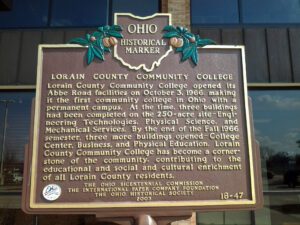
Lorain County Community College opened its Abbe Road facilities on October 3, 1966, making it the first community college in Ohio with a permanent campus. At the time, three buildings had been completed on the 250-acre site-Engineering Technologies, Physical Science, and Mechanical Services. By the end of the Fall 1966 semester, three more buildings opened-College Center, Business, and Physical Education. Lorain County Community College has become a cornerstone of the community, contributing to the educational and social and cultural enrichment of all Lorain County residents.