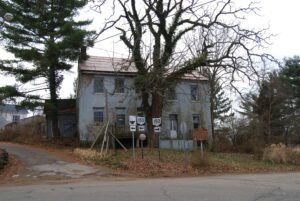
After witnessing the slave trade in Wheeling, Virginia, Quaker abolitionist Benjamin Lundy (1789-1839) resolved to battle the institution, first organizing the Union Humane Society in St. Clairsville in 1815. In 1821, Lundy moved to Mount Pleasant and began publishing the Genius of Universal Emancipation, a newspaper devoted wholly to anti-slavery issues. The newspaper would later be published in Tennessee, Baltimore, Washington D.C., and Philadelphia. Lundy traveled widely to promote circulation, lecturing on the moral evils of slavery and its associated negative economic and social effects. The Lundy home served as an Underground Railroad stop.
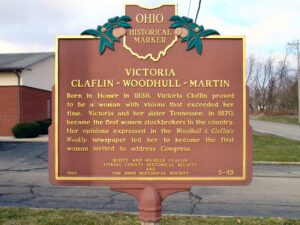
Born in Homer in 1838, Victoria Claflin proved to be a woman with visions that exceeded her time. Victoria and her sister Tennessee, in 1870, became the first women stockbrokers in the country. Her opinions expressed in the Woodhull & Claflin’s Weekly newspaper led her to become the first woman invited to address Congress.
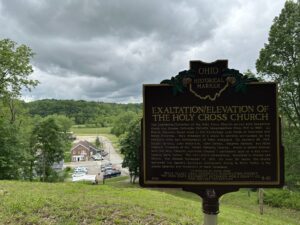
The Exaltation/Elevation of the Holy Cross Church served both Byzantine Greek and Russian Orthodox Catholic congregations from 1915 to 1967. As Slovak migrants found work in the Cambridge coal fields of Guernsey and Noble Counties, they dreamed of a place to worship surrounded by the religious rites and iconography of their homeland. On January 26, 1914, Daniel Varhola, John Fetkovich, John Demko, Stephen Varhola, and Mike Zeleznik (trustees of the “Greek Catholic Church, which is united forever with the Holy Catholic Apostolic Church”) purchased land on a hill overlooking Belle Valley. The two-sided cornerstone, inscribed in Russian and Slovak, was blessed November 15, 1915. For over 50 years, the church anchored the Eastern European immigrants living in Belle Valley to the ethnic identity and traditions of their homeland. (Continued on other side)
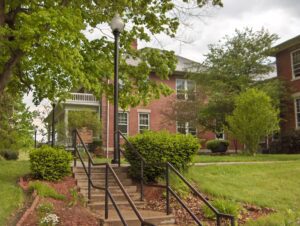
In the first quarter of the nineteenth century, when the general public believed that the insane and paupers could be rehabilitated into productive citizens, the Ohio Legislature gave authorization to county commissioners to establish county “poor houses.” The Athens County Home, formerly known as the Athens County Infirmary, opened on this site in 1857 to provide care for indigent citizens of Athens County. When fire destroyed the original building in 1903, a new building was constructed from 1904-1905, designed with the capacity to house up to one hundred people. When it was built, it was considered to be one of the finest and most modern charitable institutions of its time. The facility continued to provide housing for indigent and elderly residents until 1997 when the County Commissioners closed the home and it became a primary location for the delivery of social services in Athens County. (continued on the other side)
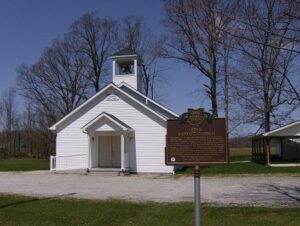
Thirteen African American families migrated to Pebble Township in Pike County in the early 1820s from Virginia. Some of the families were former slaves while others were freeborn people of color. Their farm knowledge and skill helped to make them prosperous, angering some of their white neighbors who began a campaign of harassment. Ten of the original African American settlers eventually moved away, but despite the difficulties with the white population, other African Americans continued to arrive to the settlement. They founded a church, later known as the Eden Baptist Church, built a meeting hall, and organized a school. Several of the families were also involved in the activity of the Underground Railroad. The PP Settlement thrived until the 1950s when, for economic reasons, residents moved to other communities.
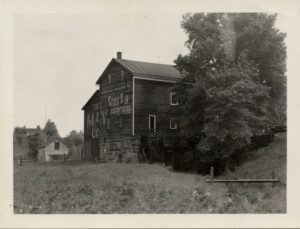
Fowlers Mill (originally Fowler’s Mills) developed around a group of mills built in the 1830s on the Chagrin River. Opportunities from these mills led to Fowlers Mill becoming the commercial center of Munson Township. From the 1830s into the twentieth century, the community expanded with construction of churches, a post office, township hall, stores, hotel, blacksmith shop, schools, and houses built in such styles as Federal, Greek Revival, Italianate, and Queen Anne. This type of community center was common in rural, nineteenth century America, but rarely survives with so much original fabric intact. On Mayfield Road, the Disciple Church was built in 1842. East of the church, the brick central school built in 1913 replaced earlier one-room schoolhouses. The gristmill is the only mill standing in Geauga County. The cemetery contains burials dating from the 1830s. The Fowler’s Mills Historic District was placed on the National Register of Historic Places in 2002.
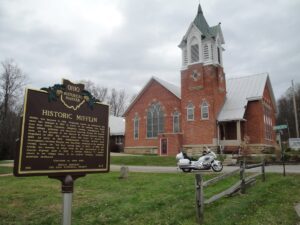
Mifflin was founded in 1816. Originally known as Petersburg, the name was changed in 1827 in honor of the settlers that moved here from Mifflin Township, Allegheny County, Pennsylvania. The first village jailhouse and crossroad watering trough are located here, on the grounds of the historic St. Michael Lutheran Church. Organized in 1835, the church built this house of worship in 1890. As early as 1810, stagecoaches traveled Mifflin’s main thoroughfare between Wooster and Mansfield, stopping at the watering trough, known for “the best spring water in Ohio”. In 1925, the trough was removed to allow room for the construction of the Lincoln Highway built in 1928. A Lincoln Highway “L” marker stands in the village today, in its original location, directing motorists eastbound.
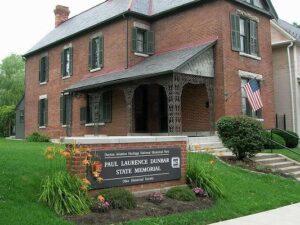
The first African-American to achieve prominence as a poet, Paul Laurence Dunbar was born and raised in Dayton, the son of former slaves. Working as an elevator operator while he established himself as a writer, Dunbar published his first book of poems, Oak and Ivy, in 1893. His third collection, Lyrics of a Lowly Life (1896) with an introduction by another Ohio-born author William Dean Howells, gained Dunbar widespread critical acclaim and popular recognition. Widely published in contemporary journals and literary magazines, Dunbar employed both turn-of-the-century African-American dialect and standard English verse to give a voice to the themes of everyday discrimination and struggles for racial equality. Tuberculosis cut his life short at age 33. Dunbar’s body of work includes twelve volumes of poetry, four books of short stories, a play, and five novels.