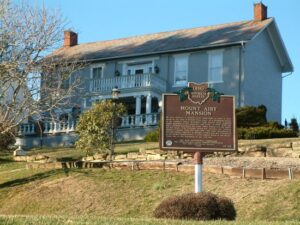
One of Ohio’s earliest proponents of women’s rights, Frances Dana Gage (1808-1884) was born in Marietta and married McConnelsville attorney James L. Gage in 1829. She immersed herself in the major social issues of the day – temperance, abolition, and universal suffrage – while raising eight children. At a women’s rights convention in 1850, Gage gained national attention by proposing that the words “white” and “men” be removed from Ohio’s constitution. She later served as the editor of an Ohio agricultural journal, as an educator for newly emancipated African Americans, and wrote children’s tales under the pen name “Aunt Fanny.” An enormously influential woman, Gage led the way for Ohio’s next generation of social activists.
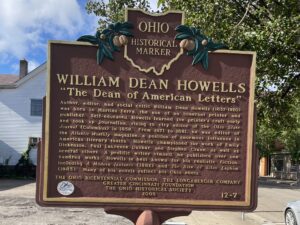
Author, editor, and social critic William Dean Howells (1837-1920) was born in Martins Ferry, the son of an itinerant printer and publisher. Self-educated, Howells learned the printer’s craft early and took up journalism, rising to city editor of the Ohio State Journal (Columbus) in 1858. From 1871 to 1881, he was editor of the Atlantic Monthly magazine, a position of enormous influence in American literary tastes. Howells championed the work of Emily Dickenson, Paul Laurence Dunbar, and Stephen Crane, as well as several others. A prolific writer himself, he published over one hundred works. Howells is best known for his realistic fiction, including A Modern Instance (1882) and The Rise of Silas Lapham (1885). Many of his novels reflect his Ohio roots.
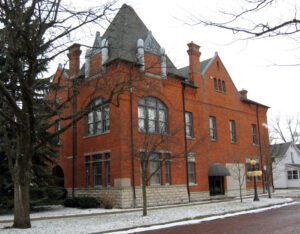
Completed in 1892 at the height of the region’s oil boom, the Pemberville Town Hall followed a late-1800s municipal trend to house many civic functions under one roof. The fire station, jail, and council chambers occupied the ground level, while the entire second floor hosted a public auditorium, or “opera house,” that seated 250. The 1897 debut of The Mikado featured new electric lighting. The ornate Opera House was the center of Pemberville’s social activities for decades, hosting dances, plays, socials, graduation ceremonies, political meetings, lectures, and husking bees. Traveling companies performed concerts, vaudeville, minstrel, and medicine shows. Following World War II the Opera House fell into disuse. It was restored in 1999 to both its former grandeur and its place in Pemberville’s cultural life.
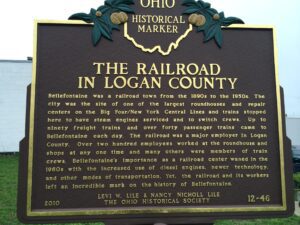
Bellefontaine was a railroad town from the 1890s to the 1950s. The city was the site of one of the largest roundhouses and repair centers on the Big Four/New York Central Lines and trains stopped here to have steam engines serviced and to switch crews. Up to ninety freight trains and over forty passenger trains came to Bellefontaine each day. The railroad was a major employer in Logan County. Over two hundred employees worked at the roundhouse and shops at any one time and many others were members of train crews. Bellefontaine’s importance as a railroad center waned in the 1960s with the increased use of diesel engines, newer technology, and other modes of transportation. Yet, the railroad and its workers left an indelible mark on the history of Bellefontaine.
A group of concerned Cincinnati women organized, in 1855, The Protestant Home for the Friendless and Female Guardian Society as a private, not-for-profit maternity home for destitute women and children. These public minded social leaders were aware that Cincinnati had grown beyond the time when the poor or unfortunate were cared for by their neighbors. The Home, which was funded through bequests and personal donations, was founded to care for poor mothers and babies, unmarried pregnant women, wanderers and strangers in the city, and to promote adoptions. (Continued on other side)
Called the “Cradle of Equal Suffrage” and “Free Speech Chapel,” Union Chapel was to be “…open and free for all denominations, but to be monopolized by no one or to the exclusion of anyone.” Built in 1858 or 1859 on land donated by Anson Matthews, the chapel reputedly exists in response to incident triggered by James A. Garfield, then principal of the Western Reserve Eclectic Institute (now Hiram College) and later president of the United States. He was scheduled to speak at the Congregationists’ “Brick Church” in December 1857. Because of the supposed controversial nature of Garfield’s speech, however, the invitation was withdrawn. (Continued on other side)
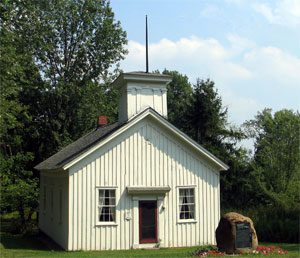
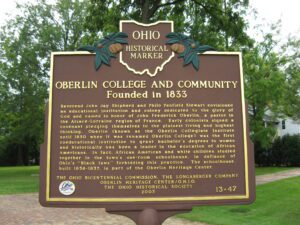
Reverend John Jay Shipherd and Philo Penfield Stewart envisioned an educational institution and colony dedicated to the glory of God and named in honor of John Frederick Oberlin, a pastor in the Alsace-Lorraine region of France. Early colonists signed a covenant pledging themselves to the plainest living and highest thinking. Oberlin (known as the Oberlin Collegiate Institute until 1850 when it was renamed Oberlin College) was the first coeducational institution to grant bachelor’s degrees to women and historically has been a leader in the education of African Americans. In fact, African American and white children studied together in the town’s one-room schoolhouse, in defiance of Ohio’s “Black laws” forbidding this practice. The schoolhouse, built 1836-1837, is part of the Oberlin Heritage Center.
In 1869 a secret organization, The Knights of Labor, was founded in Philadelphia. The K.O.L. promoted an ideal society based on bettering life for others with the slogans, “labor was the first capital” and “an injury to one is the concern of all.” Shawnee’s Local Assembly #169 Knights of Labor was organized in 1876, and quickly became a powerful voice for labor in Ohio. National labor leader, William T. Lewis, later Labor Commissioner of Ohio, taught free grammer classes at night for the miners. Lewis initiated “The Ohio Plan,” the first free empployment bureaus in the United States. William H. Bailey, later head of National District Assembly #135 of Miners and T.L. Lewis, President of the United Mine Workers in 1910, also started their careers here. Meetings involving these leaders led to the formation of the United Mine Workers in 1890. (Continued on other side)