

, OH
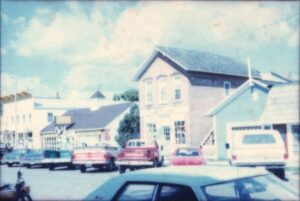
Born in Rhode Island, John Pray (1783-1872) moved to the Maumee River Valley from New York shortly after serving in the War of 1812 and completing a prospecting tour in Ohio. He built a dam across the river to Granger Island and in 1821 constructed a water-powered gristmill, the first on the lower Maumee. In 1831, he laid out the Village of Waterville with the first 50 lots. The Columbian House, a stagecoach inn constructed by Pray in 1828 and expanded in 1837, was for years the commercial and social center of Waterville and accommodated travelers from cities such as Detroit and Cincinnati. From this building, he operated the village’s post office. When Wood County was organized in 1820, Pray became a commissioner until Lucas County was formed from part of Wood in 1835. For nine years he served as Justice of the Peace in Waterville. He and his wife Lucy raised eleven children to adulthood. Circa 1854 he constructed his home, which today overlooks Pray Park.
, OH
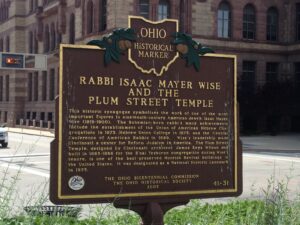
This historic synagogue symbolizes the work of one of the most important figures in nineteenth-century American Jewry, Isaac Mayer Wise (1819-1900). The Bohemian-born rabbi’s many achievements include the establishment of the Union of American Hebrew Congregations in 1873, Hebrew Union College in 1875, and the Central Conference of American Rabbis in 1889. Wise’s leadership made Cincinnati a center for Reform Judaism in America. The Plum Street Temple, designed by Cincinnati architect James Keys Wilson and built in 1865-1866 for the B’nai Yeshurun congregation during Wise’s tenure, is one of the best-preserved Moorish Revival buildings in the United States. It was designated as a National Historic Landmark in 1975.
, OH
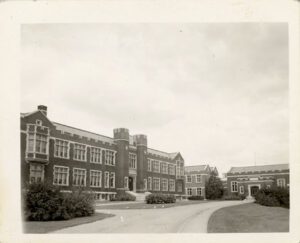
Hebrew Union College (HUC), founded in Cincinnati in 1875, is the oldest institution of higher Jewish learning in the United States. Its founder, Rabbi Isaac Mayer Wise (1819-1900), was a leading proponent of Reform Judaism in America. In 1950, the college merged with the Jewish Institute of Religion (JIR), a liberal Jewish seminary in New York founded by Rabbi Stephen S. Wise (1874-1949) in 1922. A third center opened in Los Angeles in 1954 to serve Jewry on the West Coast and, in 1963, a fourth campus opened in Jerusalem. As of 2003, HUC-JIR educates rabbis, cantors, communal, and educational professionals. It also offers advanced academic training for scholars of all faiths. The holdings of the school’s Klau Library constitute one of the most extensive Jewish libraries in the world.
, OH
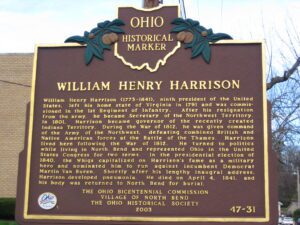
William Henry Harrison (1773-1841), ninth president of the United States, left his home state of Virginia in 1791 and was commissioned in the 1st Regiment of Infantry. After his resignation from the army, he became Secretary of the Northwest Territory. In 1801, Harrison became governor of the recently created Indiana Territory. During the War of 1812, he was given command of the Army of the Northwest, defeating combined British and Native American forces at the Battle of the Thames. Harrison lived here following the War of 1812. He turned to politics while living in North Bend and represented Ohio in the United States Congress for two terms. In the presidential election of 1840, the Whigs capitalized on Harrison’s fame as a military hero and nominated him to run against incumbent Democrat Martin Van Buren. Shortly after his lengthy inaugural address, Harrison developed pneumonia. He died on April 4, 1841, and his body was returned to North Bend for burial.
, OH
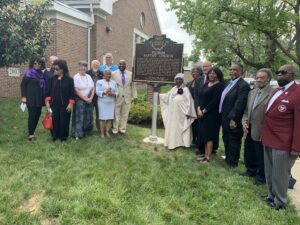
On January 9, 1919, a group of eight men and three women, being led by the Holy Spirit, met at a house on Wallace Street to form a new black Missionary Baptist Church in Hamilton, Ohio. The group quickly raised $150 to make the down payment on a two-story brick building at 333 Chestnut Street being sold for $1,850. The building was occupied on March 25, 1919, and the name Pilgrim Baptist Church was suggested and accepted. On May 11, 1919, a special council requested admittance into the Western Union Baptist Association, a district association now affiliated with the Ohio Baptist General Convention. Requirements for admission were met and Pilgrim Baptist Church was recognized as a Missionary Baptist Church. In 2019, Pilgrim Baptist Church celebrated a centennial of faithfulness in Hamilton.
, OH
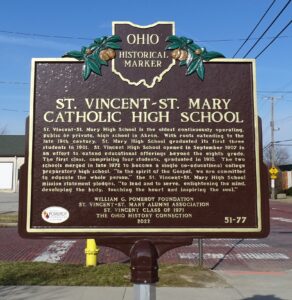
St. Vincent-St. Mary High School is the oldest continuously operating, public or private, high school in Akron. With roots extending to the late 19th century, St. Mary High School graduated its first three students in 1901. St. Vincent High School opened in September 1907 in an effort to extend educational offerings beyond the eighth grade. The first class, comprising four students, graduated in 1910. The two schools merged in late 1972 to become a single co-educational college preparatory high school. “In the spirit of the Gospel, we are committed to educate the whole person,” the St. Vincent-St. Mary High School mission statement pledges, “to lead and to serve, enlightening the mind, developing the body, touching the heart and inspiring the soul.”
, OH
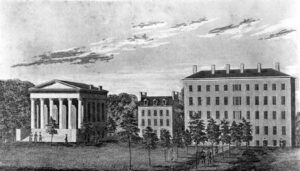
The Lanes, Baptist merchants from New Orleans, and the Kempers, a Presbyterian family from Cincinnati, gave money and land respectively for Cincinnati’s first manual labor theological seminary and high school, which opened in suburban Walnut Hills in 1829. The Reverend Lyman Beecher came from Boston as its first president. The president’s house, now known as the Stowe House after Beecher’s daughter Harriet Beecher Stowe, author of Uncle Tom’s Cabin, still remains at Gilbert and Foraker. Lane Theological Seminary, bound by present day Gilbert, Chapel, Park, and Yale streets, continued to educate Presbyterian ministers until 1932, when it was merged with McCormick Theological Seminary in Chicago.
, OH
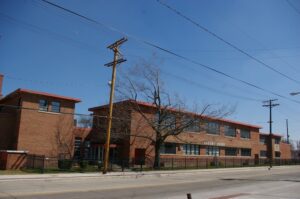
Karamu House, Incorporated was established in 1915 as the Playhouse Settlement, one of Cleveland’s many settlement houses for migrant and immigrant communities. Initiated by the Men’s Club of the Second Presbyterian Church, in 1915 Oberlin College and University of Chicago social work graduates, Russell and Rowena Woodham Jellliffe were hired as the founding directors. Originally located at 2239 East 38th Street, the Playhouse Settlement offered children’s theater and other social, recreational, and educational activities. It soon developed a partnership with the Dumas Dramatic Club, a local African American theater company that later became known as the Gilpin Players. (continued on other side)