Colonel John J. Voll from Goshen, Ohio, was the highest scoring ace of the 15th U.S. Army Air Force in the Mediterranean theater of World War II. As a Captain flying a P-51 Mustang fighter plane, he was credited with twenty-one aerial victories. His superior skill in one particular battle enabled him to maneuver three enemy aircraft into crashes without firing a shot. On a separate mission, while flying solo, Captain Voll had four confirmed kills, two probables, and damaged two additional enemy planes. (continued on other side)
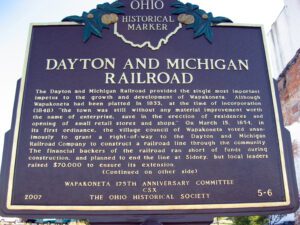
The Dayton and Michigan Railroad provided the single most important impetus to the growth and development of Wapakoneta. Although Wapakoneta had been platted in 1833, at the time of incorporation (1848), “the town was still without any material improvement worth the name of enterprise, save in the erection of residences and opening of small retail stores and shops.” On March 15, 1854, in its first ordinance, the village council of Wapakoneta voted unanimously to grant a right-of-way to the Dayton and Michigan Railroad Company to construct a railroad line through the community. The financial backers of the railroad ran short of funds during construction, and planned to end the line at Sidney, but local leaders raised $70,000 to ensure its extension. (Continued on other side)
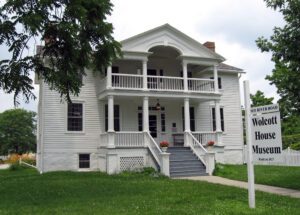
This federal style house was built in 1827 by James A. Wolcott who migrated to Ohio in 1818 from Connecticut. Of distinguished parentage, Wolcott was a leading merchant, shipbuilder, judge and politician. Here he and his wife, Mary Wells, daughter of scout William Wells and Sweet Breeze, Indian Chief Little Turtle’s daughter, made their home a center of frontier activity. This house stands as a tangible symbol of this Maumee pioneer, a Registered National Historic Place.
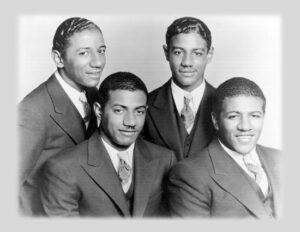
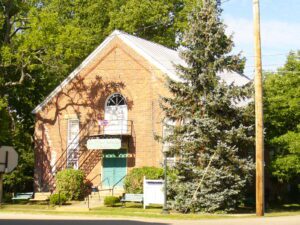
Born in Piqua, Ohio, the Mills Brothers grew up and attended school in Bellefontaine. The brothers — John, Jr., Herbert, Harry, and Donald Mills — were the first African-American vocal group to perform on a national radio broadcast and achieve commercial success. Enjoying worldwide fame throughout their career, the Mills Brothers popularized such hits as “Tiger Rag,” “Paper Doll,” and “You Always Hurt the One You Love.” After the death of John, Jr. in 1936, the remaining brothers were joined by their father, John, Sr. In all, the Mills Brothers recorded over 1,200 songs.
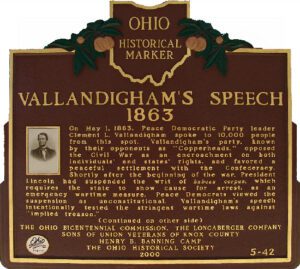
On May 1, 1863, Peace Democratic Party leader Clement L. Vallandigham spoke to 10,000 people from this spot. Vallandigham’s party, known by their opponents as “Copperheads,” opposed the Civil War as an encroachment on both individuals’ and states’ rights, and favored a peaceful settlement with the Confederacy. Shortly after the beginning of the war, President Lincoln had suspended the writ of habeas corpus, which requires the state to show cause for arrest, as an emergency wartime measure. Peace Democrats viewed the suspension as unconstitutional. Vallandigham’s speech intentionally tested the stringent wartime laws against “implied treason.” (continued on other side)
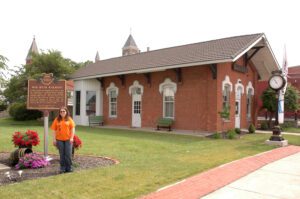
In 1832 a charter was granted by the state of Ohio for construction of a railroad between Sandusky City and Dayton. The right-of-way privileges included Hardin County. The first train, of the Mad River and Lake Erie Railroad, arrived in Kenton from Sandusky on July 14, 1846. The railroad was completed to Dayton in 1851. The depot on this site was erected in 1882.
This historic village was a hub for early Ohio industry and travel. The natural geography of the area provided ideal conditions for the establishment of a variety of mills. Col. Robert Patterson, an ancestor of the founder of National Cash Register in Dayton, John Patterson, chose Clifton for the site of a woolen mill, which furnished material for the American army during the War of 1812. Davis Mill, established in 1802 and in operation today as Clifton Mill, produced meal and flour for Civil War troops. A major stop on the stagecoach trail, “The Accommodation Line,” which ran from Springfield to Cincinnati from 1827 to 1840, the village bustled with the commotion of travelers. The once flourishing industry of Clifton faded as railroad traffic bypassed the village and manufacturers left the area.
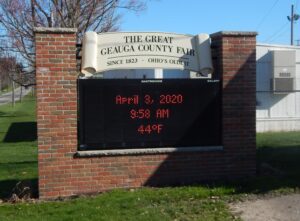
The Great Geauga County Fair is the longest continuously operating county fair in Ohio. The fair is a major county gathering event each year, pulling together people from the whole county. Geauga’s settlers imported the idea of the county fair with them from New England. The fair’s parent organization, the Geauga County Agricultural and Manufacturing Society, began holding fairs on Chardon Square in 1823. Since then, the Geauga County Fair has served as a gathering place and form of education to promote local agriculture and introduce farmers to new farming developments and each other. Controversy arose between 1840 and 1854 after Lake County ceded and Chardon, Claridon, and Burton vied for the permanent fair grounds. Burton’s proposal was accepted, improvements began immediately, and the fair grew quickly. The Great Geauga County Fair continues as a time-honored tradition.