SE of the intersection of Dumont Street and Carrel Street
Cincinnati
, OH
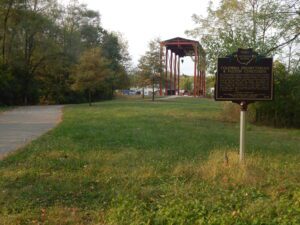
The cemetery dates to 1794 and is comprised of two adjacent cemeteries: Columbia Presbyterian Cemetery and Fulton Cemetery. Another cemetery, the Fulton Mechanics Cemetery, had been in Fulton, a village along the Ohio River and a center of boat-building and steamboat construction during the first half of 19th century. Together, the cemeteries are the burial places of Jacob Allen, John Campbell, John Langdon, and other veterans of the Revolutionary War. It is also believed that William Brown is buried here. Brown was one of three soldiers during the Revolutionary War to receive the Badge of Military Merit, predecessor of the Purple Heart. The cemetery was listed on the National Register of Historic Places in 1979. (Continued on other side)
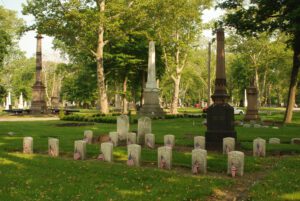
Howard Daniels, who lived from 1815-1863, was a noted architect and landscape gardener. Over the course of his life, he designed six Ohio and New York cemeteries, including Woodland that began in 1852 when he laid out 20 of its 60 acres into fashionable “rural cemetery” style. Later acreage in the cemetery adapted his curvilinear design. “As beautifully prepared for a burial place as fancy and taste could desire,” Woodland was dedicated on June 14, 1853, and became Cleveland’s primary cemetery. An ornate gatehouse, chapel, and fountains came later. Generations of Clevelanders, pioneering and prominent, as well as veterans onward from the War of 1812, are buried here. For more than a century, Woodland, in its original and newly platted sections, has embraced people from every race, the rich and poor, natives and immigrants, and the famous and obscure. It has truly become a community cemetery. [continued on other side]
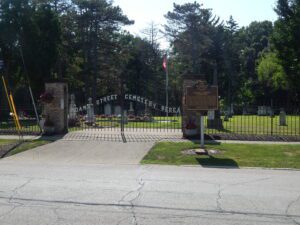
Known as the “Village Cemetery,” this was Berea’s main burial ground from 1834 to the 1880s. However, in 1886, the Cleveland Stone Co. purchased quarries adjacent to the cemetery, where Coe Lake is today. Quarrying had already caused flooding and landslides in the area. Local stories say that the company operated too near to the edge of cemetery, causing a landslide in the northwest corner that exposed some graves. Worried families moved their loved ones’ remains to other cemeteries, including those of five Civil War veterans. Pioneering families, 16 Civil War veterans, 3 mayors of Berea, several quarry owners, and many ordinary people still rest here. Of the original 589 burials, 40% were children. (Continued on other side)
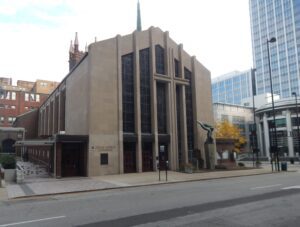
In 1817 twenty-two men, including future President William Henry Harrison, chartered Cincinnati’s first Episcopal parish, Christ Church. In 1835 members erected a Gothic Revival-style church on this site. The neighborhood evolved as the city grew with the influx of immigrants. Parish women raised funds to teach, feed, clothe, and shelter tenement families, and alleviate suffering during floods and disease outbreaks. In 1883 the women helped establish what became Cincinnati Children’s Hospital. In 1909 members opened the Late Gothic-style Parish House, a community center with kitchen, classrooms, library, auditorium, clinic, gymnasium, and bowling alley. By the parish’s centennial in 1917, music had expanded beyond worship to public concerts. In 1940 the annual Boar’s Head Festival of music and pageantry began. Since the 1960s, members have collaborated with local agencies to advocate for social and economic justice, a mission continuing into the 21st century. (Continued on other side)
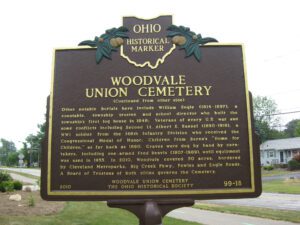
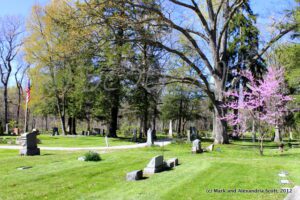
Woodvale Cemetery was established in the mid-1800s, in Middleburgh Township, Ohio. The oldest marked grave holds Fred G. Klink (1835-1858), whose family donated a half acre of land for burials. In 1876, Frank M. Stearns (1832-1911) suggested the unnamed cemetery be called Woodvale, after the wooded vale beside it. In 1908, a fire destroyed the caretaker’s house and many cemetery records. Woodvale became a non-profit, union cemetery in 1931, owned by Berea and the Village of Middleburg Hts. and covering 35 acres at 7535 Engle Road. Pioneer families buried here: Fowles, Kraft, Lovejoy, Sprague, and Stearns. Also buried here: John Baldwin (1799-1884) founder of Baldwin University and James Wallace (1878-1953) founder of German Wallace College (merged in 1913 to become Baldwin Wallace College) (Continued other side)
The northward course of the west branch of Rocky River forms a boundary for this cemetery, which lies above the river valley. Old trees convey stateliness and solemnity to these seven acres, often called “Turkey Foot” because turkeys roosted in the trees. Settlers from New England are buried here and include descendants of William Bradford, second governor of the Plymouth Colony. Julie Carter Northrop, granddaughter of one of Cleveland’s early settlers, Lorenzo Carter, is buried here. Veterans of six wars are honored here. The Daughters of the American Revolution recorded the cemetery’s tombstone engravings and cenotaphs in 1961. (Continued on other side)
United Colored American Cemetery is among the earliest in situ African American cemeteries in Hamilton County. The 11.6 acres in Madisonville were purchased by the United Colored American Association (UCAA) after the legislated closure of their earlier Avondale cemetery. Many Avondale burials and headstones were moved prior to the new cemetery’s dedication on May 30, 1883. Designed by Adolph Strauch, United Colored American Cemetery features the looping roads and picturesque elements typical of his designs at Spring Grove and Eden Park. After the dissolution of the UCAA, Cincinnati mayor Charles P. Taft asked Union Baptist Church to take ownership and maintenance of the cemetery. Union Baptist assumed ownership in 1968 and burials continued until 2019. United Colored American Cemetery was listed on the National Register of Historic Places in 2022.
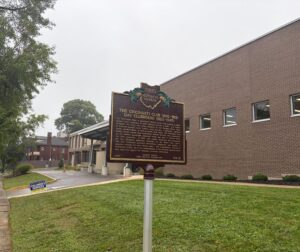
The Cincinnati Club, a prominent Jewish social club founded in 1889, opened their clubhouse at 2840 Melrose Avenue in 1894. A.E. Elzner designed the brick and stone building in the Norman-Gothic style. It featured massive round towers, wide porches, a ballroom, billiard rooms, bowling alley, as well as ornate club rooms. The Cincinnati Club hosted lavish events that celebrated Jewish identity and community. As the Jewish population migrated north and east of Walnut Hills, the club dissolved. In 1922, the vacant clubhouse was purchased by the Disabled American Veterans of the World War (DAV). The DAV Clubhouse provided recreation, resources, and shelter to disabled veterans for over twenty years. The organization, founded in Cincinnati in 1920, led to the establishment of the Veterans Administration and improved support for wounded veterans nationwide.