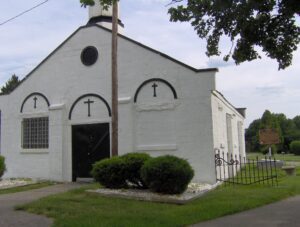
Around 1843, local Methodists organized a new Methodist Episcopal church at Fair Play and later erected a brick chapel. The congregation was short-lived, however, and fell into decline after one of its leading members, Joseph Lashorn, moved to Hamilton. In 1876, Reverend F. G. Grigsby of the United Brethren church organized a congregation here, repairing and occupying the old Methodist chapel for the next several years. The cemetery is the burial place for veterans from the Revolutionary War, War of 1812, and Civil War; some of whom are interred in unmarked graves. The last known burial was Etta Thomas in 1941.
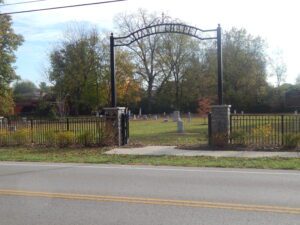
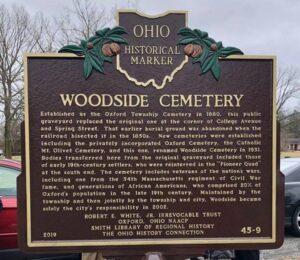
Established as the Oxford Township Cemetery in 1880, this public graveyard replaced the original one at the corner of College Avenue and Spring Street. That earlier burial ground was abandoned when the railroad bisected it in the 1850s. New cemeteries were established including the privately incorporated Oxford Cemetery, the Catholic Mt. Olivet Cemetery, and this one, renamed Woodside Cemetery in 1931. Bodies transferred here from the original graveyard included those of early 19th-century settlers, who were reinterred in the “Pioneer Quad” at the south end. The cemetery includes veterans of the nation’s wars, including one from the 54th Massachusetts regiment of Civil War fame, and generations of African Americans, who comprised 20% of Oxford’s population in the late 19th century. Maintained by the township and then jointly by the township and city, Woodside became solely the city’s responsibility in 2002.
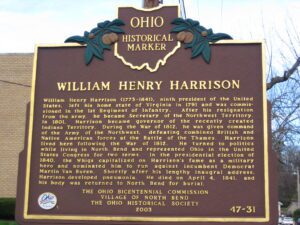
William Henry Harrison (1773-1841), ninth president of the United States, left his home state of Virginia in 1791 and was commissioned in the 1st Regiment of Infantry. After his resignation from the army, he became Secretary of the Northwest Territory. In 1801, Harrison became governor of the recently created Indiana Territory. During the War of 1812, he was given command of the Army of the Northwest, defeating combined British and Native American forces at the Battle of the Thames. Harrison lived here following the War of 1812. He turned to politics while living in North Bend and represented Ohio in the United States Congress for two terms. In the presidential election of 1840, the Whigs capitalized on Harrison’s fame as a military hero and nominated him to run against incumbent Democrat Martin Van Buren. Shortly after his lengthy inaugural address, Harrison developed pneumonia. He died on April 4, 1841, and his body was returned to North Bend for burial.
Born in Richmond, Virginia, Powhatan Beaty moved to Cincinnati in 1849, where he spent the majority of his life. Beaty enlisted as a private in the Union Army in June 1863, and two days later was promoted to first sergeant, Company G, 5th United States Colored Troops (USCT). All the officers of Company G were killed or wounded during an attack on Confederate forces at New Market Heights, Virginia, in September 1864. Beaty took command of his company, and for his valor received the Congressional Medal of Honor. Beaty was one of two African-Americans buried in Ohio to receive the Medal of Honor for service in the Civil War. He died on December 6, 1916, leaving two sons, attorney and state representative A. Lee Beaty and John W. Beaty. He is buried in Union Baptist Cemetery along with nearly 150 USCT veterans.
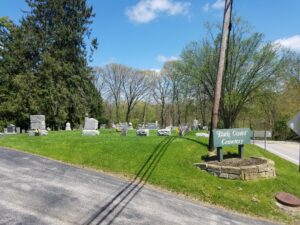
Settlers from New England purchased this land in 1817 for use as a burying ground and to build a meeting house. Located in the center of Bath Township, a part of the Connecticut Western Reserve, the site provided a convenient place for public and religious gatherings and for a cemetery. Out of need, the cemetery was established before the township was founded in 1818. Many of Bath Township’s farming families, as well as both owners and operators of businesses of Bath, are interred in the cemetery. In a tradition originating with Civil War veteran Perry Alexander, the graves of all veterans are marked with an American flag on Memorial Day as a tribute to their service.
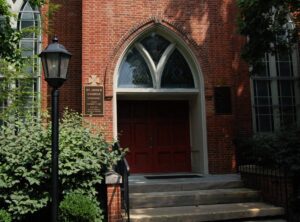
In October of 1803, members of The Scioto Company, led by James Kilbourne, came from Connecticut and founded Worthington. On February 6, 1804, the Articles of Agreement establishing St. John’s Church of Worthington were executed. St. John’s, which had been planned in Connecticut prior to the Company’s departure, became the first Episcopal church established in the Northwest Territory and served as the founding church for several Episcopal churches in Ohio. James Kilbourne served as the church’s first Deacon. Reverend Philander Chase, the first Rector of St. John’s, became the first Episcopal Bishop of Ohio and founded Kenyon College. St. John’s Church and graveyard are listed on the National Register of Historic Places.
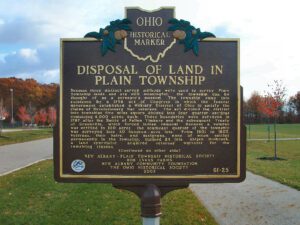
Because three distinct survey methods were used to survey Plain Township lands and are still meaningful, the township can be thought of as a surveyor’s museum. The township came into existence by a 1796 act of Congress in which the federal government established a Military District of Ohio to satisfy the claims of Revolutionary War veterans. The act divided the district into townships five miles square divided into four quarter-sections containing 4,000 acres each. These boundaries were surveyed in 1797 after the Battle of Fallen Timbers and the subsequent Treaty of Greenville, which forced Indian removal. Because a veteran was entitled to 100 acres, the southeast quarter of the township was surveyed into 40 hundred-acre lots. From 1801 to 1805, veterans, their heirs, and assignees, none of whom settled permanently in the township, claimed 24 lots. Abijah Holbrook, a land speculator, acquired veterans’ warrants for the remaining sixteen. (continued on other side)
In 1801, the Springdale Presbyterian Church acquired these two and a half acres to construct a church and cemetery. Although the church moved to a new location in 1833, the cemetery remained and continued to receive regular internments until the mid 1950s. Because of a continued decline in church membership, the Presbyterian Church was eventually unable to care for the cemetery. The church felt it was in the best interest of the community to turn ownership over to the City of Springdale. In 1987, the city received ownership of the cemetery and immediately began a maintenance and restoration project. Many forgotten graves were uncovered and broken gravestones were restored and reset. The cemetery contains seven hundred and thirty nine graves and is the final resting place for nine Revolutionary War veterans, thirteen veterans of the Civil War, and one each from the War of 1812 and World War I.