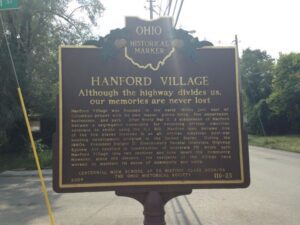
Hanford Village was founded in the early 1900s just east of Columbus proper with its own mayor, police force, fire department, businesses, and park. After World War II, a subdivision of Hanford became a segregated community for returning African American veterans to settle using the G.I. Bill. Hanford then became one of the few places involved in an all African American post-war housing development program in the United States. During the 1960s, President Dwight D. Eisenhower’s Federal Interstate Highway System Act resulted in construction of Interstate 70 which split Hanford Village into two sections and tore apart the community. However, since the division, the residents of the village have worked to maintain its sense of community and unity.
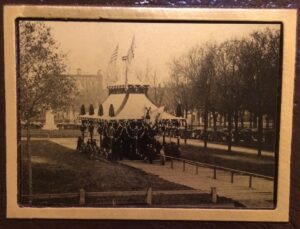
Abraham Lincoln visted Cleveland twice; once in life and the other in death. The first visit was on February 15-16, 1861, while in route to his presidential inauguration. The second, more solem visit was on April 28, 1865. Cleveland was one of twelve citiels to host a scheduled public viewing of the assassinated president’s remains. In addition to local officials, Lincoln’s cortege included a military escort of then current and former Union officers who were veterans of the Civil War. These officers would form the early membership of the organization known as the Military Order of the Loyal Legion of the United States. (continued on other side)
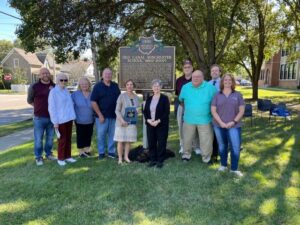
Over its 145 years, the Old Canal Winchester School building played a significant role in the community. The original four-room building opened in 1862 and its first high school class graduated seven in 1886. Canal Winchester’s growth is reflected in the school’s several additions, the first of which was in 1875. Other expansions include a separate high school building in 1909, a three-story connector in 1929 between the 1862 and the 1909 buildings, and elementary school wings in 1956 and 1967. The school was also the site of continuing education and vocational classes for adults in the 1930s and 1950s, agricultural programs for veterans after World War II, and a cannery from the time of that war to 1952. The school was added to the National Register of Historic Places in 2017 and it remains the district’s administrative center and a community gathering space.
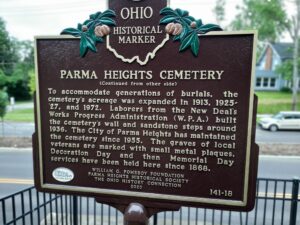
The cemetery has been the final resting place of area residents since the 1820s. Settlers from New York and New England migrated here in the 1810s and 1820s. First called “Greenbrier,” the area took the name Parma after the township was organized in 1826. A log building at the cemetery’s north end stood from 1826 to 1841 and served as a township school, public meeting place, and church. The cemetery’s small sandstone vault was erected in 1892. After voters established Parma Heights village in 1911, the Parma Heights Cemetery Improvement Association formed to care for the grounds. (Continued on other side)
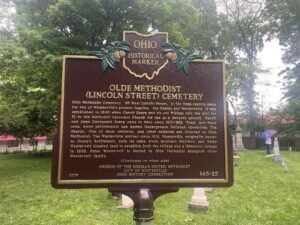
Olde Methodist Cemetery, 66 West Lincoln Street, is the final resting place for two of Westerville’s pioneer families, the Sharps and Westervelts. It was established in 1849 when Garrit Sharp and his son William sold the plot for $1 to the Methodist Episcopal Church for use as a burying ground. Garrit and Anna Goodspeed Sharp came to Ohio circa 1810-1812. They, and their sons, were abolitionists and known Underground Railroad operatives. The Sharps, five of their children, and other relatives are interred in Olde Methodist. The Westervelts arrived circa 1818. Westerville, originally known as Sharp’s Settlement, took its name when brothers Matthew and Peter Westervelt donated land to establish both the village and a Methodist college in 1839. Peter Westervelt is buried in Olde Methodist alongside other Westervelt family. (Continued on other side)