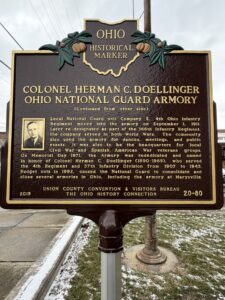
The Marysville Ohio National Guard Armory was the first such armory constructed in the state after the recognition of the Guard in 1909. The new armory and others like it were built in response to federalization of National Guard units after the passage of the Militia Act of 1903. Armory buildings served as the headquarters for local companies and provided drill rooms and arsenals for the storage of military equipment and supplies. Architect Charles Insco Williams designed Marysville’s armory and it was built by James Laughlin, both of Dayton, Ohio. Marysville contractor George W. Fox provided the brickwork for the structure. Construction began in 1910 and was completed in 1911 at a cost of $19,886. (Continued on other side)
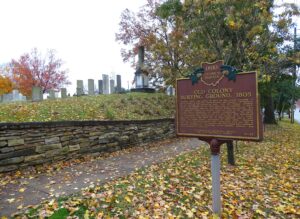
Granville, Ohio, was settled in 1805 by the Licking Company, a group formed in Granville, Massachusetts, and Granby, Connecticut, for the purpose of emigrating west. The Old Colony Burying Ground was defined on the first town plat of Granville in 1805. Many of Granville’s pioneers are interred within this ground, and the cemetery retains its original form and most of its westward facing rows of sandstone and marble gravestones. The early settlers buried here helped to lay out this town and determined the appearance and development of the village as it is today. The first burial, the infant son of Ethan Bancroft, was in April 1806. The oldest extant gravestone is dated 1808. Eighteen veterans of the Revolutionary War, thirty-nine from the War of 1812, and sixteen Civil War veterans rest here along with ministers, farmers, industrialists, physicians, young mothers, children, and other citizens of Granville.
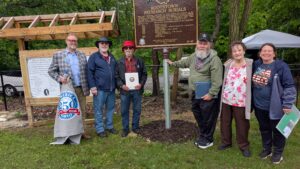
The Rootstown Old Cemetery (sometimes “Ye Olde Cemetery”) began as a two-acre parcel set aside on the Abram and Siley Reed Farm for use as a burying ground. County histories record that Nathan Chapman Sr. (1759-1809) was the first burial. Although the Reeds dedicated their parcel as a community cemetery in 1816, it was not until 1861 that Reed Family heirs sold the plot to Rootstown Township for the sum of $1. Old Cemetery remained an active burial ground for more than a century; farmer Frank Seymour (1861-1942) was the last burial. Cemetery researchers recorded three hundred and ninety-eight burials in Old Cemetery; one hundred and twenty-six of those graves were unmarked. The Rootstown cemetery is the final resting place for veterans of the American Revolution, the War of 1812, and the Civil War.
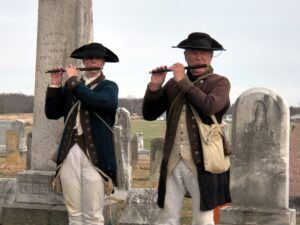
Field Musician Richard W. Thompson. Tunes played on fife and drum regulated a soldier’s life in camp and his actions on the battlefield. Heard over the roar of battle and through the haze of smoke, fifes and drums – field music – communicated orders to massed troops quickly. Richard Willoughby Thompson (c. 1742-1837), buried in Fancher Cemetery, was a field musician during the American Revolution and the War of 1812. According to his grandson Henry’s recollections from the 1920s, Thompson was born in Dublin, Ireland, and enlisted in the British army, where his service culminated in his capture while picking blackberries. He switched allegiances, joined the colonials, and was sent to Virginia. Thompson was appointed the Fife Major of the 5th Virginia Regiment and remained a Fife Major as Virginia units organized during the war. (Continued on other side)
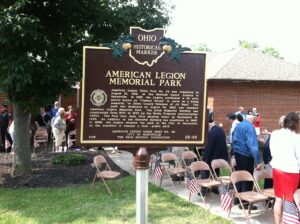
American Legion Union Post No. 79 was organized on August 21, 1919, at the National Guard Armory in Marysville. In 1927, the Legion purchased a 24 acre parcel known as “Clement Woods” to serve as a living memorial “to Union County Veterans of All Wars”. The park was dedicated on August 24, 1927, and renamed American Legion Memorial Park. The brick Memorial Building was constructed from 1937 to 1938 by the Works Progress Administration (WPA). The Post held their first meeting there on September 12, 1938. An addition to the Memorial Building was completed in 1960. In 1989, the Legion donated the park to the City of Marysville on the condition it remains a free, public park.
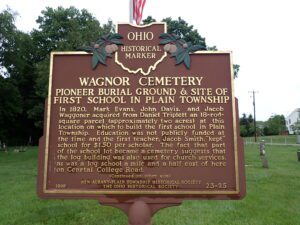
In 1820, Mark Evans, John Davis, and Jacob Waggoner acquired from Daniel Triplett an 18-rod-square parcel (approximately two acres) at this location on which to build the first school in Plain Township. Education was not publicly funded at the time and the first teacher, Jacob Smith, “kept” school for $1.50 per scholar. The fact that part of the school lot became a cemetery suggests that the log building was also used for church services, as was a log school a mile and a half east of here on Central College Road. (continued on other side)
Originally called Westfield Township, Samuel Fowler purchased this area in 1798 from the Connecticut Land Company for $12,903.23 while living in Westfield, Massachusetts. His brother Abner arrived the following year to survey the land and separate it into smaller plots that could be sold to people wanting to settle here. A Revolutionary War veteran, Abner was the first to arrive here and also the first recorded death in 1806, the same year that his son Abner Fowler II married the first school teacher in Fowler Ester Jennings. In 1817, Samuel Fowler gave five acres of land to Fowler Center to be used as a park or “common” with the provision that no permanent building ever be built on it. At about the same time, the township name was changed to Fowler to honor its founding family. Agriculture was and remains the main occupation in the Fowler area.
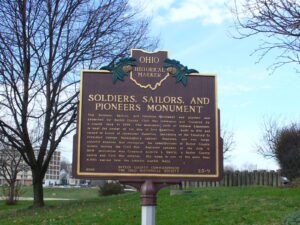
The Soldiers, Sailors, and Pioneers Monument was planned and promoted by Butler County Civil War veterans and financed by a county levy in 1899. The monument, built of Indiana Limestone, is near the center of the site of Fort Hamilton, built in 1791 and named in honor of Alexander Hamilton, Secretary of the Treasury in President George Washington’s cabinet. Featured, are two large, colorful windows that recognize the contributions of Butler County women during the Civil War. Featured speaker at the July 4, 1906, dedication was Governor Andrew L. Harris, a Butler County native and Civil War veteran. His name is one of the more than 4,300 carved into the interior marble walls.