

, OH
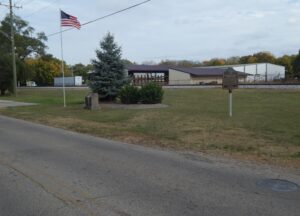
Carlisle Station Depot. The Carlisle depot for the Cincinnati, Hamilton & Dayton (CH&D) railroad was located nearby. The CH&D started operations in 1851 and was the second railroad through Warren County. Carlisle Station was a passenger and freight-shipping depot and was joined in 1872 by another, when Cincinnati & Springfield Railroad (later part of the Big Four and the New York Central Railroads) erected a depot in nearby Franklin. Carlisle was originally known as the “Jersey Settlement,” because many settlers in the early 1800s were from New Jersey. George Carlisle, vice-president of the CH&D, purchased a large tract of land here. After Carlisle and his wife Sarah donated a lot to the community in 1856, residents renamed the place “Carlisle Station.” The Carlisle Literary Association built a hall on the lot c. 1856, which, as of 2019, remains as the older section of Carlisle’s municipal building. Side B: Schenck-Stanton Rally, October 3, 1868.
, OH
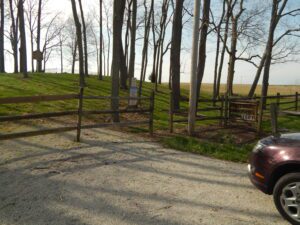
In the early years of the nineteenth century, a religious unrest known as the Second Great Awakening spread across much of the American frontier. Among the most influential of the evolving religious organizations were the Campbellites, or Disciples of Christ, founded in the 1820s by Thomas and Alexander Campbell. The Campbellite movement sought to “restore” New Testament Christianity by calling for a return to the primitive church revealed in the gospels. Campbellites denied creeds and oath-taking and rejected sectarianism. They believed in baptism by immersion and communion on Sundays. Followers also dealt with problems and transgressions of members within the church and did not use civil courts. They held a millennial view that professed human happiness and the belief that Christ would reign on earth for a thousand years. Believers spread this word to the pioneers of the Doty Settlement and elsewhere. By 1850, there were ninety Campbellite Churches in Ohio.
, OH
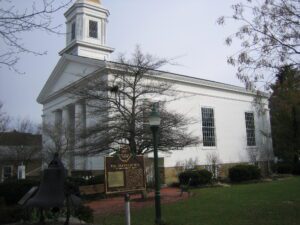
In 1804 a group of neighbors in Granville, Massachusetts and Granby, Connecticut formed The Licking Company for the purpose of moving to “Newlands” in Ohio. Inspired and informed by the settlement of Worthington in 1803, the Company purchased 29,040 acres in the U.S. Military District. Advance parties surveyed and mapped a site, established a mill, and planted grain. The Company planned a public square, a school, library, quarry, burying ground, and property for the support of churches. In November and December 1805, some 150 emigrants in ox-drawn wagons arrived in their new home and built temporary shelters on the designated public square. On December 9 through 12 1805, Company members selected their Granville lots in an auction that was described as peaceable and honest.
, OH
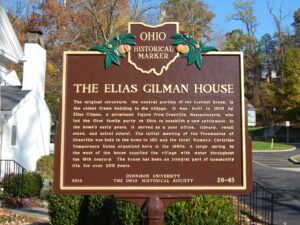
The original structure, the central portion of the current house, is the oldest frame building in the village. It was built in 1808 by Elias Gilman, a prominent figure from Granville Massachusetts, who led the first family party to Ohio to establish a new settlement . In the home’s early years, it served as a post office, library, retail store, and select school. The initial meeting of the Freemasons of Granville was held in the home in 1811 and the local Women’s Christian Temperance Union organized here in the 1880s . A large spring to the west of the house supplied the village with water throughout the 19th century . The house has been an integral part of community life for over 200 years.
, OH
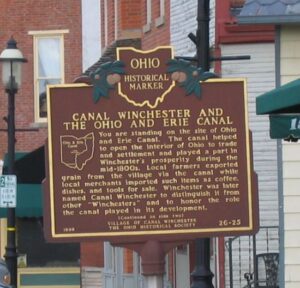
You are standing on the site of Ohio and Erie Canal. The canal helped to open the interior of Ohio to trade and settlement and played a part in Winchester’s prosperity during the mid-1800s. Local farmers exported grain from the village via the canal while local merchants imported such items as coffee, dishes, and tools for sale. Winchester was later named Canal Winchester to distinguish it from other “Winchesters” and to honor the role the canal played in its development. (Continued on side two)
, OH
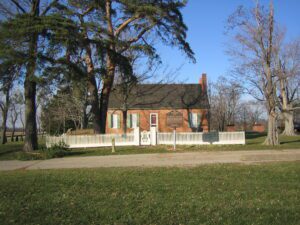
As Oxford Township was developing in the mid-1800s, a cluster of farmsteads near its northern border developed and was designated the “Doty Settlement.” As was the custom, the community took its name from a prominent family in the area. In or near the settlement were a church and cemetery, a school, a blacksmith shop, a sawmill, a distillery, a furniture shop, and a fulling mill for cleansing, shrinking, and thickening cloth. With the frontier spirit of self-reliance, it was seldom necessary to travel several miles into Oxford village for additional goods or services. Working together, the community farmed local fields and bartered for other items. Men, women, and children worked long, hard hours in the fields harvesting corn and wheat. It is evident that these families, living in an agricultural society, possessed many useful skills for surviving in the Ohio country.
, OH
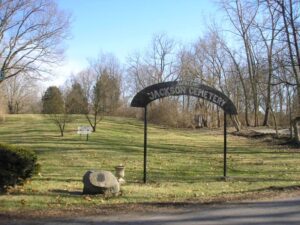
In 1833, John Randolph from Roanoke, Virginia, died leaving three wills that requested that all of his slaves be set free and that land be purchased for them. Although contested for thirteen years by his family, the slaves were freed and the executor of the wills, Randolph’s cousin Judge William Leigh purchased about 2,000 acres of farm land in Mercer County, Ohio. Traveling by wagon train, the freed slaves, 383 in all, reached their destination in 1846, but were forced to turn back by earlier established white settlers. They turned around and ended up north of Piqua where they purchased land and developed the Village of Rossville. Later some moved on to other places in Miami County and well as Shelby County. In Rossville, they established an African Baptist Church in 1869, cemetery in 1866, and public black school in 1872.
, OH
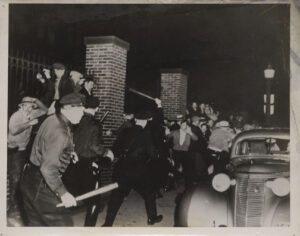
Five Depression-era strikes against many of Akron’s rubber companies culminated in a giant “sit-down” strike against Goodyear Tire and Rubber Company, the industry’s leader, in February and March of 1936. The fledgling United Rubber Workers (URW), created in September 1935, used the tactic of being at work but not working that had been pioneered by rank-and-file workers in a successful 1934 strike against the General Tire and Rubber Company. After a peaceful month-long strike, the URW won recognition from Goodyear and reached a settlement on March 22. The 1936 Akron Rubber Strike was one of the earliest successes for the Committee for Industrial Organization (CIO), sparking a wave of industrial organizing and similar strikes in 1936 and 1937. The “sit-down” strategy extended beyond the rubber industry and was instrumental in the founding of the industrial union movement in the United States.