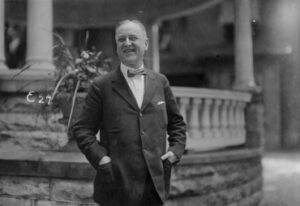
One of Ohio’s most influential politicians in the early 20th century, Washington Court House native Harry Daugherty (1860-1941) was widely known as a “President-maker” and served instrumental roles in President Warren G. Harding’s administration, culminating a long career in state and national politics. As Attorney General from 1921 to 1924, Daugherty established the first federal women’s penitentiary, recommended former president William Howard Taft to the Supreme Court, and ended a controversial 1922 railroad strike. Implicated in scandals complicated by the suicide of his assistant and fellow Fayette County native Jess Smith, Daugherty was eventually cleared in congressional investigations and two bribery trials, and subsequently published an insider’s account of the Harding Administration. Both Daugherty and Smith are buried in Washington Cemetery.
Ohio’s first female county sheriff, Maude Charles Collins (1893-1972) of Vinton County was appointed to finish her husband Fletcher’s term after he was killed in the line of duty in October 1925. In 1926, she ran for the office in her own right on the Democratic ticket and handily beat males in both the primary and general elections. “Sheriff Maude” investigated crimes, answered calls, patrolled roads, and performed the duties of her office, all while raising five children. She gained national attention for solving an intriguing double murder case in 1926, later featured in Master Detective and Startling Detective magazines. In 1927 she was the first woman to deliver inmates to the Ohio State Penitentiary in Columbus. Collins, a pioneering woman in law enforcement, was inducted into the Ohio Women’s Hall of Fame in 2000. She is buried in Hamden Cemetery.
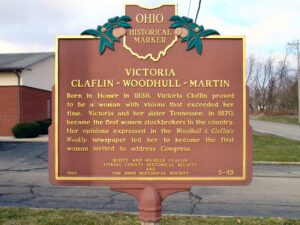
Born in Homer in 1838, Victoria Claflin proved to be a woman with visions that exceeded her time. Victoria and her sister Tennessee, in 1870, became the first women stockbrokers in the country. Her opinions expressed in the Woodhull & Claflin’s Weekly newspaper led her to become the first woman invited to address Congress.
On this site on May 29, 1851, Sojourner Truth, a former slave, gave her world famous “And Ain’t I a Woman?” speech, recalling the hardships she had endured. Active in both the abolitionist and women’s rights movements, she electrified an audience of women and men who had come to the Universalist Stone Church for a two-day women’s rights convention.
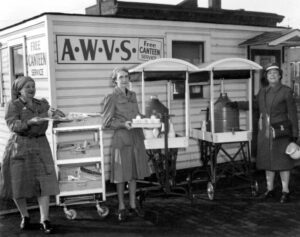
The Lima Chapter of the American Women’s Voluntary Services Organization established a community-based, free canteen during World War II for troops traveling on the Pennsylvania Railroad and adjacent Baltimore & Ohio-Nickel Plate Railroads. Meeting as many as forty trains a day, the ladies served 2.5 million troops between 1942-1945. Food, coffee, and other items were donated to the canteen from a twelve county area. The “AWVS” disbanded in 1945, but succeeding volunteers continued to provide service throughout the Korean Conflict and Viet Nam War. Lima’s “Servicemen’s Free Canteen” was the longest, continuously operated service canteen in the United States. An estimated four million soldiers, sailors, and marines were served between 1942-1970.
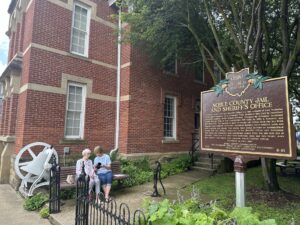
The Noble County Jail and Sheriff’s Office is a fine example of Late Victorian architecture designed by a prominent Ohio architect and built by important nineteenth century Noble County builders. Designed by Columbus architect Joseph Warren Yost, it was constructed 1881-1882 by Mills & Summers and cost $9,477.55. The building is made of orange-red bricks from the Ava Brick Company and features horizontal sandstone banding and a detailed gable end with brackets and finials. The Queen Anne design includes an asymmetrical façade with two distinct entrances to the Sheriff’s Office and Residence. The office and residence face courthouse square while the jail cells are at the rear. There are four first-floor individual cells and two larger men’s and women’s cells above with concrete barrel-vaulted ceilings. (Continued on other side)
Betsey Mix Cowles dedicated her life to fighting slavery and improving the status of women. Her desire for a formal education led her to Oberlin College, where she completed two years of study in 1840. An advocate of immediate abolition, Cowles lectured on the moral depravity of slavery, opened her home, at this site, to fugitive slaves. Opposed to expansion of slavery into the West, Cowles protested the Mexican War. Cowles served as president of Ohio’s first women’s rights convention (in Salem) in 1850, and the following year wrote a treatise on equal pay for working urban women. She served as the first dean of women at Grand River Institute, and later became one of the first women public school superintendents in Ohio.
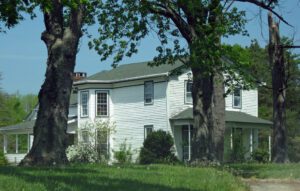
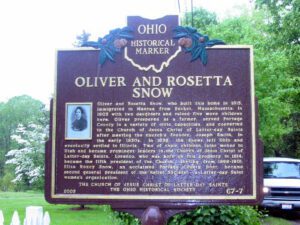
Oliver and Rosetta Snow, who built this home in 1815, immigrated to Mantua from Becket, Massachusetts, in 1805 with two daughters and raised five more children here. Oliver prospered as a farmer, served Portage County in a variety of civic capacities, and converted to the Church of Jesus Christ of Latter-day Saints after meeting the church’s founder, Joseph Smith, in the early 1830s. In 1838, the Snows left Ohio and eventually settled in Illinois. Two of their children later moved to Utah and became prominent leaders in the Church of Jesus Christ of Latter-day Saints. Lorenzo, who was born on this property in 1814, became the fifth president of the Church, serving from 1898-1901. Eliza Roxcy Snow, an acclaimed Portage County poet, became second general president of the Relief Society, a Latter-day Saint women’s organization.