2210 Summit Street once housed one of Ohio’s longest-running lesbian bars. In 1970, a lesbian bartender at Jack’s A Go Go recognized that while Columbus had bars for gay men, it needed one geared toward lesbian clientele. Patrons knew the bar as “Jack’s,” Logan’s Off Broadway, and Summit Station. Staff welcomed women from small towns, women working in trades, women of color, butch/femme lesbians, and transgender people. Regulars recall that stepping through the door felt like finally entering a place of true belonging. Women could dance, “get together,” break up, sing karaoke, party with friends, and celebrate birthdays and holidays. Summit Station remained a safe public space, despite ongoing police harassment of its gender non-conforming regulars. A sign posted outside declared: “Ladies Night, Every Night. Men $5.” (Continued on other side)
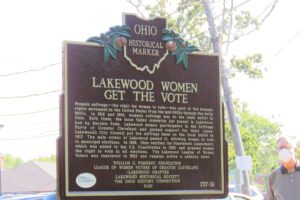
Women’s suffrage–the right for women to vote–was part of the women’s rights movement in the United States from the mid-1800s through the early 1900s. In 1912 and 1914, women’s suffrage was on the state ballot in Ohio. Both times, the issue failed statewide but passed in Lakewood. Led by Bernice Pyke, Lakewood women participated in the Suffrage Party of Greater Cleveland and gained support for their cause. Lakewood’s City Council put the suffrage issue on the local ballot in 1917. The male voters of Lakewood passed it, allowing women to vote in municipal elections. In 1919, Ohio ratified the Nineteenth Amendment, which was added to the U.S. Constitution in 1920 and granted women the right to vote in all elections. The Lakewood League of Women Voters was chartered in 1922 and remains active a century later.
The Central Avenue Public Bath House was designed by Frederic Betz, the City of Cleveland’s first appointed architect. Opened in February 1920, it served the Black population in the congested Central neighborhood. The brick building featured symmetrical windows and entrances at either end that led into men’s and women’s waiting rooms and individual shower rooms. Larger group showers for children were in the basement. The second floor featured club rooms as well as a physician’s room and a nurse’s room. In 1926, a swimming pool and gymnasium were added. In 1940, as the need for public bathing facilities waned, Central Avenue Public Bath House was converted into a recreation center. One of Cleveland’s five remaining Bath Houses, Central Avenue stands as a manifestation of the city’s commitment to the health and welfare of its citizens.