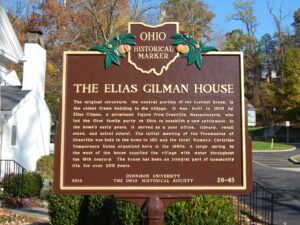
The original structure, the central portion of the current house, is the oldest frame building in the village. It was built in 1808 by Elias Gilman, a prominent figure from Granville Massachusetts, who led the first family party to Ohio to establish a new settlement . In the home’s early years, it served as a post office, library, retail store, and select school. The initial meeting of the Freemasons of Granville was held in the home in 1811 and the local Women’s Christian Temperance Union organized here in the 1880s . A large spring to the west of the house supplied the village with water throughout the 19th century . The house has been an integral part of community life for over 200 years.
Katharine Kennedy Brown (1891-1986), born in Dayton, was a leading figure in local, state, and national Republican politics. Soon after the 19th Amendment was passed in 1920, she earned a seat on the Montgomery County Republican Executive Committee; moving up to the Ohio State Republican Central Committee in 1928 and the Republican National Committee in 1932 ─ serving on both until 1968. She founded the first Republican Women’s Club in the county. (Continued other side)
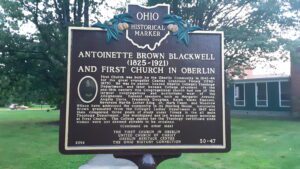
First Church was built by the Oberlin Community in 1842-44 for the great evangelist Charles Grandison Finney (1792-1875). He was its pastor, headed Oberlin College’s Theology Department, and later became College president. In the mid-19th century this Congregational church had one of the largest congregations and auditoriums west of the Alleghenies. Eminent speakers such as Margaret Atwood, Angela Davis, Frederick Douglass, Ralph Waldo Emerson, Reverend Martin Luther King, Jr., Mark Twain, and Woodrow Wilson have addressed the community in its Meeting House. Antoinette Brown graduated from the College’s Ladies’ Department in 1847 and then completed three years of study under Finney in the all male Theology Department. She worshipped and led women’s prayer meetings at First Church. The College denied her the Theology certificate since women were not deemed suitable to be ordained. (continued on other side)
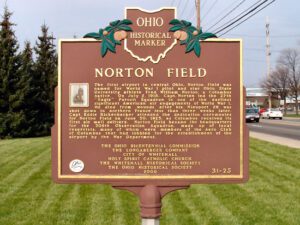
The first airport in central Ohio, Norton Field was named for World War I pilot and star Ohio State University athlete Fred William Norton, a Columbus native. On July 2, 1918, Capt. Norton led the 27th “Eagle” Pursuit Squadron in one of the earliest significant American air engagements of World War I. He died from wounds after his Nieuport 28 was shot down in northern France less than three weeks later. Capt. Eddie Rickenbacker attended the dedication ceremonies for Norton Field on June 30, 1923, as Columbus received its first air mail delivery. Norton Field became the headquarters for the 308th Observation Squadron, made up of local reservists, many of whom were members of the Aero Club of Columbus that had lobbied for the establishment of the airport by the War Department.
Chartered in 1849, the Institute was the first of three women’s colleges established in Oxford. The original brick building was completed in 1850, and forms the core structure. The Reverend John Witherspoon Scott, a member of Miami University’s early faculty, headed the Institute. In 1867, the Institute merged with Oxford Female College and later became the Oxford College for Women. Miami University acquired the building in 1928; in 1930 the Daughters of the American Revolution rededicated it as the “Caroline Scott Harrison Memorial.” From 1929-1998 it served as a Miami dormitory, nicknamed “Ox College.” Since 2003, the three-story building has housed the Oxford Community Arts Center. The structure is the oldest extant women’s college building in Ohio. It was placed on the National Register of Historic Places in 1976.
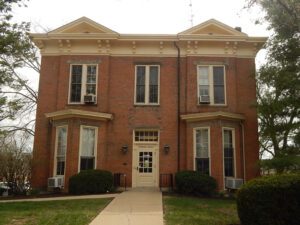
Built by “Old Miami” University President Robert L. Stanton, D.D. (1810-1885) as his private home and president’s office, Stanton’s 1868 Italianate house faced University Square, and welcomed students and guests. The house retains its original symmetrical façade, enclosed portal, grand staircase, double parlors, parlor doors, marbleized slate mantels, and triangular bay windows. Stanton served as president from 1866-1871. Stanton’s son, Robert Brewster Stanton, MU ’71, famed civil engineer, lived here as an undergraduate. His Miami mentor, mathematics professor Robert W. McFarland (1825-1910), purchased the house in 1873. McFarland rented it while distinguishing himself at Ohio State University during Miami’s twelve-year closure, and then resided here while first president of “New Miami” (1885-1888) and until his death. McFarland’s daughter Frances and her husband Llewellyn Bonham sold the home to Miami in 1940.
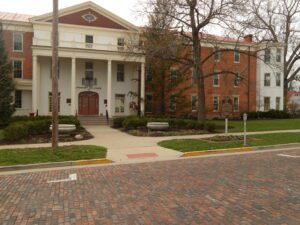
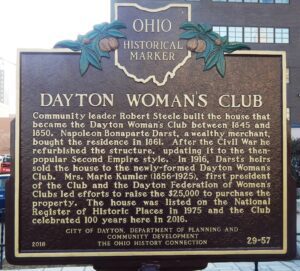
Dayton Woman’s Club. Community leader Robert Steele built the house that became the Dayton Woman’s Club between 1845 and 1850. Napoleon Bonaparte Darst, a wealthy merchant, bought the residence in 1861. After the Civil War he refurbished the structure, updating it to the then-popular Second Empire style. In 1916, Darst’s heirs sold the house to the newly-formed Dayton Woman’s Club. Mrs. Marie Kumler (1856-1925), first president of the Club and the Dayton Federation of Women’s Clubs led efforts to raise the $25,000 to purchase the property. The house was listed on the National Register of Historic Places in 1975 and the Club celebrated 100 years here in 2016.
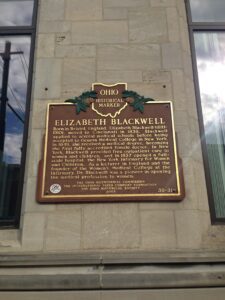
Born in Bristol, England, Elizabeth Blackwell (1821-1910), moved to Cincinnati in 1838. Blackwell applied to several medical schools before being accepted to Geneva Medical College in New York. In 1849, she received a medical degree, becoming the first fully accredited female doctor. In New York, Blackwell provided free outpatient care to women and children, and in 1857 opened a full-scale hospital, the New York Infirmary for Women and Children. As a lecturer in England and the founder of the Women’s Medical College at the Infirmary, Dr. Blackwell was a pioneer in opening the medical profession to women.