

, OH
In 1834, ministers gathered at Providence Church in Berlin Crossroads and organized the Providence Anti-Slavery Baptist Association; believed to be both the first African American Baptist Association in Ohio and among the earliest in the country. The Association’s name boldly reflected its stance: opposition to slavery and a commitment to freedom. Several affiliated churches and their members were known Underground Railroad safe houses and conductors. Providence Association grew to include member churches across Ohio—including Athens, Bidwell, Beaver, Blackfork, Burlington, Gallipolis, Glouster, Ironton, Middleport, Nelsonville, Rutland—as well as congregations in West Virginia, Kentucky, and Michigan.
, OH
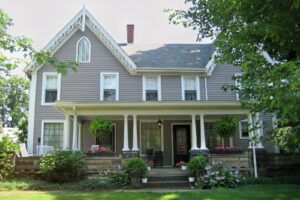
Unserheim, meaning “Our Home” in German, is the name of this ante-bellum Queen Anne style home, which was placed on the National Register of Historic Places in 1998. From 1857-1878, it was home to Daniel Howell Hise, a Quaker and ardent abolitionist. On April 8, 1849, Hise wrote, “Welcome! Welcome to the protection I can give, with or without the law.” A major stop on the Underground Railroad, Unserheim’s secret rooms and tunnel provided shelter to slaves on their flight to freedom. Hise’s belief in abolitionism was so strong that following John Brown’s Raid at Harper’s Ferry, he was instrumental in erecting the Edwin Coppock Monument at Hope Cemetery. Coppock had been executed for his participation in the raid. Hise also supported the Women’s Rights Movement and opened Unserheim to such notable guests as famed suffragists Susan B. Anthony and Sojourner Truth.
, OH
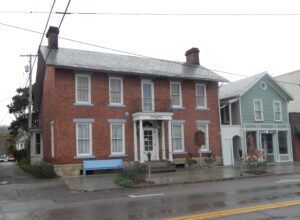
This brick, Federal-style house was built in 1836. Helen Moore, the grand daughter of General Robert McConnel, officer during the War of 1812 and founder of McConnelsville, married Dr. Hiram L. True and made their home here. Dr. True practiced medicine in the area and was widely known for his interest in science, serving as president of the local Scientific Society. Their daughter Evelyn True Button was born in the house in 1875. A graduate of Ohio Wesleyan University, Evelyn traveled to the Philippines in 1898 on a missionary trip to train teachers. A teacher, principal, community leader, and ardent worker for women’s rights, she died in the place of her birth in 1975. She bequeathed the house to the Morgan County Historical Society to serve as a depository of furnishings and artifacts of Morgan County heritage.
, OH
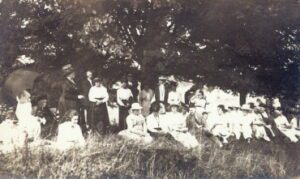
After embracing the cause of women’s suffrage, Harriet Taylor Upton (1854-1945) devoted her life to the movement. Born in Ravenna, she moved to Warren as a child and lived in this house beginning in 1873. Upton was treasurer of the National American Woman Suffrage Association from 1895 to 1910 and brought its headquarters to Warren in 1903, where it remained until 1910. She served as president of the Ohio Woman Suffrage Association for 18 years. As the first woman vice chair of the National Republican Executive Committee, Upton was instrumental in the passage of child labor laws and securing governmental appointments for women. Her devotion to women’s causes and skills as a public speaker earned her nationwide respect.
, OH
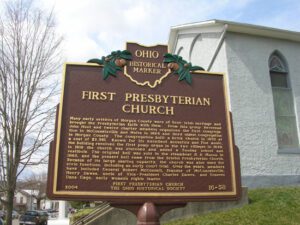
Many early settlers of Morgan County were of Scot-Irish heritage and brought the Presbyterian faith with them. From this group Reverend John Hunt and twelve charter members organized the first congregation in McConnelsville and Malta in 1824 and third oldest congregation in Morgan County. The congregation built a brick church in 1832 at a cost of $2,361. Known for its excellent acoustics and fine music, the building received the first pump organ in the two villages in 1849. In 1916 the church was stuccoed and added a Sunday school and vestibule. The original bell was sold to the steamboat H.D. Munson in 1865, and the present bell came from the Bristol Presbyterian Church. Because of its large seating capacity, the church was also used for civic functions, including an early court trial. Over the years, members have included General Robert McConnell, founder of McConnelsville, Henry Dawes, uncle of Vice-President Charles Dawes, and Frances Dana Gage, early women’s rights leader.
, OH
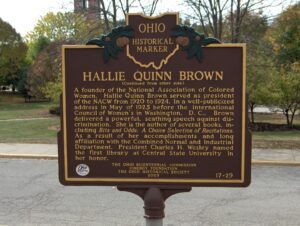
Hallie Quinn Brown (c. 1850) was born in Pittsburgh, Pennsylvania to former slaves. She and her family moved to Wilberforce, Ohio in 1870, where she received a Bachelor of Science degree from Wilberforce University in 1873. Brown taught school in the South until her appointment as professor of elocution at Wilberforce University in 1893. A gifted elocutionist and author, Brown received national and international acclaim not only for her recitals and written works, but also for her passionate belief in civil rights and African American culture. (Continued on other side)
, OH
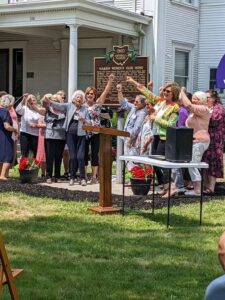
Marion civic leaders Shauck Elah Barlow and Ida Harsh Barlow built “Waldheim,” their Colonial Revival residence, between 1903-1905. Ida Barlow, then president of the Marion Women’s Club, hosted a December 1905 meeting in her new home. Members discussed art, music, literature, and ideas for “civic improvement.” In 1909, this and other Marion clubs reorganized as the Marion County Federation of Women’s Clubs. Federation members soon organized into action: providing college loans to young women; sponsoring visiting city and later school nurses; purchasing trash receptacles; providing dental clinics for low-income residents; and funding railroad crossing safety equipment. Upon her death in 1945, Barlow bequeathed her house to the Federation as the “Women’s Club Home.” The new Federation headquarters offered meeting space for the Executive Board and the many associated clubs. (Continued on other side)
, OH
The Newbury Woman Suffrage Political Club, headquartered at Union Chapel, planted the Centennial Oak on July 4, 1876. The White Oak (Quercus alba) was chosen for its endurance, longevity, and beauty. The picnic and planting celebration included speeches, songs, fireworks, and a poem dedicated to the Oak written by local suffragist Anna Green. As the club gained national recognition, it attracted such notable suffragists as Susan B. Anthony and Harriet Taylor Upton as visitors and speakers. A Newbury gathering on August 23, 1919, held to celebrate Ohio’s recent ratification of the 19th Amendment, included suffragists Upton and Frances Jennings Casement. The last living founding member of Newbury’s Woman Suffrage Club, Dr. Julia Porter Green, led a parade from the chapel to Centennial Oak. There she placed a wreath of evergreen and goldenglow upon the tree.