

, OH
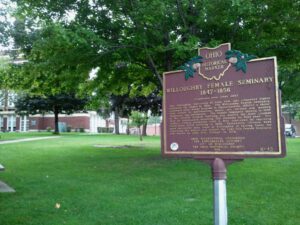
The village of Chagrin, founded in 1798, changed its name in 1834 to honor Dr. Westel Willoughby, a pioneer medical educator. That same year, the Willoughby University of Lake Erie was chartered, and the Willoughby Medical College opened its doors, signaling the beginning of medical education in northern Ohio. The Medical College trained 160 doctors, educated in contemporary methods of medicine, anatomy, chemistry, and surgery. Financial struggles and public outcry against grave-robbing — which supplied cadavers for anatomy classes — hampered the college’s development. The movement of faculty to Cleveland and the transfer of the state charter to Columbus hastened the demise of the Medical College in 1847, and laid the foundation for the establishment of the medical schools of Case Western and Ohio State universities. (Continued on side two)
, OH
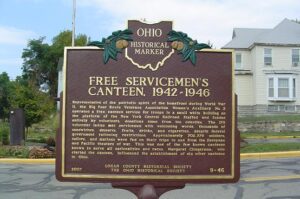
Representative of the patriotic spirit of the homefront during World War II, the Big Four Route Veterans Association Women’s Auxiliary No. 3 operated a free canteen service for troops in a small white building on the platform of the New York Central Railroad. Staffed and funded entirely by volunteers, donations came from ten counties. The 170 volunteer ladies met servicemen with welcoming words, thousands of sandwiches, desserts, fruits, drinks, and cigarettes, despite federal government rationing restrictions. Approximately 702,779 soldiers, sailors, and marines were fed on their trips to and from the European and Pacific theaters of war. This was one of the few known canteens known to serve all nationalities and races. Margaret Clingerman, who started the canteen, influenced the establishment of six other canteens in Ohio.
, OH
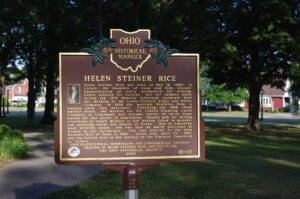
Helen Steiner Rice was born on May 19, 1900, in Lorain, the daughter of Anna and John Steiner. Demonstrating an early propensity for writing, Helen planned for college, but her father’s death during the 1918 Spanish Influenza epidemic kept her working at the Lorain Electric Light and Power Company. In 1929 she married Franklin Rice, a Dayton bank vice president. Following the 1929 stock market crash, she worked for the Gibson Greeting Cards Company in Cincinnati and became editor of verse lines. Known for her words of inspiration, Helen’s gift for writing continues to reach millions in her poetry found in modern-day greeting cards and dozens of books. One of America’s most prolific poets, she was also an early advocate of women in the workplace. She was elected to the Ohio Women’s Hall of Fame in 1992. Helen died April 23, 1981, and was buried next to her parents at the Elmwood Cemetery in Lorain.
, OH
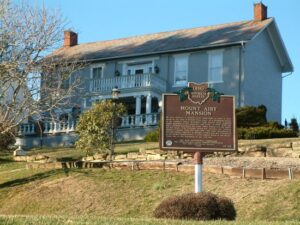
One of Ohio’s earliest proponents of women’s rights, Frances Dana Gage (1808-1884) was born in Marietta and married McConnelsville attorney James L. Gage in 1829. She immersed herself in the major social issues of the day – temperance, abolition, and universal suffrage – while raising eight children. At a women’s rights convention in 1850, Gage gained national attention by proposing that the words “white” and “men” be removed from Ohio’s constitution. She later served as the editor of an Ohio agricultural journal, as an educator for newly emancipated African Americans, and wrote children’s tales under the pen name “Aunt Fanny.” An enormously influential woman, Gage led the way for Ohio’s next generation of social activists.
, OH
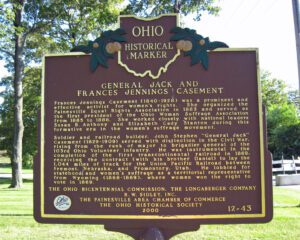
Western Reserve agriculturalist Charles Clement Jennings built the Casement House, also known as the “Jennings Place,” for his daughter Frances Jennings Casement in 1870. Designed by Charles W. Heard, son-in-law and student of Western Reserve master builder Jonathan Goldsmith, it is an excellent example of the Italianate style, featuring ornate black walnut woodwork, elaborate ceiling frescoes, and an innovative ventilation system. It remained in the Casement family until 1953. It was added to the National Register of Historic Places in 1979.
, OH
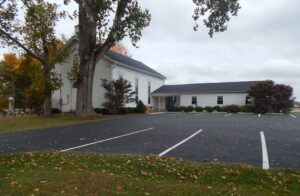
The comingling of faiths in an area settled predominantly by Quakers helps explain the origins of Jonah’s Run Baptist Church. Ministered to by a Baptist preacher, the children and neighbors of Daniel Collett (1752-1835), an Episcopalian and private in the Revolutionary War, and his wife Mary Haines Collett (1753-1826), a Quaker from Virginia, became Baptists and started the church in 1838. Levi Lukens (1767-1860), a Quaker from Pennsylvania by way of Virginia, purchased the land where the church stands in 1812 and sold it in 1839 to a founder of the congregation. Like local Quaker meetinghouses, the church had separate entrances for men and women and a partition between the two that divided the sanctuary. The congregation’s sons and daughters lived their faith. Howard McCune (1852-1923) was the Clinton Baptist Association’s moderator and president of the Ohio Baptist Convention’s state board. Anne Cossum (1894-1977) was a missionary in China from 1920-1927.
, OH
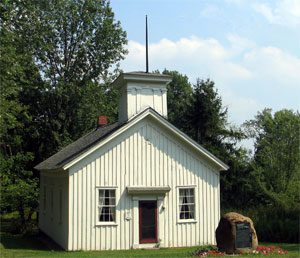
Called the “Cradle of Equal Suffrage” and “Free Speech Chapel,” Union Chapel was to be “…open and free for all denominations, but to be monopolized by no one or to the exclusion of anyone.” Built in 1858 or 1859 on land donated by Anson Matthews, the chapel reputedly exists in response to incident triggered by James A. Garfield, then principal of the Western Reserve Eclectic Institute (now Hiram College) and later president of the United States. He was scheduled to speak at the Congregationists’ “Brick Church” in December 1857. Because of the supposed controversial nature of Garfield’s speech, however, the invitation was withdrawn. (Continued on other side)
, OH
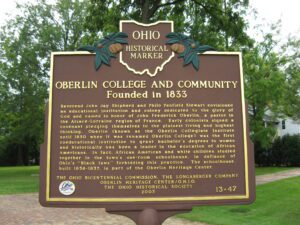
Reverend John Jay Shipherd and Philo Penfield Stewart envisioned an educational institution and colony dedicated to the glory of God and named in honor of John Frederick Oberlin, a pastor in the Alsace-Lorraine region of France. Early colonists signed a covenant pledging themselves to the plainest living and highest thinking. Oberlin (known as the Oberlin Collegiate Institute until 1850 when it was renamed Oberlin College) was the first coeducational institution to grant bachelor’s degrees to women and historically has been a leader in the education of African Americans. In fact, African American and white children studied together in the town’s one-room schoolhouse, in defiance of Ohio’s “Black laws” forbidding this practice. The schoolhouse, built 1836-1837, is part of the Oberlin Heritage Center.