

, OH
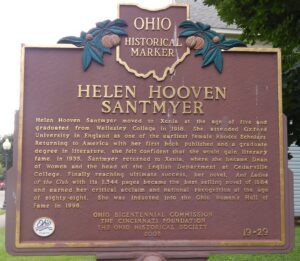
Helen Hooven Santmyer moved to Xenia at the age of five and graduated from Wellesley College in 1918. She attended Oxford University in England as one of the earliest female Rhodes Scholars. Returning to America with her first book published and a graduate degree in literature, she felt confident that she would gain literary fame. In 1935, Santmyer returned to Xenia, where she became Dean of Women and the head of the English Department at Cedarville College. Finally reaching ultimate success, her novel, And Ladies of the Club with its 1,344 pages became the best selling novel of 1984 and earned her critical acclaim and national recognition at the age of eighty-eight. She was inducted into the Ohio Women’s Hall of Fame in 1996.
, OH
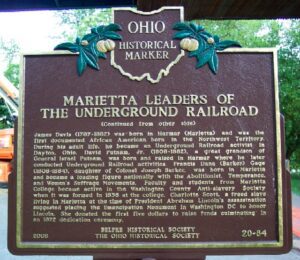
People living in Marietta and along the Muskingum River shared a history of slavery opposition. Manasseh Cutler, from Massachusetts and an Ohio Land Company agent, helped draft the Ordinance of 1787 that prohibited slavery in the Northwest Territory. General Rufus Putnam, Captain Jonathan Stone, and other Ohio Land Company Revolutionary War veterans, founded Marietta at the mouth of the Muskingum River in 1788 bringing with them their anti-slavery sentiments. A proposal to legalize slavery in the proposed state of Ohio was vetoed largely due to the efforts of Marietta’s Ephraim Cutler and General Putnam at the 1802 Ohio Constitutional Convention. These conditions were precursors toward the formation of the Underground Railroad as fugitive slaves crossed the Ohio River seeking freedom. From 1812 through 1861, large numbers of fugitive slaves fleeing toward Canada, were aided by descendants of early settlers who operated Underground Railroad Stations along the Muskingum River. (Continued on other side)
, OH
Frances Dana (Barker) Gage was born on October 12, 1808, in Marietta. She married James L. Gage in 1829 and they raised eight children, including four sons who served with Union forces during the Civil War. Throughout much of her life, Frances was deeply involved with the Temperance and Anti-Slavery movements and Women’s Rights issues. Presiding over the Women’s Rights Convention in Akron in 1851, she invited Sojourner Truth to give her famous “Ain’t I a Woman” speech. The Gage family moved in 1853 to St. Louis, the western extension of the Mason-Dixon Line, where her life was threatened whenever she spoke out against slavery. During the Civil War, she traveled south to aid Union soldiers and teach freed slaves. Though crippled and permanently disabled by a stroke, she continued to lecture on social issues until 1867. Frances Dana Gage died on November 10, 1884, in Greenwich, Connecticut.
, OH
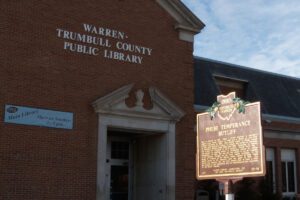
Born in Warren in 1859, Phebe T. Sutliff received a Bachelor’s degree from Vassar College in 1880 and a Master of Arts from Cornell University in 1890. Miss Sutliff taught at Hiram College in Ohio and Rockford College in Illinois and served as President of Rockford College from 1896 until 1901. Returning to Warren, she turned her attention to civic matters. During World War I, she started an evening school of citizenship classes for foreign immigrants. In 1924, she was the first woman to run for Congress in her district. Elected as the first woman president of the Board of Trustees of the Warren Public Library in 1938, Phebe Sutliff served in this capacity until her death in 1955. Miss Sutliff was inducted into the Ohio Women’s Hall of Fame in 1990. Her legacy to the community was the establishment and endowment of the Sutliff Museum.
, OH
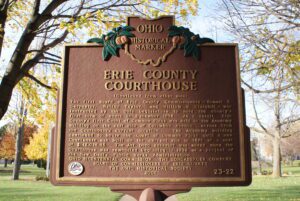
Jury of Erie County Women, First to be Impaneled Under Federal Suffrage proclaimed the headline of the Sandusky Register on August 28, 1920. One of the first female Court of Common Pleas juries in the nation was impaneled in Erie County on August 26, 1920, moments after the 19th amendment to the Constitution of the United States was declared ratified. On that date, Judge Roy Williams was to conduct a trial and jurors were needed. Out of the ten men he contacted, only one could serve. Frustrated, Judge Williams later told the women, “When I learned shortly after 10:30 this morning that suffrage had been proclaimed, I decided to impanel a woman jury. Twelve women were summoned. Twelve women served.” (continued on other side)
, OH
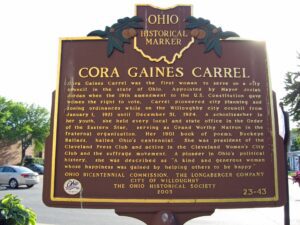
Cora Gaines Carrel was the first woman to serve on a city council in the state of Ohio. Appointed by Mayor Josiah Jordan when the 19th amendment to the U.S. Constitution gave women the right to vote, Carrel pioneered city planning and zoning ordinances while on the Willoughby city council from January 1, 1921 until December 31, 1924. A schoolteacher in her youth, she held every local and state office in the Order of the Eastern Star, serving as Grand Worthy Matron in the fraternal organization. Her 1901 book of poems, Buckeye Ballads, hailed Ohio’s centennial. She was president of the Cleveland Press Club and active in the Cleveland Women’s City Club and the suffrage movement. A pioneer in Ohio’s political history, she was described as “A kind and generous woman whose happiness was gained by helping others to be happy.”
, OH
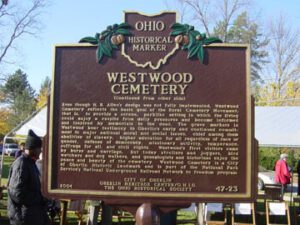
Shortly after Oberlin Colony was established in 1833, a two-acre burying ground was set aside south of Plum Creek in the area bounded by Main, Morgan, and Professor streets. By 1861, however, with the town and Oberlin College growing and the Civil War escalating, the need for a larger cemetery became clear. After an extensive search, 27.5 acres of land belonging to Henry Safford were acquired one mile west of the center of Oberlin. H.B. Allen was hired to create a design in the style of the Rural Cemetery Movement, and in July 1864 Westwood Cemetery was formally dedicated. Burials in Westwood had actually begun in August 1863, and over the next few years hundreds of remains were reinterred from Oberlin’s “Old Cemetery” and from burying grounds in surrounding communities. In the mid-1860s the cemetery was enlarged to its present 47 acres, and in 2004 burials and memorials were estimated to number almost ten thousand. (Continued on other side)
, OH
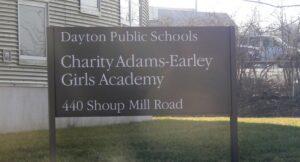
In 1942, Charity Adams Earley (1918-2002) became the first African American woman to receive a commission in what became the Women’s Army Corps (WACs). She rose through the ranks to command the 6888th Central Postal Directory Battalion in Europe, the only unit of African American women to serve overseas in World War II. Upon leaving the service in 1946, she was the WAC’s highest-ranking African American officer, a lieutenant colonel. Raised in Columbia, South Carolina, Earley moved to Ohio to attend Wilberforce University and later The Ohio State University. She married Stanley Earley, Jr., M.D. in 1949 and they later moved to Dayton. She became active in civic affairs, including serving on the Sinclair Community College Board of Trustees.