George Bellows (1882-1925) is widely recognized as one of America’s premier artists. His vivid portrayals of modern urban life have become indelible icons of American art. Born and reared in Columbus, he retained close ties here throughout his life. Bellows gained fame while a young artist in New York, becoming a key figure among a group of artists nicknamed the “Ashcan School” because of their preference for commonplace subjects painted in dark colors. Bellows also excelled at printmaking, and it was largely through his efforts that lithography came to be accepted as a fine art in America. Bellow’s career was unexpectedly cut short by his death from complications following an appendectomy at the age of forty-two.
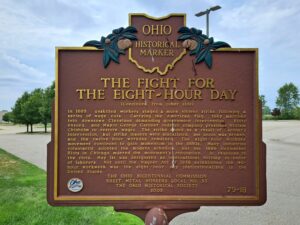
Organized efforts to establish an eight-hour workday existed as early as 1866 in the United States. The Cleveland Rolling Mills Strikes of 1882 and 1885, as part of this almost-70-year struggle, contributed to the establishment of the eight-hour workday. Both strikes challenged the two-shift, twelve-hour workday in addition to seeking recognition of the Amalgamated Association of Iron, Steel, and Tin Workers. The first strike – by English, Welsh, and Irish skilled workers – was at the Newburgh Rolling Mills, a major producer of steel rails for the rapidly expanding railroad industry that once stood near this site. It was quickly broken when unskilled Polish and Czech immigrants, unaware of the ongoing labor dispute, were hired. The strike ended when these new workers did not support the union. (continued on other side)
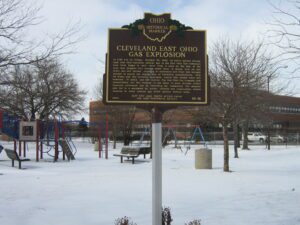
At 2:30 p.m. on Friday, October 20, 1944, an above ground storage tank that held liquefied natural gas in the East Ohio Gas Company’s tank farm began to emit vapor from a seam on the side of the tank that dropped into nearby sewer lines. It mixed with air and sewer gas and ignited, resulting in explosions and fires that brought damage to nearly one square mile of Cleveland neighborhoods. With 79 homes and two factories destroyed, nearly 700 people were left homeless, 131 killed, and 225 injured. The East Ohio Gas Company took responsibility for this tragedy to aid those in need through direct financial assistance and by rebuilding the community. The disaster also led to a movement by public utilities and communities across America to store natural gas below ground without tanks.
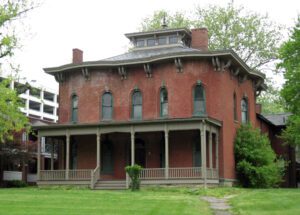
The Cozad-Bates House is one of the oldest remaining structures in Cleveland’s University Circle. The original section, built circa 1853, is the only pre-Civil War residential structure left in the neighborhood. Built by Samuel and Jane Cozad’s son, Andrew Cozad, the first section used locally made brick to form a simple two-story, one-room-deep, vernacular English-I house. The family owned a large portion of the land which is now occupied by University Circle. Justus Cozad, Andrew’s son, returning from the west where he worked as a railroad superintendent and civil engineer, built the later section on Mayfield Road for his larger family in 1872. It is a rare surviving example of Italianate-influenced residential architecture, including a hipped roof, curved bay windows, paired eave brackets, and prominent belvedere. The house was listed on the National Register of Historic Places in 1974 and designated as a Cleveland Landmark in 2006.
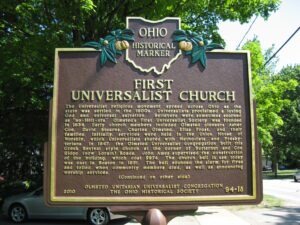
The Universalist religious movement spread across Ohio as the state was settled in the 1800s. Universalists proclaimed a loving God and universal salvation. Believers were sometimes scorned as “no-Hell-ers.” Olmsted’s First Universalist Society was founded in 1834. Early church members included Olmsted pioneers Asher Coe, David Stearns, Charles Olmsted, Elias Frost, and their families. Initially, services were held in the Union House of Worship, which Universalists shared with Methodists and Presbyterians. In 1847, the Olmsted Universalist congregation built this Greek Revival style church at the corner of Butternut and Coe Ridge (now Lorain) Roads. John Ames supervised the construction of the building, which cost $974. The church bell in use today was cast in Boston in 1851. The bell sounded the alarm for fires and tolled when community members died, as well as announcing worship services.
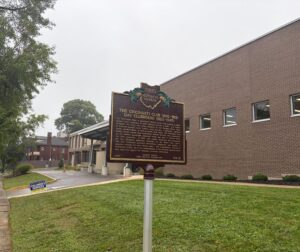
The Cincinnati Club, a prominent Jewish social club founded in 1889, opened their clubhouse at 2840 Melrose Avenue in 1894. A.E. Elzner designed the brick and stone building in the Norman-Gothic style. It featured massive round towers, wide porches, a ballroom, billiard rooms, bowling alley, as well as ornate club rooms. The Cincinnati Club hosted lavish events that celebrated Jewish identity and community. As the Jewish population migrated north and east of Walnut Hills, the club dissolved. In 1922, the vacant clubhouse was purchased by the Disabled American Veterans of the World War (DAV). The DAV Clubhouse provided recreation, resources, and shelter to disabled veterans for over twenty years. The organization, founded in Cincinnati in 1920, led to the establishment of the Veterans Administration and improved support for wounded veterans nationwide.
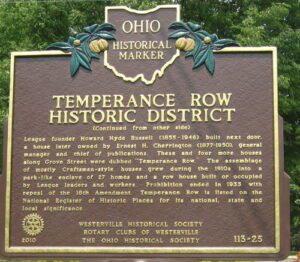
Here lived the reformers of the Anti-Saloon League of America who led the movement that turned the United States “dry” in 1920 with the 18th Amendment prohibiting the manufacture, sale or transportation of intoxicating liquor. Moving its headquarters to Westerville in 1909, the League built a publishing house that buried the liquor industry in a 10-year avalanche of books, pamphlets and periodicals that helped win Prohibition and made Westerville the “Dry Capital of the World.” Rev. Purley A. Baker (1858-1924), the League’s general superintendent, bought 11 acres and erected his rustic home at Park and Grove streets in 1910. (Continued other side)
The Ohio State University Columbus Campus, 2201 Fred Taylor Drive
Columbus
, OH
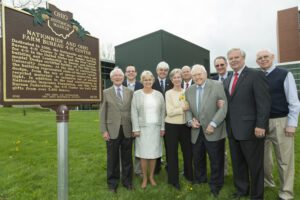
In 1902, Albert Belmont Graham (1868-1960), a school teacher and superintendent, established the Boys and Girls Agricultural Experiment Club in Springfield, Ohio. Graham believed in learning by doing, a concept at the core of 4-H, which stands for Head, Heart, Hands, and Health. In 1905, Graham became the first Superintendent of Agricultural Extension at The Ohio State University and he brought the idea of 4-H with him. 4-H is in all 50 states and over 70 countries, and more than 7 million members enroll annually. One in six Ohioans have been members.