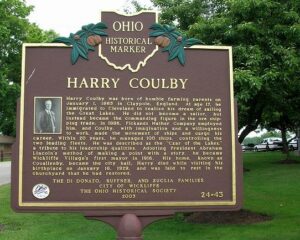
Harry Coulby was born of humble farming parents on January 1, 1865 in Claypole, England. At age 17, he immigrated to Cleveland to realize his dream of sailing the Great Lakes. He did not become a sailor, but instead became the commanding figure in the ore shipping trade. In 1886, Pickands Mather Company employed him, and Coulby, with imagination and a willingness to work, made the movement of ships and cargo his career. Within 20 years, he managed 100 ships, controlling the two leading fleets. He was described as the “Czar of the Lakes,” a tribute to his leadership qualities. Adopting President Abraham Lincoln’s method of making a point with a story, he became Wickliffe Village’s first mayor in 1916. His home, known as Couallenby, became the city hall. Harry died while visiting his birthplace on January 18, 1929, and was laid to rest in the churchyard that he had restored.
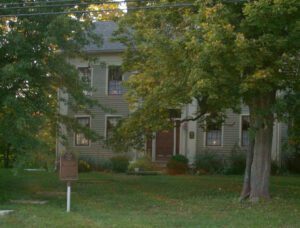
Built in 1819, this classic Greek Revival style colonial is attributed to the works of master builder and architect Jonathon Goldsmith. Goldsmith is known for his simple, yet elegant craftsmanship and architectural designs, especially the unique front doorways that are signatures of his creations. The house reveals original detailed woodwork and a functional floor plan. It was constructed for Uri Seeley, one of the earliest settlers of Lake County. Seeley and his family were dedicated to the anti-slavery movement and used this residence as a stop for travelers on the Underground Railroad. The property was listed on the National Register of Historic Places in 1973.
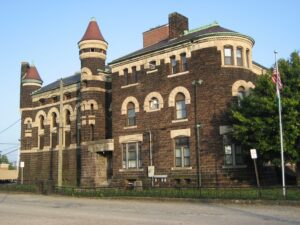
Designed by J. W. Yost, a renowned Ohio architect, the jail first opened for use in 1889. The Richardsonian Romanesque structure cost $120,000 to build. It was constructed of pink sandstone known as “brownstone,” which was quarried near Millersburg, Ohio. The front three levels were built to house the families of the sheriff and the jail matron. Sheriff Andrew Crilly was the first to occupy the sheriff’s quarters when the jail opened. The rear portion of the building was used for the incarceration of male and female prisoners on separate floors. The 32 cells, each a minimum of 8′ x 8′ in size, had an official total capacity of 68 prisoners. However, well over that number were housed here at times. The jail building was last used for incarcerations in 1987. (Continued on/from other side)
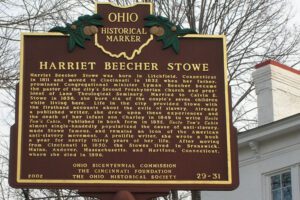
Harriet Beecher Stowe was born in Litchfield Connecticut in 1811 and moved to Cincinnati in 1832 when her father, prominent Congregational minister Lyman Beecher became the pastor of the city’s Second Presbyterian Church and president of Lane Theological Seminary. Married to Calvin E. Stowe in 1836, she bore six of the couple’s seven children while living here. Life in the city provided Stowe with the firsthand accounts about the evils of slavery. Already a published writer, she drew upon these experiences and the death of her infant son Charley in 1849 to write Uncle Tom’s Cabin. Published in book form in 1852, Uncle Tom’s Cabin almost single-handedly popularized the cause of anti-slavery, made Stowe famous, and remains an icon of the American anti-slavery movement. A prolific writer, she wrote a book a year for nearly thirty years of her life. After moving from Cincinnati in 1850, the Stowes lived in Brunswick, Maine, Andover, Massachusetts, and Hartford, Connecticut, where she died in 1896.
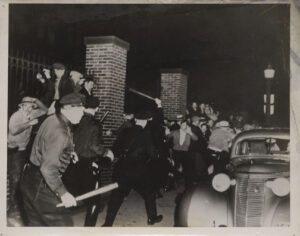
Five Depression-era strikes against many of Akron’s rubber companies culminated in a giant “sit-down” strike against Goodyear Tire and Rubber Company, the industry’s leader, in February and March of 1936. The fledgling United Rubber Workers (URW), created in September 1935, used the tactic of being at work but not working that had been pioneered by rank-and-file workers in a successful 1934 strike against the General Tire and Rubber Company. After a peaceful month-long strike, the URW won recognition from Goodyear and reached a settlement on March 22. The 1936 Akron Rubber Strike was one of the earliest successes for the Committee for Industrial Organization (CIO), sparking a wave of industrial organizing and similar strikes in 1936 and 1937. The “sit-down” strategy extended beyond the rubber industry and was instrumental in the founding of the industrial union movement in the United States.
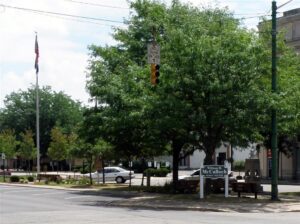
William McCulloch was born in Holmes County where he was educated in a one-room schoolhouse before moving to Wooster to attend high school and the College of Wooster. He attained prominence as Ohio’s Speaker of the House from 1939-1943 and House member from the Fourth Ohio Congressional District from 1948-1973. During his time in Washington, McCulloch was best known as a co-sponsor and staunch advocate of the Civil Rights Act of 1964. He was recognized by President Lyndon Johnson as the prime mover for passage of this landmark legislation. As a conservative Republican voice in the House, he was instrumental in championing other civil rights legislation, including fair housing and public accommodations. McCulloch was a founding partner in 1928 of the Piqua law firm that bears his name.
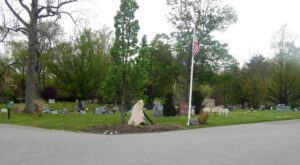
Founded in 1876 by a group of Toledo businessmen, Woodlawn Cemetery was designed in the tradition of the country’s “rural cemetery” movement, which was first popularized in Europe in the 1830s. This movement reflects the change in American burial practices in the nineteenth century as attitudes of death changed from grim to sentimental. The cemetery’s landscape emphasizes nature and art. Besides being a burial place, the cemetery is an arboretum, bird sanctuary, outdoor museum, and historical archive. Woodlawn also became a fashionable park for Toledo’s residents to escape the commotion of the city. The cemetery chronicles the growth of Toledo and northwest Ohio, and is an important cultural and historic landmark in regards to community planning and development, and landscape and building architecture. Historic Woodlawn Cemetery was listed on the National Register of Historic Places in 1998.
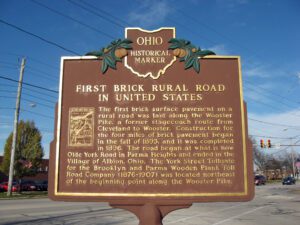
In the late nineteenth century, a movement to improve inadequate plank and dirt roads was brought on by the popularity of bicycling, the introduction of the automobile, and the need to improve travel to and from rural areas. Ohio, as a leader in the manufacture of brick paving blocks, was quick to upgrade roads. Toll roads were waning in popularity and the need for free roads was recognized. An act passed in 1892 authorized Cuyahoga County to levy a road tax. With funds levied, the Commissioners selected the Wooster Pike as one of three road improvement projects.