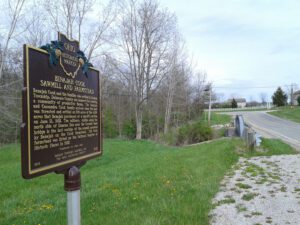
Benajah Cook and the families who settled in Harlem Township, Delaware County are honored for creating a community of productive farms. The Benajah and Cassandra Cook family arrived when the land was forested and settled on 500 acres of the 4,000 acres that Benajah purchased at a sheriff’s auction on June 12, 1807. The millrace, visible along the north side of Duncan Run near the Gorsuch Road bridge is the last vestige of the sawmill operated by Benajah on the Cook farmstead. The Cook farmstead was listed on the National Register of Historic Places in 1977.
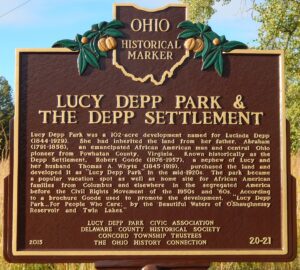
Lucy Depp Park was a 102-acre development named for Lucinda Depp (1844-1929). She had inherited the land from her father, Abraham (1791-1858), an emancipated African American man and central Ohio pioneer from Powhattan County, Virginia. Known historically as the Depp Settlement, Robert Goode (1876-1957), a nephew of Lucy and her husband Thomas A. Whyte (1845-1919), purchased the land and developed it as “Lucy Depp Park” in the mid-1920s. The park became a popular vacation spot as well as home site for African American families from Columbus and elsewhere in the segregated America before the Civil Rights movement of the 1950s and 60s. According to a brochure Goode used to promote the development, “Lucy Depp Park…For People Who Care; by the Beautiful Waters of O’Shaughnessy Resevoir and Twin Lakes.”
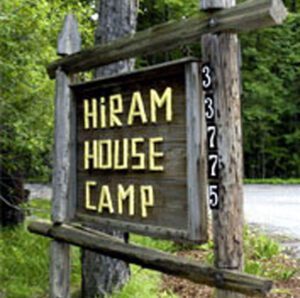
Hiram House was Ohio’s first settlement house and among the earliest in the nation, opening in October 1896 in Cleveland’s Whiskey Island neighborhood. Representing the ideals of a late-1800s urban progressive movement, settlement houses provided–through “service, not charity” –health, recreational, and self-development opportunities that were not widely available in this era. Founded by Hiram College divinity graduate George A. Bellamy (1872-1960), Hiram House administered a wide range of social services for people of different ethnic and economic backgrounds. Bellamy established the “Fresh Air Camp” circa 1900; Cleveland industrialist Samuel Mather donated this tract of land in 1903. In continuous operation since its founding, Hiram House has provided outdoor experiences and educational programs for thousands of Ohio children.
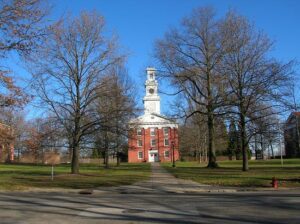
With the help of town founder, David Hudson, Western Reserve College and its Academy were founded in 1826. Often called “The Yale of the West,” the college saw success initially as all of its professors and college presidents were Yale College graduates. Nationally, Western Reserve College became involved with the Underground Railroad and anti-slavery movement 28 years before the Civil War began. Moreover, Western Reserve College established the Loomis observatory, named for Elias Loomis, a Yale tutor and WRC professor, which is now the second oldest observatory in the United States. The Western Reserve College moved to Cleveland in 1882 and eventually became Case Western Reserve University while the Academy remained in Hudson. Today, the Western Reserve Academy is one of the nation’s oldest and most respected independent college preparatory schools.
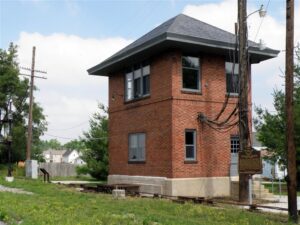
The Bradford or “BF” Tower was built by the Pennsylvania Railroad circa 1929, at the important site of Bradford Junction. It replaced an earlier wooden tower that stood to its west. From this building, operators controlled the movement of every train, aligned track switches, set the track side signals, and relayed messages to the crews in the locomotive and caboose of passing trains. The tower originally housed a desk, telegraph equipment, and the all-important railroad clock. Its core housed many steel throw-arms, known as Armstrong levers. These were hand thrown, connecting track switches and signals via pipes throughout the junction area. The operator telegraphed other outlying towers and dispatching centers in Columbus, Ohio and Indianapolis and Logansport, Indiana. Railroad telephones appeared during the late 1920s and radios just after World War II. The tower was closed January 3, 1984. This is an example of the once common railroad interlocking tower that dotted railroads throughout Ohio and the United States.
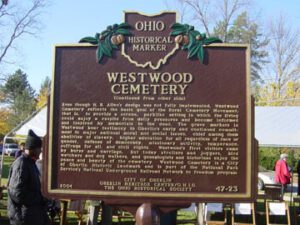
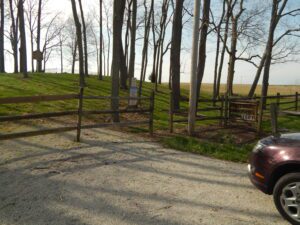
Shortly after Oberlin Colony was established in 1833, a two-acre burying ground was set aside south of Plum Creek in the area bounded by Main, Morgan, and Professor streets. By 1861, however, with the town and Oberlin College growing and the Civil War escalating, the need for a larger cemetery became clear. After an extensive search, 27.5 acres of land belonging to Henry Safford were acquired one mile west of the center of Oberlin. H.B. Allen was hired to create a design in the style of the Rural Cemetery Movement, and in July 1864 Westwood Cemetery was formally dedicated. Burials in Westwood had actually begun in August 1863, and over the next few years hundreds of remains were reinterred from Oberlin’s “Old Cemetery” and from burying grounds in surrounding communities. In the mid-1860s the cemetery was enlarged to its present 47 acres, and in 2004 burials and memorials were estimated to number almost ten thousand. (Continued on other side)
In the early years of the nineteenth century, a religious unrest known as the Second Great Awakening spread across much of the American frontier. Among the most influential of the evolving religious organizations were the Campbellites, or Disciples of Christ, founded in the 1820s by Thomas and Alexander Campbell. The Campbellite movement sought to “restore” New Testament Christianity by calling for a return to the primitive church revealed in the gospels. Campbellites denied creeds and oath-taking and rejected sectarianism. They believed in baptism by immersion and communion on Sundays. Followers also dealt with problems and transgressions of members within the church and did not use civil courts. They held a millennial view that professed human happiness and the belief that Christ would reign on earth for a thousand years. Believers spread this word to the pioneers of the Doty Settlement and elsewhere. By 1850, there were ninety Campbellite Churches in Ohio.
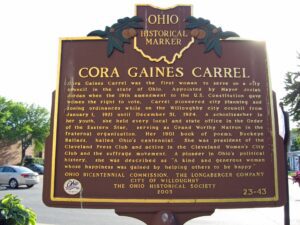
Cora Gaines Carrel was the first woman to serve on a city council in the state of Ohio. Appointed by Mayor Josiah Jordan when the 19th amendment to the U.S. Constitution gave women the right to vote, Carrel pioneered city planning and zoning ordinances while on the Willoughby city council from January 1, 1921 until December 31, 1924. A schoolteacher in her youth, she held every local and state office in the Order of the Eastern Star, serving as Grand Worthy Matron in the fraternal organization. Her 1901 book of poems, Buckeye Ballads, hailed Ohio’s centennial. She was president of the Cleveland Press Club and active in the Cleveland Women’s City Club and the suffrage movement. A pioneer in Ohio’s political history, she was described as “A kind and generous woman whose happiness was gained by helping others to be happy.”