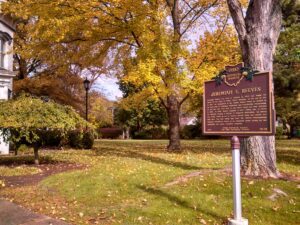
Jeremiah Reeves was born in England in 1845 and began his career in the mills of Wales, United Kingdom, at the age of ten. In 1867, he immigrated to the United States where he worked in the steel mills of Cleveland, Pittsburgh, and Connellsville, Pennsylvania. He met his wife Jane Rees in the latter place and they married in 1869. In 1883, Reeves acquired a steel rolling mill in Dover for $14,000. Despite a history of financial difficulties, the Reeves Iron Works would go on to expand several times and employ over 800 men. The iron works and later the Reeves Manufacturing Company established Dover as an industrial center during the late nineteenth and early twentieth centuries.
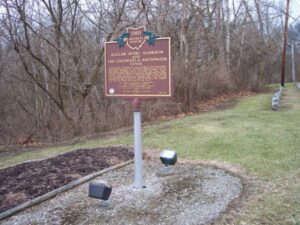
In 1837, Cincinnati merchants projected a branch canal to join the Whitewater Canal at West Harrison, Indiana, with the goal of tapping commerce from Indiana’s Whitewater Valley. The major obstacle on this route was the ridge between North Bend and Cleves, just northeast of this site. Engineer Darius Lapham designed a 1,782-foot tunnel though this barrier. Lined with brick made on site, the tunnel, 24 feet wide and 20 1/2 feet high, was the first canal tunnel in Ohio. Six workers died in its construction. The Cincinnati & Whitewater Canal opened in 1843 but was abandoned by 1856, after the main Whitewater Canal had been rendered useless by repeated flooding. The canal tunnel was subsequently used as a railroad tunnel from 1863 until 1888, illustrating the progression of transportation technology in the mid-nineteenth century.
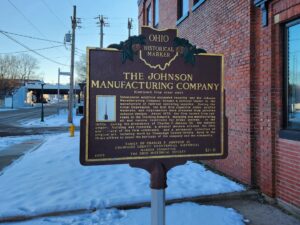
The Johnson Manufacturing Company was incorporated in 1902 by brothers James B., J. Will, Isaac T., and Charles F. Johnson, all of Quaker heritage. The company manufactured tin and galvanized iron ware for railroad lines across the United States. The initial product was the No. 1 long-spouted locomotive oiler with the patented dripless spout. That was quickly followed by other types of oil cans, signaling equipment, engine buckets, tallow pots, torches, track inspection devices, tin cups, and caboose and cabin car lamps, all carrying the Diamond J trademark. The makers created the patterns and everything was cut, riveted, and soldered by hand. As production expanded, the original frame building at 605 Miami Street was replaced by a brick structure in 1910, the southernmost part of the present building. (continued on other side)
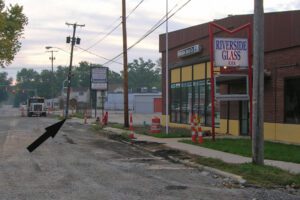
In 1884, the first natural gas well was successfully drilled in Findlay, and when The Great Karg Well, then the largest in the world, was drilled in 1886, the boom was on. Many industries, especially glass, were attracted to Findlay, lured by free or cheap gas for fuel. They included eight window, two bottle, two chimney lamp, one light bulb, one novelty, and five tableware glass factories. Famed manufacturing pioneer and inventor Mike Owens (later associated with Owens Illinois) managed the Richardson Glass Works, located at this site in 1891-1892. Tableware glass companies included Bellaire Goblet (1888-1892), Columbia Glass (1886-1892), Dalzell, Gilmore & Leighton (1888-1901), Findlay Flint Glass (1889-1991), and Model Flint Glass (1888-1893). Tableware companies employed women as decorators and packers. Hundreds of skilled glassworkers came from the eastern states of America, as well as Europe, especially Belgium, France, and Germany. Bottle glassworkers were among the first workers to unionize and to use collective bargaining.
The Mustill house and store are survivors of Akron’s canal era and date to the 1840s. Joseph and Sarah Mustill moved their family from England to Akron in 1833 and owned the store and Greek Revival house at Lock 15 on the Ohio & Erie Canal. Three generations of Mustills lived and worked the grocery business at Lock 15, first Joseph and Sarah, then their son Fred with his wife Emma, and their children Maria, Frederick, Edwin and Franklin. A popular place to buy or barter goods, the store served canallers, farmers, craftsmen, and neighbors for many years.
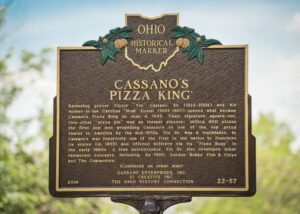
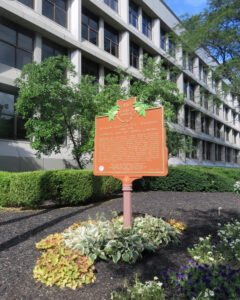
Kettering grocer Victor “Vic” Cassano, Sr. (1922-2002) and his mother-in-law Caroline “Mom” Donisi (1893-1987) opened what became Cassano’s Pizza King on June 4, 1953. Their signature square-cut, thin-crust “pizza pie” was an instant success; selling 400 pizzas the first day and propelling Cassano’s to one of the top pizza chains in America by the mid-1970s. Vic Sr. was a trailblazer, as Cassano’s was reportedly one of the first in the nation to franchise its stores (in 1955) and offered delivery via its “Pizza Bugs” in the early 1960s. A true entrepreneur, Vic Sr. also developed other restaurant concepts, including, by 1980, London Bobby Fish & Chips and The Commodore. (Continued on other side)
Industrialist and entrepreneur Franklin Augustus Seiberling (1859-1955) named his fledgling rubber goods manufacturing company “Goodyear” to honor Charles Goodyear, the man who invented the vulcanization process for curing rubber. Seiberling founded the company with his brother, Charles Willard, because of their desire to participate in an enterprise that afforded an “opportunity for invention.” Incorporated in 1898, Goodyear Tire and Rubber Company rapidly grew with the young automotive industry and helped establish Akron as the “Rubber Capital of the World.” Among Seiberling’s many significant inventions were the tire-making machine and the detachable wheel rim. He resigned from Goodyear in 1921 and went on to found the Seiberling Rubber Company. Stan Hywet Hall, F.A. Seiberling’s estate in west Akron, is a National Historic Landmark.
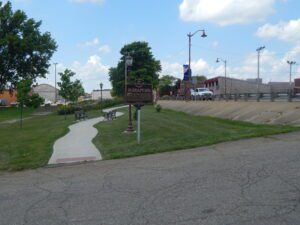
NW corner of N Tuscarawas Avenue and W Front Street
Dover
, OH
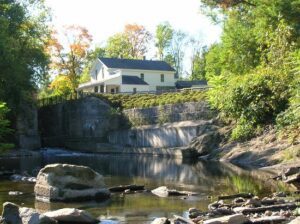
Christian Deardorff (1781-1851) with his brother-in-law Jesse Slingluff (1775-1836) platted and founded Dover and built the area’s first gristmill on Sugar Creek. With the coming of the Ohio and Erie Canal to Dover, Deardorff lobbied successfully to make Dover a toll stop for the canal and the be afforded a source of water power for his mill. A dam built on Sugar Creek obstructed for the mill there. Deardorff received access to the canal near Tuscarawas Avenue, and there erected a mill, later named the Cascade Mill by the Hardesty brothers when they purchased it in 1872. The Hardestys, from Carroll County, came to Dover in the 1860s and began operating a large mill on the Calico Ditch, near the foot of 2nd Street. The Dover Milling Company bought the last Hardesty-owned mill in 1951.