Thomas Burk Sr. purchased a quarter section of federal land here in 1804. A school house was erected on this purchase in 1809. That same year, a road from Williams’ Mill (Millville) was blazed and a saw mill was built on Indian Creek west of this marker. Obadiah Welliver opened a tavern on his purchase in 1812. Burk sold his grist mill in 1818 and it is thought that the hamlet around this mill was called Dogtown because of a vicious dogfight there. In 1825, Reily Post Office was established at Welliver’s Tavern. That year a woolen mill with textile production machinery was built by Elias Sayres, near the saw mill. Multi-millionaire Elias Jackson (“Lucky”) Baldwin (1828-1909), the founder of Santa Anita Racetrack near Los Angeles, was born here.
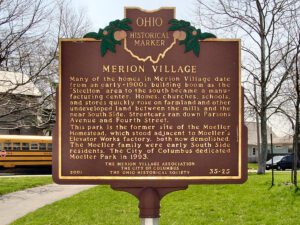
Merion Village was named for the Nathaniel Merion family, who in 1809 settled what is now the South Side of Columbus on 1800 acres of the Refugee Lands. Entrepreneur William Merion operated “Merion’s Landing” in the 1830s to capitalize on the canal trade from the Columbus Feeder Canal. This area saw a large influx of German immigrants as the South Side industrialized in the mid-nineteenth century. Later, many Irish, Italian, and eastern European immigrants who worked in the local steel mills and foundries made their homes here.
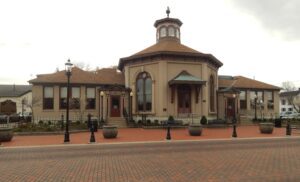
Clark Lane (1823-1907), industrialist and philanthropist, was a son of John Lane (1793-1880) and Rosanah Crum (1795-1877). John came with his family to the Ohio Country when it was still part of the Northwest Territory. As a young man, Clark worked in his family’s blacksmith shop, and eventually helped found Owens, Lane & Dyer Machine Company in 1854. It built agricultural machinery, sawmills, papermaking machines, and other products, initiating Hamilton’s prominence in metals manufacturing. Lane funded the Butler County Children’s Home, an orphanage for over a century, and constructed an octagon house as his residence on Third Street. He built this library in 1866, also as an octagon, and donated it to the people of Hamilton. A 19th century admirer wrote, “The name and generous deeds of Clark Lane will never fade from the memories of a grateful people who have been recipients of his favor.”
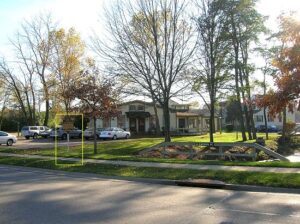
On this site in 1882, Gustave H. Grimm (1850-1914), a German immigrant tinsmith, established the G.H. Grimm Manufacturing Company. His device, the Champion Evaporator revolutionized maple syrup production with the use of a corrugated pan which increased the efficiency of evaporating liquids such as saps. Grimm’s business became the world’s leading manufacturer of maple supplies. His contributions as an inventor, researcher, and manufacturer established him as a leader in the maple sugar industry.
In 1934, workers at the Electric Auto-Lite Company and other automotive-related manufacturers secretly organized the Automobile Workers Federal Union Local 18384, American Federation of Labor (AFL), which became the United Auto Workers (UAW) Local 12. Anti-unionism, broken pledges by management, and abuse of workers had festered locally for generations. Workers bitterly resented the fact that management took advantage of the Depression’s high unemployment to decrease wages. In February, workers struck at Auto-Lite, Bingham Stamping, Logan Gear, and Spicer Manufacturing Company. When management refused to negotiate in good faith, the workers, including a large number of women, struck the Auto-Lite in mid-April. Auto-Lite management secured a court order limiting the number of strikers to twenty-five. The strike appeared to be lost until the Lucas County Unemployed League organized fierce resistance to the court injunction as the crowd around the plant grew to ten thousand. (continued on other side)
In 1879, local hardware store owners L.W. Loomis and H.E. Parks established a summer resort at Front Street and Prospect Avenue. The High Bridge Glens and Caves park spanned both sides of the Cuyahoga River and featured a dance and dining pavilion, scenic trails and overlooks, cascades and waterfalls, deep caverns, curious geological formations, and a suspension footbridge. The park also offered several manmade attractions, including what is believed to have been one of the earliest roller coasters in the area. At the height of its popularity, the park attracted more than 8,000 visitors a day, including Congressman (later president of the United States) William McKinley. (continued on other side)
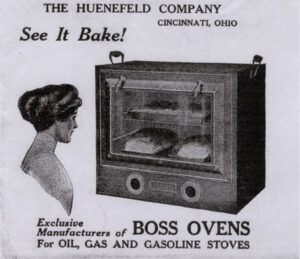
The first full-size glass door oven was invented and manufactured here by Ernst H. Huenefeld of The Huenefeld Company in 1909. Specially designed and patented sheet metal frames in the door allowed for expansion and contraction of the glass. The large window, guaranteed against steaming up or breaking from heat, allowed users to view their baking without opening the oven door. Huenefeld had acquired this property in 1903 for a new factory. The Huenefeld Company, established in 1872 on Pearl Street, moved its manufacturing here in 1904 from its downtown Cincinnati locations. The company, in operation until its sale in 1966, was widely known as a manufacturer of ranges, stoves, ovens, heaters, furnaces, refrigerators, washing machines, and other household products. A standard feature in homes today, the glass door oven was a technological breakthrough in 1909.
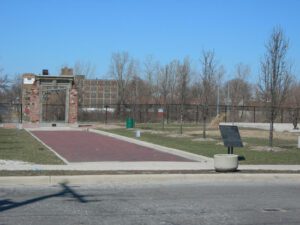
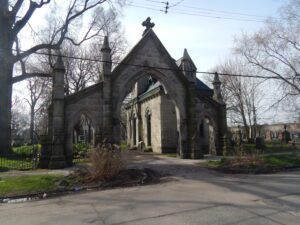
In January 1836, Barber and Lord sold a six-acre parcel for $160 that was to be used “forever as a public burying ground.” When Ohio City incorporated, the township cemetery became the city cemetery. Ohio City’s council established the cemetery’s rules and regulations, appointed a sexton, arranged for the ground to be platted, and purchased a hearse. After annexation by Cleveland, the cemetery became known as “the west side cemetery” and, later, the Monroe Street Cemetery. Under Cleveland’s charge, the cemetery was landscaped, protected by patrolmen, and fenced to keep out wandering hogs. Until the late 1890s, Monroe Street was the only public cemetery on Cleveland’s west side. Architect Joseph Ireland designed the cemetery’s Gothic Revival gateway arch (1874). Architect Walter Blythe designed the cemetery’s gatehouse, also in the Gothic Revival style (1876).