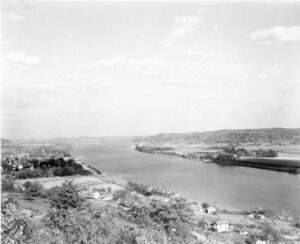
On April 1, 1818, six families from the Cilcennin area of Mid-Wales sailed from Aberaeron, Wales to Baltimore. The group of 36 people was led by John Jones Tirbach. From Baltimore they traveled to Pittsburgh and then by flatboats down the Ohio River toward their destination-Paddy’s Run in Butler County in the southwest corner of Ohio. They stopped in Gallipolis for provisions where their boats were cut loose by either travel-weary women or citizens of Gallipolis who wanted them to stay. The men found work on the Gallipolis to Chillicothe road that was under construction. The terrain reminded them of Mid-Wales, so they purchased land near Centerville and remained. These Welsh prospered and wrote home to Wales with news of their success, prompting others to come. (continued on other side)
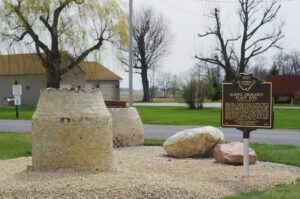
On March 2, 1942, four months after the U.S. entered WWII, farmers living between Marion-Williamsport and Marseilles-Galion Roads and between State Route 98 and the Norfolk & Western Railroad were notified to vacate their farms by the first of May. This displaced approximately 126 farm families from over 12,600 acres so that a munitions factory could be built. The site included the administration area, cafeteria, fire and police stations, and a hospital, in addition to the widely dispersed powder houses and the production lines. Manufacturing began in the fall of 1942. The plant’s operators included U.S. Rubber, Atlas Powder, the Permanente Metals Division of the Kaiser Corporation, Kilgore Manufacturing, and Ferro Enamel, who made bombs until August 14, 1945 — VJ Day. (Continued other side)
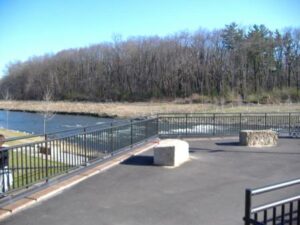
Officially opening on August 4, 1840, the Pennsylvania and Ohio Canal followed the route of present railroad tracks through Munroe Falls approximately one thousand feet south of this marker. This 82-mile long "feeder canal" connected the Beaver Valley canal system at New Castle, Pennsylvania with the Ohio and Erie Canal in Akron, thereby linking Pittsburgh with Cleveland and the western Great Lakes. Many communities along the canal’s path became linked to national and world commerce through their establishment as canal ports. New England investor Edmund Munroe purchased property and water rights along the canal’s proposed route, and in 1837 established the Munroe Falls Manufacturing Company. The village of Munroe Falls grew around the manufacturing company site and was incorporated on October 26, 1838. When this section of the canal closed in 1869, the waterway through Munroe Falls was filled and railroad tracks were laid over its path. A portion of the canal bed is still visible east of State Route 91.
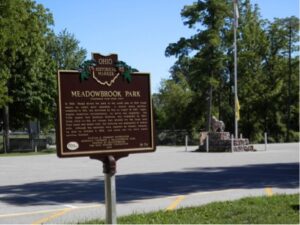
Meadowbrook Park began as a Tiffin, Fostoria & Eastern Electric Railway plan to draw weekend riders. Laura Stephenson Sneath, wife of a major company stakeholder, led the park development. Originally north of Wolf Creek, Meadowbrook included a baseball diamond and a 1902 dance pavilion. In 1923, William Richards purchased the buildings and leased the land from Henry Matthews of Matthews Boat Company. The pavilion was destroyed by fire under suspicious circumstances on October 12, 1925, but no one was charged. James Garfield Haugh, president of the Gem Manufacturing Company, purchased the land in 1925. (Continued on other side)
Attracted by the availability of raw materials and railroad transportation, the Pittsburgh Plate Glass Company (PPG) built a plant here in 1899 to make soda ash for the company’s glassmaking operations. This plant began production in 1900 as the Columbia Chemical Company and represents the beginning of PPG’s diversified chemical manufacturing operations. During the 20th century this plant operated the world’s deepest (at 2,200 feet) limestone mine and manufactured commodity chemicals such as chlorine, caustic soda, and calcium chloride. By 2000, manufacture of specialty chemicals for the optical, pharmaceutical, printing, and rubber industries superseded mining and commodity chemical manufacturing. PPG’s reclamation of its former soda ash waste disposal sites, known as “lime lakes,” has won recognition for environmental stewardship.
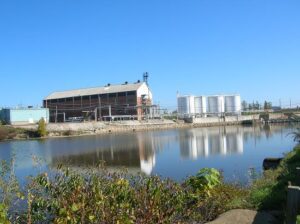
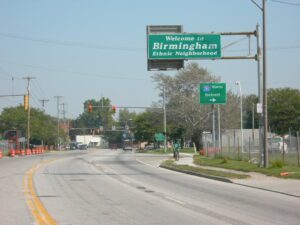
The Birmingham and Ironville neighborhoods were so named because of their early iron industries located along Front Street and the Maumee River. This became Toledo’s first area of heavy industrial development with iron manufacturing, coal shipping, oil refining, shipbuilding, and flour milling operations. In 1864 the Manhattan Iron Company built a charcoal blast furnace near the river’s mouth, securing fuel from nearby forests.
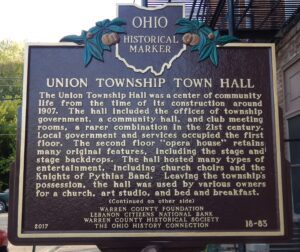
The Union Township Hall was a center of community life from the time of its construction around 1907. The hall included the offices of township government, a community hall, and club meeting rooms, a rarer combination in the 21st century. Local government and services occupied the first floor. The second floor “opera house” retains many original features, including the stage and stage backdrops. The hall hosted many types of entertainment, including church choirs and the Knights of Pythias Band. Leaving the township’s possession, the hall was used by various owners for a church, art studio, and bed and breakfast.(Continued on other side)
791 Farmview Rd (located on OH 588 just off US Route 35)
Bidwell
, OH
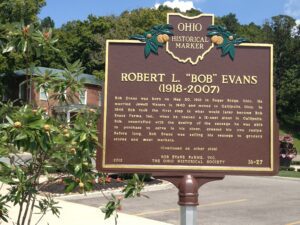
Bob Evans was born on May 30, 1918 in Sugar Ridge, Ohio. He married Jewell Waters in 1940 and moved to Gallipolis, Ohio. In 1946 Bob took the first step in what would later become Bob Evans Farms, Inc., when he opened a 12-seat diner in Gallipolis. Bob, unsatisfied with the quality of the sausage he was able to purchase to serve in his diner, created his own recipe. Before long, Bob Evans was selling his sausage to grocery stores and meat markets.