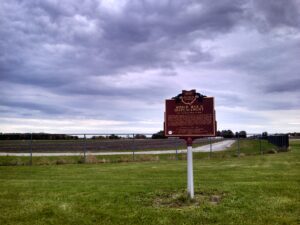
During the early months of World War II, ordinary citizens as well as soldiers made enormous sacrifices for the war effort. In March 1942 the War Department announced plans to build a 13,000-acre munitions manufacturing complex northeast of Marion. Using the power of eminent domain, the U.S. Government purchased the homes and farms of 126 families in the Likens Chapel community. Given only two months to vacate their property, many displaced farmers found the government-appraised values for their land inadequate for buying similar farms elsewhere and the growing season too advanced to plant new crops. (continued on other side)
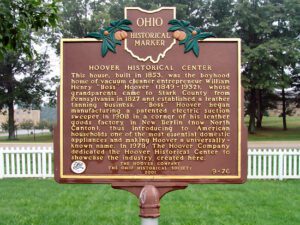
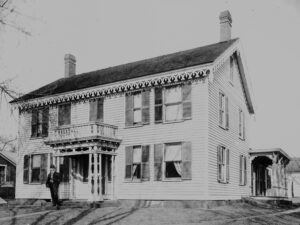
This house, built in 1853, was the boyhood home of vacuum cleaner entrepreneur William Henry “Boss” Hoover (1849-1932), whose grandparents came to Stark County from Pennsylvania in 1827 and established a leather tanning business. “Boss” Hoover began manufacturing a patented electric suction sweeper in 1908 in a corner of his leather goods factory in New Berlin (now North Canton), thus introducing to American households one of the most essential domestic appliances and making Hoover a universally-known name. In 1978, The Hoover Company dedicated the Hoover Historical Center to showcase the industry created here.
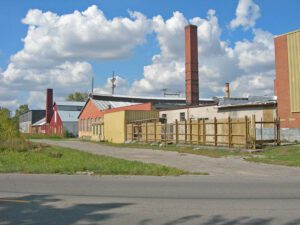
First organized as the Kenton Lock Manufacturing Company in 1890, the Kenton Hardware Company became one of the world’s largest cast iron toy factories. Under the management of L.S. Bixler, toy stoves, banks, fire company outfits, horse drawn vehicles, automobiles and cap pistols were produced. The immensely popular Gene Autry cap pistol was produced at this plant beginning in 1938. The Company ceased production in 1952 but Kenton toys continue to be popular collectors items worldwide.
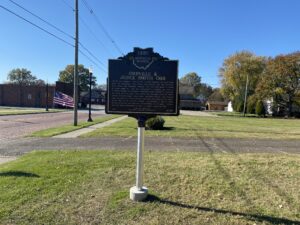
Orrville was founded in 1852 at the railroad crossing that would later serve the Pittsburgh, Fort Wayne and Chicago and the Columbus, Mount Vernon and Cleveland railroads. The town was named in honor of Judge Smith Orr, who was instrumental in bringing the railroad to Wayne County. Orr persuaded landowner Robert Taggart to partition ten acres into town lots. After buying out the land owned by fellow settlers Christian Horst, David Rudy, and Peter Perrine, Orr engaged Jesse Straughan to create the first plat map that centered the newly-formed town on the railroad crossing. Incorporated on May 9, 1864, Orrville prospered and attracted manufactories of all kinds. Orrville was the largest manufacturing town in Wayne County by 1873.
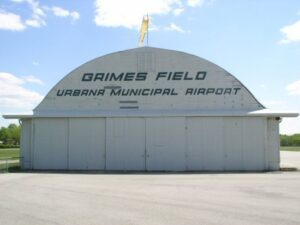
Raised in an Ohio orphanage, Warren G. Grimes (1898-1975) ran away after finishing the ninth grade and at age 16 went to work for the Ford Motor Company in Detroit. He later became a partner in an electrical business where he was instrumental in designing and developing the first lights for the Ford Tri-Motor airplane. In 1930 Grimes moved to Urbana and founded a small lighting fixture plant, Grimes Manufacturing. The inventor of the familiar red, green, and white navigation lights found on the wing tips and tails of aircraft, Grimes, known as the “Father of the Aircraft Lighting Industry,” also developed other aircraft fixtures, including landing, instrumental, and interior lights. Every American-made airplane flown during World War II was equipped with Grimes lights. Grimes served as mayor of Urbana and chairman of the State of Ohio Aviation Board.
The Johnson House was built in 1852 and its first owner was Henry J. Traver (1827-1911), owner of Traver & Company carriage factory across the street. From 1877 until 1994 the house was the residence and office of four doctors who maintained their practices there. The first was Dr. Daniel Cranz (1854 — 1914); followed by Dr. Thomas Ritter (1855—1928). In 1900, Dr. Robert Johnson (1878 — 1952) purchased the house. His daughter Dr. Myra Johnson (1909 — 1994) took over the practice after he died and until she retired in 1976. After her death, the house was converted into a museum. It is operated by the Wadsworth Area Historical Society and owned by the City of Wadsworth. (Continued on other side)
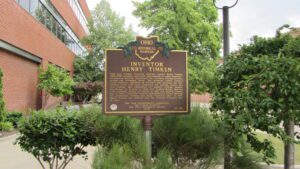
Born near Bremen, Germany, carriage builder Henry Timken (1831-1909) designed significant improvements in roller bearings–fundamental machine components that minimize friction between moving and stationary parts. His patented (1898) tapered roller bearings improved on standard ball bearings by controlling heavy side loads generated by steered axles, and thus became key components of modern vehicle design. Established in St. Louis in 1899, the Timken Roller Bearing Axle Company moved to Canton in 1901 and quickly became one of Ohio’s industrial leaders, manufacturing roller bearings for automotive, railroad and many industrial uses. In 1998, Henry Timken was inducted into the National Inventors Hall of Fame.
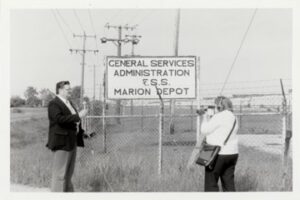
Early in 1942, during World War II, the U. S. Army Corps of Engineers acquired 640 acres along two miles of U. S. Route 30 South (now State Route 309) from ten landowners. By June 11 of that year, the farm families were removed and construction of The Marion Engineer Depot (MED) began, costing $4 million. The first military encampment in Marion County, the 333rd Engineering Regiment, arrived in May and established its camp in a wheat field. They lived in tents while constructing streets and railroad tracks around the Depot. MED was dedicated on December 7, 1942. During the war, food, munitions, equipment, and other military supplies flowed in and out of MED and heavy machinery was renovated. Peak employment came in July 1944 with 1,487 civilian and 47 military personnel on site. (Continued on other side)