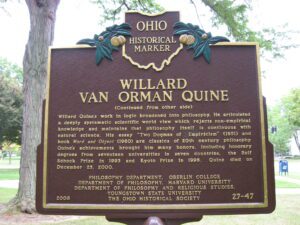
Willard Van Orman Quine was one of the greatest philosophers and logicians of the 20th century. Born in Akron on June 25, 1908, Quine studied philosophy and logic at Oberlin College (B.A. 1930). He received his Ph.D. in philosophy from Harvard University in 1932 and spent his entire career on the Harvard faculty, from 1956 to 1978 as Edgar Pierce Professor of Philosophy. Quine’s early research in logic led to his New Foundations system of set theory and to the Quine-McCluskey algorithm, used in computer science. His textbook Methods of Logic established the standards for undergraduate logic instruction. (Continued on other side)
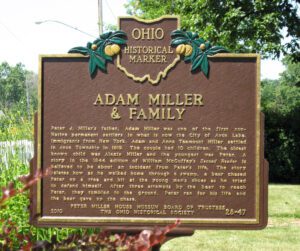
The Peter J. Miller House was constructed around 1830 and is one of the last remaining pre-Civil War lakefront houses in Lorain County. The architecture is Greek Revival. Peter Miller married Ruth Houseworth in 1828. They had five children. In 1851 Peter Miller died and it’s believed that his family continued to reside on the property until 1925. The City of Avon Lake purchased the property in 1962. The house was opened for tours, and restoration proceeded, as funds were available. In 1975 the water heating system burst and caused extensive damage. In 1985 a new committee took over and was successful in restoring the house. Volunteer trustees have overseen the operation of the house as a museum since September 1989.
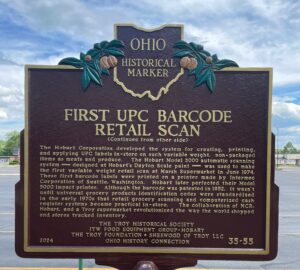
On June 26, 1974, the first retail scan of a product marked with a Universal Product Code (UPC or barcode) was made in the checkout line of Troy’s Marsh Supermarket located at 982 N. Market Street. A ten-pack of Wrigley’s Juicy Fruit chewing gum was scanned to simulate the purchase of a product. The barcode was scanned on the NCR 255 computerized check-out system developed by National Cash Register (NCR). The system featured a Spectra Physics Model A scanner and an NCR 726 in-store computerized cash register. The Troy grocery store, considered a “typical” American grocery, was conveniently located near NCR and Hobart facilities. Spectra Physics and NCR later donated one of the original scanners and cash registers used at Marsh’s to the National Museum of American History, Smithsonian. (Continued on other side)
Toledo’s first fire station was built in November 1837 one city block due north of this site at the southwest corner of Cherry Street and Eagle Lane at 519 Cherry on what is now the driveway for the Goodwill Industries Building. It was a small non-descript, wooden building, built by contractors Hoisington and Manning for $78. It was replaced by a two-story brick building with tin-clad window sills and trim in December 1854. With fire trucks becoming larger and heavier, it was necessary to construct a new building in 1872 at a cost of $7000. Designated Station No. 2, it remained in service until 1953 when the new headquarters station at Huron and Orange streets was dedicated. It disappeared for good during the Urban Renewal projects of the late 1950s and 1960s.
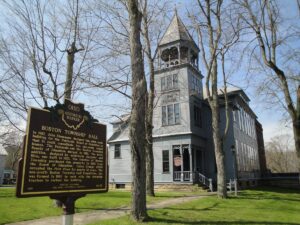
In 1887, John Eisenmann designed this stick-style building for the Peninsula Board of Education so that it could consolidate two one-room school houses. The Peninsula and the Boston Township Boards of Education merged in 1919. The brick addition, designed by architects Harpster and Bliss, was built in 1920. The trustees of Boston Township purchased this property in 1939 from the Board of Education. Union Grange #2380 occupied the first floor for nearly 50 years. The non-profit Boston Township Hall Committee, Inc. was formed in 1990 to work with the township trustees to restore the building.
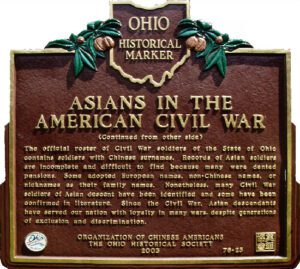
Despite exclusionary laws preventing U.S. citizenship, Asians served in the Union and Confederate armies and navies during the American Civil War (1861-1865). Many of these soldiers were denied citizenship following their services due to the anti-Asian sentiment, which culminated in the Naturalization Act of 1870 and the Chinese Exclusion Act of 1882. The exclusionary laws continued until 1943, and all restrictions on national origin or race were abolished in 1965. In April 2003, House Joint Resolution 45 was introduced to Congress to posthumously proclaim Civil War soldiers of Asian descent to be honorary citizens of the United States as recognition of their honorable services. (continued on other side)
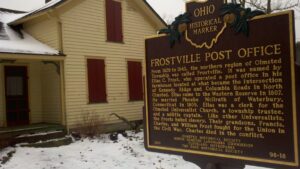
The North Olmsted Historical Society was founded in 1953 and became incorporated as a non-profit association in 1961. A year later, Frostville Museum opened in the Prechtel House. The society took on the challenge of preserving the history of the entire original township and became the Olmsted Historical Society in 1969. The Frostville Museum has grown from one house to a small village. Volunteers are dedicated to preserving the past and the present for the future. In August 2010, First Lady Michelle Obama designated the society as a Preserve America Steward. Frostville is an affiliate of the Cleveland Metroparks.
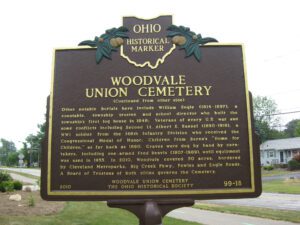
Woodvale Cemetery was established in the mid-1800s, in Middleburgh Township, Ohio. The oldest marked grave holds Fred G. Klink (1835-1858), whose family donated a half acre of land for burials. In 1876, Frank M. Stearns (1832-1911) suggested the unnamed cemetery be called Woodvale, after the wooded vale beside it. In 1908, a fire destroyed the caretaker’s house and many cemetery records. Woodvale became a non-profit, union cemetery in 1931, owned by Berea and the Village of Middleburg Hts. and covering 35 acres at 7535 Engle Road. Pioneer families buried here: Fowles, Kraft, Lovejoy, Sprague, and Stearns. Also buried here: John Baldwin (1799-1884) founder of Baldwin University and James Wallace (1878-1953) founder of German Wallace College (merged in 1913 to become Baldwin Wallace College) (Continued other side)