

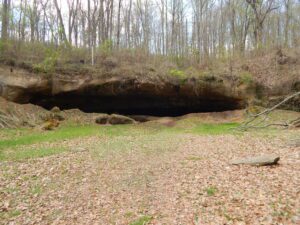
, OH
On a forested hillside south of New Straitsville, the spacious 1000 square foot Robinson’s Cave offered a secluded location with great acoustics where large groups of Hocking Valley coal miners could meet in secret. Beginning in about 1870, labor-organizing meetings were held at the cave by various emerging unions including the Knights of Labor. New Straitsville resident Christopher Evans, a well-known union organizer, used Robinson’s Cave to lead miners throughout the long Hocking Valley Coal Strike of 1884-1885. These meetings gave the miners a voice in the formation of a national organization called the National Federation of Miners and Mine Laborers, later renamed the National Progressive Union. The cave was also where non-union miners met to plan to set the Columbus & Hocking Coal & Iron Company mines on fire in a desperate attempt to end the Hocking Valley Strike. [continued on other side]
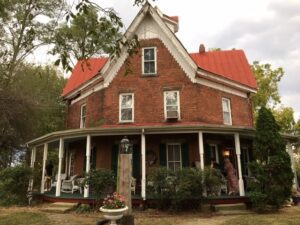
, OH
Zimmerman-Bury Octagon House. The Zimmerman-Bury Octagon House was built by Ezekiel B. Zimmerman (1843-1935) and Francis B. Hess Zimmerman (1848-1920) in 1883. Ezekiel graduated from Smithville Academy and was an avid reader. One of Ezekiel’s sons, Ernest Zimmerman (1888-1973), remembered that his father had encountered Orson Fowler’s manifesto A Home for All, or the Gravel Wall and Octagon Mode of Building (1853) and surmised that his father patterned the house after Section V of the book. The approximate 99,000 bricks comprising the house were made on the property, creating exterior walls and a center stairway which are three bricks or about 12 inches thick. Ernest noted the house’s “Russian Tin” roof, referring to its metal standing seam construction. The roof and architectural ornament make the house stand out compared to other octagon structures in Ohio. (Continued on other side)
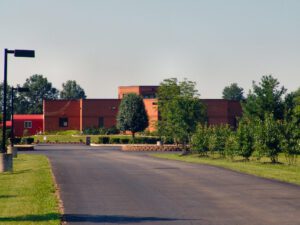
, OH
In 1985, Hindu immigrants from India formed a celestial organization, The Bharatiya Temple Society of Central Ohio, and through its membership adopted the Constitution and Bylaws and named the place of worship Bharatiya Hindu Temple. Later they bought a house at 3903 Westerville Road in Columbus for prayer and worship. In 1994, the membership moved to the current location and built this temple to serve the religious, spiritual, educational, and cultural needs of those who wish to live an active peaceful life in accordance with the Vedic dharma, philosophies, and traditions.
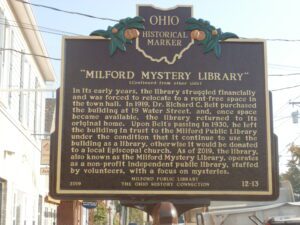
, OH
The Milford Public Library, Clermont County’s oldest continuously operating library, was founded in 1900 by a local civic organization, the Milford Village Improvement Society. It was preceded by a circulating library–one that charges patrons for renting books–that was chartered in 1822. At the time of the Milford Public Library’s founding, circulating libraries were in decline and public libraries were increasing in number as an inexpensive alternative. To obtain support for their proposed “reading room,” the Society’s Literary Committee travelled door-to-door, soliciting members and books. To become a member of the library, adults paid 25 cents and children paid 10 cents in annual dues. The library’s first–and current–home is the stone building at 19 Water Street. (Continued on other side)
, OH
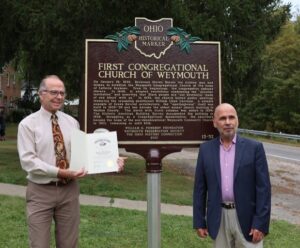
On January 19, 1835, Reverend Steven Barnes led sixteen men and women to establish the Weymouth Congregational Church at the home of Lathrop Seymour. From its beginnings, the congregation opposed slavery. In 1848, it adopted resolutions condemning the “peculiar institution” and asserting that Black people are “our brother[s] ‘made one blood’ with us.” In 1853, the church hosted public meetings featuring the crusading abolitionist William Lloyd Garrison. A notable example of Greek Revival architecture, the “meetinghouse” itself was built in 1835-’36 and has become the oldest extant church building in Medina County. The porch with Doric columns was added in 1854. The Historical American Building Survey documented the building in 1936. Struggling as a Congregational denomination, the sactuary became the home of the non-denominational Weymouth Community Church in 1920, remaining so until 2018.
, OH
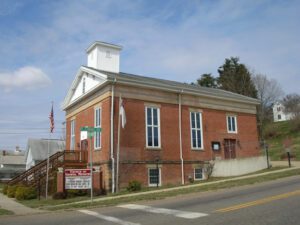
This former Universalist Church, which held a strong conviction for education and the pursuit of knowledge, was built in 1852 at a cost of $3,500. In 1865, its members decorated the first Christmas tree to be placed in a church in McConnelsville. Two years later they installed a pipe organ at a cost of $1,000, the first such organ in the community. The first Sunday School Library was also added, allowing members to borrow books and return them a week later. A number of prominent local families attended the church, including the Manly, Whitiker, Beckett, Arrick, and Murray families from the 1850s through the early twentieth century. Richard Bilbe, a former slave who had been freed, served as an early trustee of the church and attended with his family. The church was restored and reopened as a non-denominational church in 1997.
, OH
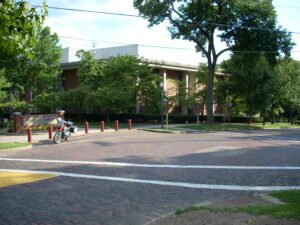
In April 1797, a committee of Marietta citizens, led by General Rufus Putnam, met to establish an academy suitable for preparatory instruction for their youth. Muskingum Academy, completed late that year, became the first institution of its kind in the Northwest Territory, providing “classical instruction… in the higher branches of an English education.” Its first instructor was David Putnam, a 1793 Yale graduate. The building also served as the home of the Congregationalist Church until 1808. Growing and expanding with Ohio’s first city, the academy served Marietta’s educational needs for more than thirty years as the forerunner of Marietta College.
, OH
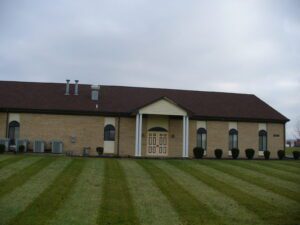
The Jain Center of Cincinnati and Dayton was established on April 22, 1979 as a non-profit tax-exempt organization under the laws of the United States and the State of Ohio. The foundation stone of the Jain temple, the first of its kind in Ohio, was laid down on August 21-22, 1994. The temple was dedicated on September 2 – 4, 1995 when more than one thousand people from all over Ohio and many other states participated in holy rituals to install three idols of Jinas (Gods). The Jain Center is a place for the teaching of non-violence, reverence for life, and compassion for all beings. The center was the home of the twelfth biennial convention for the Federation of Jain Associations in North America, which was held on July 3 – 6, 2003. (Continued on the other side)