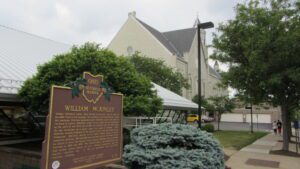
One of seven native Ohioans to serve as president of the United States, William McKinley (1843-1901) was born at this site. The original house was moved from this site and ultimately destroyed by fire. The McKinleys lived here until 1852 when they moved to Poland, Ohio, where William attended the Poland Seminary. He briefly attended Allegheny College in Pennsylvania, but poor health and family financial strain forced him to return to Ohio. As an enlistee in the 23rd Ohio Volunteer Infantry during the Civil War, McKinley rose to the rank of major. After the war, he settled in Canton and practiced law. Elected to Congress in 1876, McKinley favored high protective tariffs, a policy he continued to support as President.(Continued on other side)
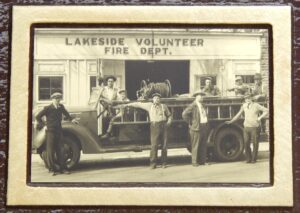
The Lakeside Volunteer Fire Protective Association responded to both fire and medical emergencies on the Marblehead Peninsula for more than 100 years. It was founded in 1905, after a devastating fire destroyed Lakeside’s business district. In 1946, the Association began providing emergency medical aid. During their service, the Lakeside Volunteer Fire Protective Association progressed from hand-drawn chemical carts to the area’s first heavy-duty fire and rescue truck. In 2013, the Association donated its assets to the newly-formed Danbury Township Volunteer Fire Department and passed into history.
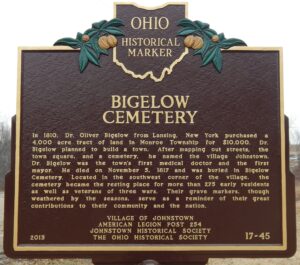
In 1810, Dr. Oliver Bigelow from Lansing, New York purchased a 4,000 acre tract of land in Monroe Township for $10,000. Dr. Bigelow planned to build a town. After mapping out streets, the town square, and a cemetery, he named the village Johnstown. Dr. Bigelow was the town’s first medical doctor and the first mayor. He died on November 5, 1817 and was buried in Bigelow Cemetery. Located in the southwest corner of the village, the cemetery became the resting place for more than 275 early residents as well as veterans of three wars. Their grave markers, though weathered by the seasons, serve as a reminder of their great contributions to their community and the nation.
The 17th Infantry, created by Congress in 1812 and formed with personnel from western states, was the only Regular Army regiment in General James Winchester’s column of the Army of the Northwest’s campaign to regain Detroit. During the War of 1812, the 17th fought at Frenchtown, Fort Meigs, Fort Stephenson, and Thames River. In 1815, the 17th was consolidated with the 5th, 19th, and 28th Infantry to form the 3rd Infantry. In May 1861, the 17th Infantry was again organized as a Regular Army regiment and has since served continuously with distinction.
801 E. Pete Rose Way, Bicentennial Commons at Sawyer Point
Cincinnati
, OH
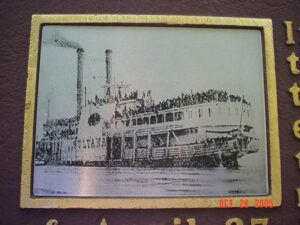
In 1862, less than a mile upriver from this marker, the John Lithoberry Shipyard in Cincinnati constructed the Sultana, a 260-foot, wooden steam transport. At the end of the Civil War, the U.S. Government contracted the Sultana to transport recently freed Federal prisoners north from Confederate stockades. During the night of April 27, 1865, while carrying over 2,300 Union soldiers – over six times its capacity of 376 passengers – a steam boiler aboard the Sultana exploded. The ship erupted in a massive fireball and sank in the cold, flood-swollen Mississippi River ten miles north of Memphis, Tennessee. Over 1,700 individuals died – some 200 more than those lost aboard the Titanic in 1912 – in what remains the worst maritime disaster in American history. Of the total casualties, Ohio lost the most of any state, with 791 dead. Indiana lost 491 persons, with Kentucky suffering 194 dead. It is estimated that, of the Ohio casualties, over fifty were Cincinnatians.
William McKinley’s house, once located at this site, was the scene of his 1896 front porch campaign for President of the United States. During the campaign McKinley addressed about 750,000 people who came to his home in Canton. McKinley’s public service began when he volunteered at the start of the Civil War in 1861 as a private with the Union Army. He was discharged as a major after four years of service. Later McKinley became President of the Canton Y.M.C.A. and the Stark County Prosecutor. McKinley served in the United States House of Representatives between 1877 and 1891 and was then elected Governor of Ohio. He helped to found the Canton Public Library. McKinley won presidential elections in 1896 and 1900. His administration was characterized by high tariffs, money backed by gold, national prosperity, and the Spanish-American War. In 1901 an anarchist shot and killed President McKinley.
In April 1784, the Continental Congress adopted the Report of Government for the Western Territory, a broad plan drafted primarily by Thomas Jefferson for organizing the United States’ new western lands that were ceded by the states and purchased from Native Americans. One of the most far-reaching legislative acts in American history, the resulting Land Ordinance of 1785, passed on May 20th, established the public land system by which all federal land was surveyed and distributed. The Ordinance established a rectilinear survey system that divided land into townships of six miles square aligned by north-south and east-west baselines, and set aside certain lands for Revolutionary War veterans and for public schools.
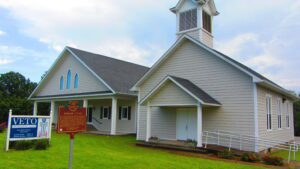
Ephraim Cutler (1767-1853) arrived in Marietta from Connecticut in 1795. Prominent in southeast Ohio, Cutler was appointed judge of the court of common pleas and justice of the peace, surveyed land for the Ohio Company, and was a trustee of Ohio University. In 1802, Cutler was chosen as a Washington County delegate to Ohio’s constitutional convention in Chillicothe. A contested issue at the convention was whether to permit or exclude slavery in the new state of Ohio. As a member of the committee that introduced Article VIII, or the bill of rights, of Ohio’s Constitution, Cutler drafted Section 2, which specifically excluded slavery or involuntary servitude in Ohio on the basis that the Ordinance of 1787 forbade it. The section passed through the convention by one vote. Veto Lake was named for Cutler’s role in having slavery vetoed in Ohio.