

, OH
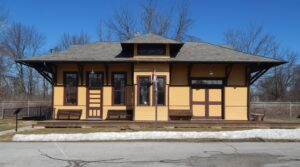
Arriving in 1853, the Central Ohio Railroad called this place “Kirkersville Station,” and it was later changed by stationmaster James Outcalt, who renamed the town Outville after himself. As rail traffic increased in Ohio, a successor company, the Baltimore and Ohio Railroad, built numerous rural depots, this one in 1899. After 1940, the depot was closed and then sold and moved from town in 1963. The Harrison Township Trustees arranged for the return of the depot to Outville in 1993. Today, it stands as the only one of its type remaining on this line, and one of only a handful of original railroad buildings extant between Columbus and Pittsburgh. It serves as a reminder of local railroad and transportation history. The Queen Anne, Stick/Eastlake architectural style depot was listed on the National Register of Historic Places in 1995.
, OH
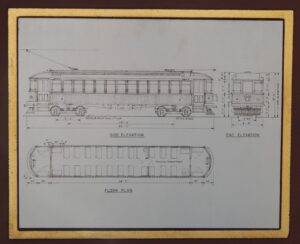
The Dayton, Springfield, and Urbana Electric Railway (DS&U) was an “Interurban” rail system that ran between the cities of Urbana, Springfield and Dayton. Its beginning can be traced to the franchise given to William H. Hanford to operate a single line of electrical railway between Springfield and the southern boundary of Champaign County in 1895. Hanford then sold his rights to John G. Webb of Springfield and Colonel Frederich Colburn of Kentucky, who along with other syndicate members formed the Dayton, Springfield, and Urbana Electric Railway. In 1897 Boston promoter Arthur E. Appleyard joined the syndicate and brought investment monies, organizational skills, and energy to the venture. He quickly became managing director/treasurer and the real driving force of the DS&U. The railway was organized into two divisions. One operated between Dayton and Springfield and the other between Springfield and Urbana. [continued on other side]
, OH
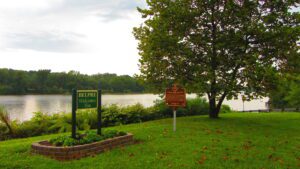
Born in Massachusetts in 1805, Sala Bosworth spent all but nineteen years of his eighty-five years in Washington County. After studying at the Philadelphia Academy of Fine Arts, he returned to the county to paint many full size and miniature portraits of prominent Washington County citizens. His historical drawings were used in Samuel P. Hildreth’s Pioneer History. He is also known for his mural in what is now the Unitarian Universalist Church in Marietta. Bosworth moved to Cincinnati late in life and started to paint with watercolors. He died there in 1890. Charles Sullivan also studied at the Philadelphia Academy and became a fast friend of Bosworth after coming to Washington County in 1833. While he also painted portraits, he excelled in his landscapes, including views of Blennerhassett Island, the Blennerhassett mansion, and the mounds at Marietta. Sullivan died in Marietta in 1867.
, OH
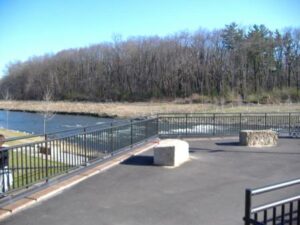
Officially opening on August 4, 1840, the Pennsylvania and Ohio Canal followed the route of present railroad tracks through Munroe Falls approximately one thousand feet south of this marker. This 82-mile long "feeder canal" connected the Beaver Valley canal system at New Castle, Pennsylvania with the Ohio and Erie Canal in Akron, thereby linking Pittsburgh with Cleveland and the western Great Lakes. Many communities along the canal’s path became linked to national and world commerce through their establishment as canal ports. New England investor Edmund Munroe purchased property and water rights along the canal’s proposed route, and in 1837 established the Munroe Falls Manufacturing Company. The village of Munroe Falls grew around the manufacturing company site and was incorporated on October 26, 1838. When this section of the canal closed in 1869, the waterway through Munroe Falls was filled and railroad tracks were laid over its path. A portion of the canal bed is still visible east of State Route 91.
, OH
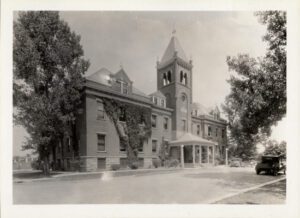
Central State University originated on March 19, 1887, when the Ohio General Assembly passed an act establishing a Combined Normal and Industrial (CN&I) Department at Wilberforce University. Through various transitional changes, it emerged as an independent, state university. In 1941, the General Assembly expanded the CN&I, which offered two-year courses, into the College of Education and Industrial Arts, with four-year programs. In 1947, it separated from Wilberforce University. The history of Central State University tells the history of higher education and advancement for African Americans in Ohio. It is within the walls of these structures, and others unfortunately demolished or destroyed by the 1974 tornado, that thousands of African Americans received valuable training for successful and rewarding careers. Thus, many of the contributions of African Americans to the promotion and betterment of education, medicine, law, social justice, technology, and the arts in Ohio have their roots here on the campus of Central State University.
, OH
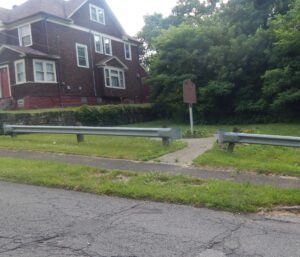
Oscar D. Boggess (1832-1907) was born in Virginia, the son of a slave and her master. He and his family were granted freedom in the will of his father and master. The will was contested up to the United States Supreme Court, which upheld Boggess’ freedom. Boggess moved to Pennsylvania at age 20, and during the Civil War, joined the 43rd United States Colored Troops. He earned the Butler Medal of Honor for bravery at the Battle of the Crater near Petersburg, Virginia, in July 1864. Boggess moved to Youngstown after the war, and worked as a stonemason. He was a charter member of Tod Post 29, Grand Army of the Republic, in Youngstown, and a co-founder of the Oak Hill Avenue African Methodist Episcopal Church, the city’s first African American religious congregation. The Boggess home, formerly located near this site, hosted the church’s first meetings in 1870.
, OH
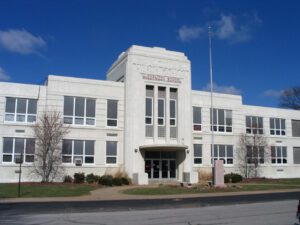
Ohio’s oldest continuing summer theatre, the Huron Playhouse has been housed at McCormick Middle School for its entire history. Dr. Frederick G. Walsh (1915-1999) of the Bowling Green State University (BGSU) Speech Department founded the theatre in 1949. Huron met Walsh’s expectations for an attractive site for the playhouse, and Huron Schools Superintendent R.L. McCormick (1904-1978) offered the use of this school. The curtain opened on the first Huron Playhouse production, Norman Krasna’s hit Broadway comedy John Loves Mary, on June 29, 1949. With persisting support from BGSU, actors and alumni, and the local community, the acclaimed Playhouse has provided theatrical experience for thousands of students and entertainment for generations of Huron residents.
, OH
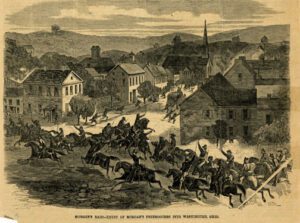
During the American Civil War 1860-1865, a Confederate cavalry, led by Brigadier General John Hunt Morgan, infiltrated the states of Kentucky, southern Indiana, and southeastern Ohio as a diversionary tactic to draw northern troops from eastern Tennessee. The 2,500 calvarymen passed through Gallia County, Ohio, and reached the village of Vinton on July 17, 1863. The Rebels plundered the town searching for horses, food, and forage. Near this marker, they crossed the covered bridge over Big Raccoon Creek and then burned the 120-foot structure behind them. Area residents were left unharmed and no lives were lost.