801 E. Pete Rose Way, Bicentennial Commons at Sawyer Point
Cincinnati
, OH
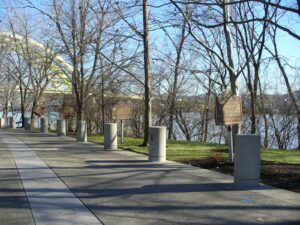
In memory of the Irish people who left a country where only their rivers run free. The Irish came to Cincinnati where they contributed to housing, education, employment, religious freedom, medical care and recreation, and embraced all aspects of life in the city. The descendants of Irish immigrants hope that our hands will ever be extended in friendship and never in want.
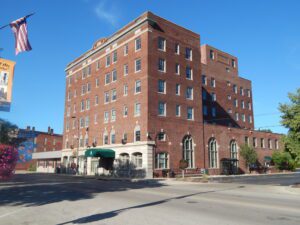
The Hotel Ashtabula was built in 1920 during an economic boom that lasted most of that decade. Architecturally, it represents a combination of Second Renaissance Revival and Georgian Revival styles. The H.L. Stevens and Company of Chicago and New York designed and built the hotel and others like it in Cleveland, Dayton, and Warren, Ohio and throughout the Midwest. The building included a ball room accommodating 300, a dining room that could seat 125, and club meeting and social rooms. A prominent structure of this downtown street, the Hotel Ashtabula was a hub for social activity. (Continued other side)
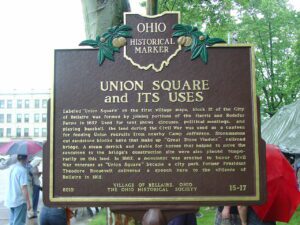
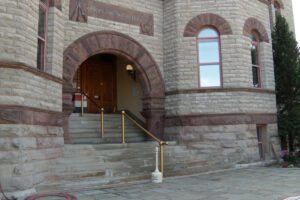
Labeled “Union Square” on the first village maps, block 12 of the City of Bellaire was formed by joining portions of the Harris and Rodefer Farms in 1857. Used for tent shows, circuses, political meetings, and playing baseball, the land during the Civil War was used as a canteen for feeding Union recruits from nearby Camp Jefferson. Stonemasons cut sandstone blocks here that make up “Great Stone Viaduct” railroad bridge. A steam derrick and stable for horses that helped to move the sandstone to the bridge’s construction site were also placed temporarily on this land. In 1882, a monument was erected to honor Civil War veterans as “Union Square” became a city park. Former President Theodore Roosevelt delivered a speech here to the citizens of Bellaire in 1912.
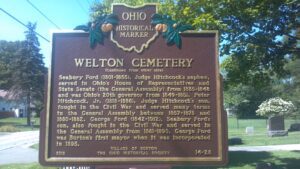
Welton Cemetery was known as Roselawn Cemetery until the early 1900s. Early settlers to the Burton area donated the land. Welton Cemetery is the burial place for veterans of the nation’s wars and for several state officials. Judge Peter Hitchcock (1781-1853) served in the War of 1812. From 1810-1852, he was elected to both houses of Ohio’s General Assembly and one term in the U.S. House of Representatives and served on the state’s Supreme Court. He was Chief Justice from 1831-1833 and 1849-1851. In 1850, he was a member of Ohio’s constitutional convention. (Continued on other side)
Following the Civil War, many of Ohio’s disabled and wounded veterans found inadequate provisions for their long-term needs. In response, the Grand Army of the Republic’s Department of Ohio lobbied for a state-operated veterans’ home. In 1886 Governor Joseph B. Foraker signed a bill establishing the Ohio Soldiers’ and Sailors’ Home for honorably discharged veterans. A board of trustees led by Sandusky publisher I.F. Mack selected the site, and the Sandusky community donated the tract of land, utilities, and a connection to the Baltimore and Ohio Railroad. The facility opened in November 1888. (continued on other side)
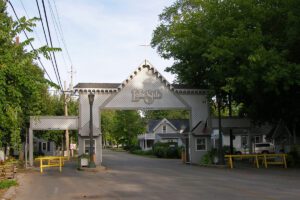
Established in 1873, Lakeside is a pioneer of the American Chautauqua Movement, one of the greatest revival movements in United States history which flourished in the late nineteenth and early twentieth centuries. Founded by the Methodist Church, Lakeside is one of the few existing Chautauqua communities that remain and thrive today. Each summer, the late-Victorian community provides spiritual, cultural, intellectual, and recreational programs designed to nurture the mind, body, and spirit. It draws visitors from across the country and around the world for its Chautauqua program. Lakeside is recognized on the National Register of Historic Places.
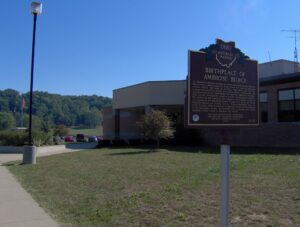
An influential American journalist of the late nineteenth century, Ambrose Bierce (1842 – c. 1914) was born in Meigs County and reared in Kosciusko County, Indiana. He fought in the Union Army during the Civil War, a formative experience related in his short stories “Chickamauga” and “An Occurrence at Owl Creek Bridge.” Moving to San Francisco in the years after the war, he began his career as a writer and newspaper columnist. His cynical wit and elaborate puns reached a wide audience during the last quarter of the nineteenth century through such papers as William Randolph Hearst’s San Francisco Examiner. Bierce’s best-known book, the Devil’s Dictionary (1911), is a lexicon of humorous definitions first published in his newspaper columns. In December 1913 or January 1914, Bierce vanished during travels in rebellion-torn Mexico.
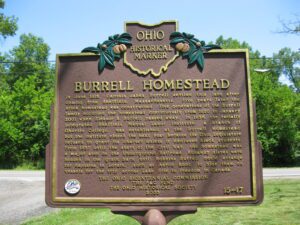
In June 1815, Captain Jabez Burrell settled this land after coming from Sheffield, Massachusetts. Five years later the brick homestead was constructed. Five generations of the Burrell family occupied the homestead continuously from 1820 to January 2001 when Eleanor B. Burrell passed away. In 1836, the racially integrated Sheffield Manual Labor Institute, a branch of Oberlin College, was established at the Burrell Homestead, but the Institute closed the next year because the Ohio Legislature refused to grant its charter unless it excluded black students. From 1837 until the start of the Civil War, the homestead was a major stop on the Underground Railroad. Runaway slaves were hidden in the grain barn until Robbins Burrell could arrange for captains in Lorain, such as Aaron Root, to hide them on vessels for the trip across Lake Erie to freedom in Canada.