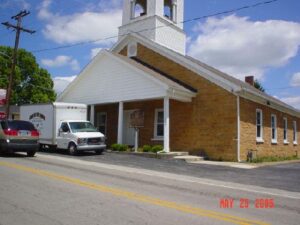
The First Presbyterian Church of West Union, built in 1810, is known as the “Church of the Governors.” Although the date is uncertain, the congregation was organized circa 1800 on Thomas Kirker’s land on Eagle Creek, about three miles from West Union. Kirker, Ohio’s second governor, was influential in organizing the congregation and raising funds for the construction of the building. Stonemason, Thomas Metcalfe, Kentucky governor from 1828-1832, was awarded the contract to build the walls for $250.00; the total construction cost was $500.00. The first three regular ministers – William Williamson, Dyer Burgess, and John P. Van Dyke – all held strong anti-slavery sentiment that was felt throughout the congregation. During the Civil War, soldiers of the 70th Ohio Volunteer Infantry, a regiment of recruits from Adams County and eastern Brown County, were said to have been temporarily quartered in the church before leaving West Union in 1861.
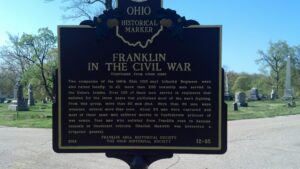
Men from Franklin Township were among the first from Ohio to leave for the war and participated in many of the conflict’s great campaigns. Individual companies of the 1st Ohio (90 day), 2nd Ohio, 75th Ohio, and 79th Ohio infantry were raised locally. Other Franklin men served in the 60th (1 year), 69th Ohio, and 93rd Ohio Infantry Regiments, the 4th Ohio Cavalry Regiment, and the 2nd Ohio Heavy Artillery Regiment. The township’s regiments served from First Bull Run in 1861 to Bentonville in 1865, participating in the battles of Perrysville, Stone’s River, Chicamauga, Chancellorsville, and Gettysburg, among many others.
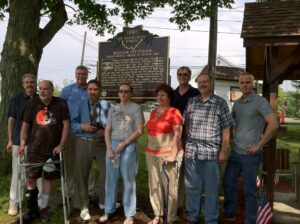
The General at Union Station in Chattanooga, Tennessee (circa 1907). Born in Knoxville in 1840 and reared at a farm in New Somerset, William Pittenger mustered into the 2nd Ohio Volunteer Infantry, under a 90-day enlistment, in 1861. He fought at the First Battle of Bull Run and was the war correspondent for the Steubenville Herald. After reenlisting, he participated in the ill-fated Andrews Raid of 1862. While attempting to disrupt enemy supply lines, the raiders stole the Confederate locomotive “The General.” After being chased north, they were captured. (Continued on other side)
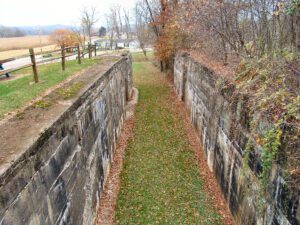
The Upper Trenton Lock (Lock 15 South) of the Ohio & Erie Canal was built between 1828 and 1829. Originally built of cut sandstone blocks, the lock was named for the Village of Trenton, now Tuscarawas. Lock 16, or Lower Trenton Lock, lies only 800 feet southwest of Lock 15. The lock tender, who lived in a house on this site, served both locks. Repeated flood damage prompted reconstruction of Lock 15 in 1907. The deteriorated stonemasonry was completely replaced with concrete at a cost of $6,815. The old stone was used to shore up the towpath. Use of the state-owned canal had declined significantly by this point, and the great flood of 1913 brought the canal era to an end in Ohio.
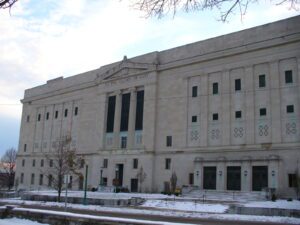
The first Masonic Lodge in Dayton was founded in 1808, located in the first Montgomery County Courthouse. Various other locations were home to Masons in Dayton, but by World War I, rapid growth of the Masonic community called for the creation of a new Lodge building. Masons of the time, including civic and business leaders of Dayton, conceived the idea of a new Masonic Center located on the hill at Belmonte Park North and Riverview Avenue. Ground was broken and construction of the $2.5 million Masonic Temple began on July 20, 1925. Through contributions from the Masonic community, the tremendous task of raising a majority of the building cost, $1.5 million, was accomplished in merely ten days in 1924. It is doubtful that the Temple could be duplicated given the fact that the large quantities of marble and mahogany and cherry woods used in construction would be difficult to procure today.
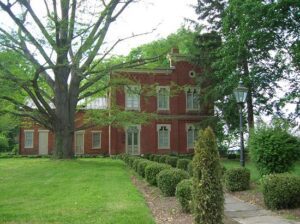
This classic Gothic Revival home built in the early 1850s, was one of Ohio’s early wineries with terraced hillside vineyards overlooking the city of Chillicothe. From 1919 until his death in 1966, it served as the home and working studio of noted American craftsman, artist, and historian Dard Hunter. A major artistic contributor to the Arts and Crafts Movement of the early twentieth century, Hunter gained international recognition when in 1916 he became the first individual in the history of printing to produce all aspects of a book by hand. Eight of the twenty books he wrote on the history of paper were printed at this site. Hunter is regarded as the world’s leading authority on the history of paper and his artistic achievements have had an enduring impact on American Graphic Arts.
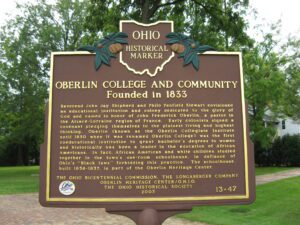
Reverend John Jay Shipherd and Philo Penfield Stewart envisioned an educational institution and colony dedicated to the glory of God and named in honor of John Frederick Oberlin, a pastor in the Alsace-Lorraine region of France. Early colonists signed a covenant pledging themselves to the plainest living and highest thinking. Oberlin (known as the Oberlin Collegiate Institute until 1850 when it was renamed Oberlin College) was the first coeducational institution to grant bachelor’s degrees to women and historically has been a leader in the education of African Americans. In fact, African American and white children studied together in the town’s one-room schoolhouse, in defiance of Ohio’s “Black laws” forbidding this practice. The schoolhouse, built 1836-1837, is part of the Oberlin Heritage Center.
Bergholz New Somerset Road/Jefferson County Road 53
Bergholz
, OH
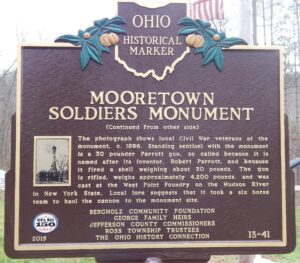
In 1871 Robert and Martha McLaughlin George erected a Soldiers Monument in the memory of their son Thomas and other soldiers from Ross Township, Jefferson County, Ohio who died in service to the United States during the Civil War. All were native to Ross Township and some, like 25 year-old Thomas George, were members of Company K, 2nd Ohio Volunteer Infantry. Captain David Mitchell commanded Company K, whose recruits came from Mitchell’s Sald Works (Holt) and Yellow Creek. The unit fought in many battles, including Perryville, Kentucky, Stone River, Tennessee, Chickamauga, Georgia, and in the Atlanta campaign. Corporal Thomas George was killed at Perryville on October 8, 1862. Many of his comrades were killed in battle; others parished from disease or died as prisoners of war.