

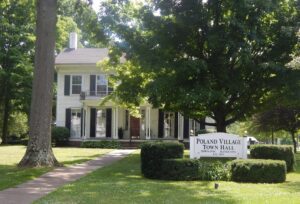
, OH
The Village of Poland officially incorporated in August 1866, a year after the end of the Civil War. In April 1867, the citizens elected John Leslie as mayor. As of 1880, Poland’s population exceeded 400. Through its history, the village has consisted of a four-acre village green, churches, schools, hotels, a sawmill, gristmill, post office, tannery, and foundry, as well as carriage, tin, and cabinet shops; drug, dry goods, and hardware stores, and doctors, blacksmiths, and shoemakers. Residents swam in and skated on Yellow Creek. The Poland Municipal Forest was established in 1938 and annexed later as the Village continued to grow. In 1966, the residents held a three day Centennial Celebration, featuring an address by Governor James Rhodes. The centennial year also saw the publication of a history of Poland and the restoration of Centennial Gardens.
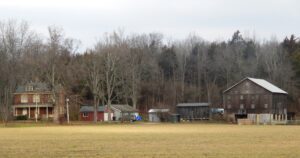
, OH
Lewis-Sample Farmstead. The farmstead shares the name of the Lewis and Sample families, two owners since European-descended settlers began moving into the Ohio County in the late 1700s. Andrew (1762-1847) and Martha Lewis (1774-1852) acquired this land in 1804. Like others, Andrew saw for himself the rich land north of the Ohio River while in the army during the Ohio Indian Wars of the 1790s. By 1834, the Lewis farmstead had expanded to more than 350 acres with a brick house, still house, and sawmill on Indian Creek. The Sample family purchased the farm in 1871 and owned it until 2007.
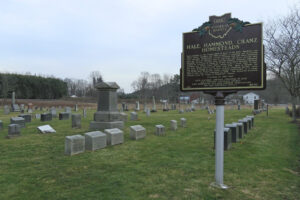
, OH
This cemetery is the resting place of many of the Hale, Hammond, and Cranz family members who were integral in founding and developing Bath Township. Connecticut natives Jonathan Hale and Jason Hammond were the first to purchase land in the area that would become Bath Township. In 1810, Jonathan Hale and his nephew, Theodore Hammond, arrived at Township 3, Range 12 of the Connecticut Western Reserve. Jonathan and Mercy Piper Hale’s family built a brick home in 1827. The Hale family lived in this home until 1956, when it became the Hale Farm & Village of the Western Reserve Historical Society. Jason and Rachel Hale Hammond’s family started construction on a frame home in 1818 that was completed in 1836. The Hammond property extended from the valley to Hammond’s Corners. (Continued on other side)
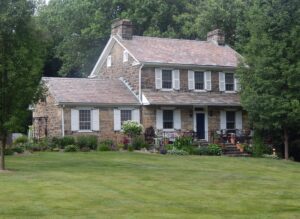
, OH
The Kyle-McCollum House, thought to be the oldest continuously inhabited residence still on its original site in Youngstown, was built by War of 1812 veteran Joshua Kyle (c. 1766-1842) and his wife Mary Stewart (c. 1774-1844). The Kyles moved from Westmoreland County, Pennsylvania, to the Mahoning Valley around 1800 and purchased about 1,300 acres of land on a hill above Mill Creek. Using stone quarried from the property, they built a house, completed in 1813. The Federal style of the house is typical of early 19th-century homes built in the Connecticut Western Reserve. The structure is two and a half stories with stone load-bearing walls that are two feet thick. Beside his farm, Kyle built a sawmill on Mill Creek near Slippery Rock, a site now under Lake Glacier. [Continued on other side]
, OH
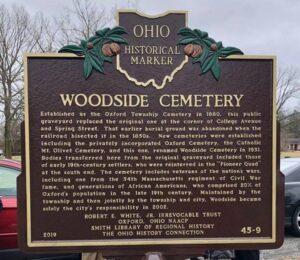
Established as the Oxford Township Cemetery in 1880, this public graveyard replaced the original one at the corner of College Avenue and Spring Street. That earlier burial ground was abandoned when the railroad bisected it in the 1850s. New cemeteries were established including the privately incorporated Oxford Cemetery, the Catholic Mt. Olivet Cemetery, and this one, renamed Woodside Cemetery in 1931. Bodies transferred here from the original graveyard included those of early 19th-century settlers, who were reinterred in the “Pioneer Quad” at the south end. The cemetery includes veterans of the nation’s wars, including one from the 54th Massachusetts regiment of Civil War fame, and generations of African Americans, who comprised 20% of Oxford’s population in the late 19th century. Maintained by the township and then jointly by the township and city, Woodside became solely the city’s responsibility in 2002.
, OH
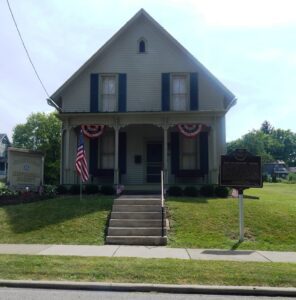
Alexander Frankfort (1842-1930), the last surviving Civil War veteran from Struthers, built this house in 1884. His wife, Louisa Jane Johns Frankfort (1851-1921), purchased the land from Thomas Struthers for $190.00. The house is of balloon frame construction and has sandstone foundation. The main beam traversing the basement was made from a large tree on the property. Married in 1874, the Frankforts had eight children, but four little ones had died by 1884. The Frankforts brought their fifth child, the infant Alma (1884-1984) to this then new house, where she and three sisters grew up. Alma lived and worked here as a seamstress for 93 years. The house was empty until 1986 when the Mohr family, Alma’s nephews, donated it to the Struthers Historical Society. The historical society renovated the house and opened as a museum in 1989.
, OH
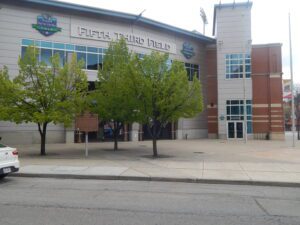
Moses Fleetwood Walker was born on October 7, 1856 in Ohio to Moses M. Walker, a physician, and Caroline, a midwife. He attended and played baseball at Oberlin College and the University of Michigan. In 1883, Walker joined the newly formed Toledo Blue Stockings and became the first African American major league ballplayer when Toledo joined the Major League-sanctioned American Association the following year. As a barehanded catcher, his biggest assets were his catching ability, powerful throwing arm, and aggressive base running. He endured racial prejudice from teammates, opponents, and baseball fans, and eventually left to become a writer, inventor, civil rights advocate, and entrepreneur. Walker was elected to the Ohio Baseball Hall of Fame in 1991. He died in 1924 and is buried in Stuebenville, Ohio in the family plot at Union Cemetery.
, OH
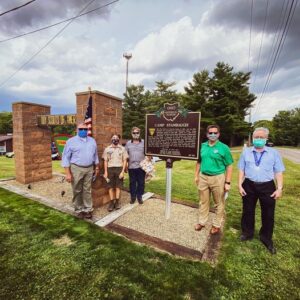
The Boy Scouts of America began in 1910, and by 1912, Scouting was established in the Mahoning Valley. Camp Stambaugh opened in July 1919, thanks to a gift from the estate of prominent local industrialist Henry H. Stambaugh (1858-1919). In his will he had named his friend and business partner Phillip J. Thompson as trustee of Stambaugh’s 86.5 acre Indian Creek Farm. Stambaugh’s expectation was that Thompson would convey the property to the local Scouting organization. In 1919 the property was mostly a treeless pasture and one could see Indian Creek from Stambaugh’s hay barn near Leffingwell Road. That first summer a Council Ring was carved from an old limestone quarry just north of the creek. (Continued on other side)