

, OH
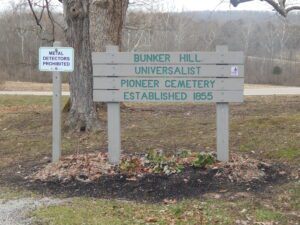
The Bunker Hill Society was organized about 1845 and fellowshipped in 1854. A frame meeting house, capable of seating 300, was dedicated in 1855. Thirty people united with the church during the 1859 Annual Meeting. The membership suffered greatly during the Civil War, many enlisting in the Union Army. Some members, Like John G. Agnew, were Peace Democrats (Copperheads). Agnew withdrew from the church on July 5, 1863 saying, “I feel the course I am and have been pursuing does not comport with the Christian character. Nor do I think that I can be better while this war lasts. I do not wish to be a reproach upon the church.” The church was re-fellowshipped in 1900. The last sermon was delivered October 23, 1910. Fire destroyed the building May 8, 1924.
, OH
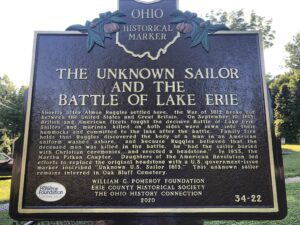
Almon Ruggles (1771-1840) came to Ohio from Connecticut in 1805 and led survey teams that divided the Firelands section of the Connecticut Western Reserve into townships. The Firelands was territory granted to Connecticut residents whose property was destroyed by the British during the Revolutionary War. Ruggles purchased a lakeshore section of this surveyed land for one dollar per acre, which is now known as Ruggles Beach. After settling permanently in Ohio in 1810, he established a farm, built gristmills, and worked for different Connecticut land proprietors. Ruggles also served in the Ohio Senate, the Ohio House, and was briefly appointed as associate judge of Huron County. Upon his death, his ashes were buried on part of his property, now known as Oak Bluff Cemetery.
, OH
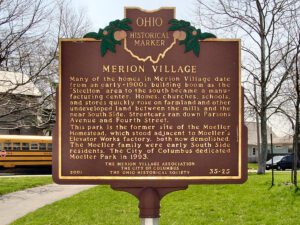
Merion Village was named for the Nathaniel Merion family, who in 1809 settled what is now the South Side of Columbus on 1800 acres of the Refugee Lands. Entrepreneur William Merion operated “Merion’s Landing” in the 1830s to capitalize on the canal trade from the Columbus Feeder Canal. This area saw a large influx of German immigrants as the South Side industrialized in the mid-nineteenth century. Later, many Irish, Italian, and eastern European immigrants who worked in the local steel mills and foundries made their homes here.
, OH
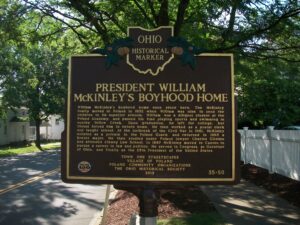
William McKinley’s boyhood home once stood here. The McKinley family moved to Poland in 1852 when William was nine to send the children to its superior schools. William was a diligent student at the Poland Academy, and passed his time playing sports and swimming in nearby Yellow Creek. Upon graduation, he left for college, but illness forced him to return home. He then worked as a postal clerk and taught school. At the outbreak of the Civil War in 1861, McKinley enlisted as a private in the Poland Guard, and returned in 1865 a brevet major. He then studied under Poland lawyer Charles Glidden and attended Albany Law School. In 1867 McKinley moved to Canton to pursue a career in law and politics. He served in Congress, as Governor of Ohio, and finally as the 25th President of the United States.
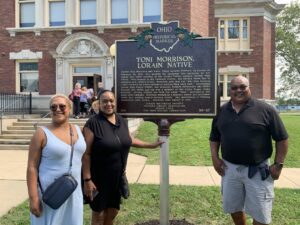
, OH
Author Toni Morrison was born, Chloe Ardelia Wofford, in Lorain on February 18, 1931. Her passion for language was nurtured by her family and while working at the Lorain Public Library during high school. Then housed in the Carnegie Center, the library hired her to reshelve and catalog books. Morrison said that she “was slow because I kept reading the books instead of putting them back fast.” Graduating Lorain High School (1949), she attended Howard University (BA 1953), Cornell (MA 1955), and she was a member of the Alpha Kappa Alpha sorority. During college she took the name “Toni,” shortening her saint name Anthony. Morrison worked as a literary editor and professor while also writing award-winning novels. She maintained a lifelong connection with Lorain. Morrison died August 5, 2019.
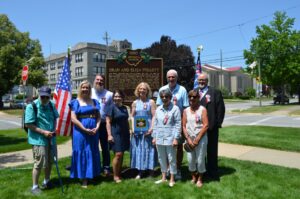
, OH
Oran Follett constructed his Sandusky house between 1835 and 1837. The golden sandstone mansion was home to Follett and his family until his death in 1894. Sold to James Flynn and then the Krupp family, the house remained a private residence until rented to the Works Progress Administration in 1935. The Sandusky Board of Education purchased the house in 1939 and used it as the adjacent high school’s Home Economics annex, meeting space, offices, and occasionally as art gallery or dance venue. From 1958 to 1968, it housed the Sandusky School of Practical Nursing. The Sandusky Library took over management of the house in 1973, opening it as museum in 1976. Considered one of the finest Greek Revival mansions in Ohio, the Follett House was listed on the National Register of Historic Places in 1974.
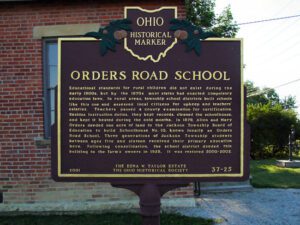
, OH
Educational standards for rural children did not exist during the early 1800s, but by the 1870s most states had enacted compulsory education laws. In rural areas, township school districts built schools like this one and assessed local citizens for upkeep and teacher’s salaries. Teachers passed a county examination for certification. Besides instruction duties, they kept records, cleaned the schoolhouse, and kept it heated during the cold months. In 1879, Allen and Mary Orders deeded one acre of land to the Jackson Township Board of Education to build Schoolhouse No. 10, known locally as Orders Road School. Three generations of Jackson Township students between ages five and sixteen received their primary education here. Following consolidation, the school district deeded this building to the farm’s owners in 1928. It was restored in 2000-2002.
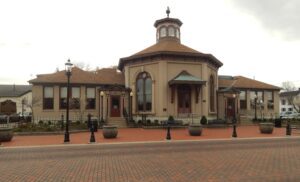
, OH
Clark Lane (1823-1907), industrialist and philanthropist, was a son of John Lane (1793-1880) and Rosanah Crum (1795-1877). John came with his family to the Ohio Country when it was still part of the Northwest Territory. As a young man, Clark worked in his family’s blacksmith shop, and eventually helped found Owens, Lane & Dyer Machine Company in 1854. It built agricultural machinery, sawmills, papermaking machines, and other products, initiating Hamilton’s prominence in metals manufacturing. Lane funded the Butler County Children’s Home, an orphanage for over a century, and constructed an octagon house as his residence on Third Street. He built this library in 1866, also as an octagon, and donated it to the people of Hamilton. A 19th century admirer wrote, “The name and generous deeds of Clark Lane will never fade from the memories of a grateful people who have been recipients of his favor.”