

, OH
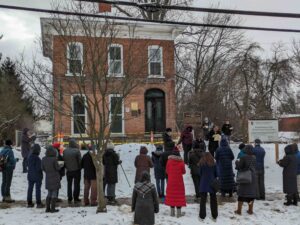
The Wilson Bruce Evans House, 33 East Vine Street, is a rare example of a residence built and occupied by an African American abolitionist and Underground Railroad operative. Free-born in North Carolina, Wilson Bruce Evans (1824-1898) moved to Oberlin in 1854. A skilled cabinetmaker, he opened a carpentry shop with his brother, Henry (1817-1886). Together they completed the original house by 1856. At the center of Oberlin’s interracial antislavery politics, Evans defied the Fugitive Slave Act of 1850, and was indicted for his part in the 1858 Oberlin-Wellington Rescue. During the Civil War, Evans enlisted in the predominantly white 178th O.V.I., serving August 1864-June 1865. The Wilson Bruce Evans House was added to the National Register of Historic Places in 1980, and named a National Historic Landmark in 1997. (Continued on the other side)
, OH
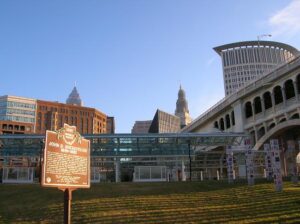
Born at Richford, New York, John D. Rockefeller moved to the Cleveland area with his family at age 14. He began his business career as a bookkeeper in 1855. From modest beginnings he became one of the richest men of his era by developing the world’s largest oil corporation, the Standard Oil Company, which was founded here in the Flats of Cleveland. Rockefeller moved to New York City in 1884 but maintained two homes in Cleveland, returning often with his wife Laura (1839-1915). Although he was a controversial businessman, Rockefeller donated millions of dollars to Cleveland charities and institutions, and land for Rockefeller and Forest Hills parks. John and Laura Rockefeller are interred in Lake View Cemetery.
, OH
Marcellus F. Cowdery, Sandusky’s first Public School superintendent, encouraged William D. Curtis to formulate a chalk that did not break easily or scratch chalkboards. Curtis conducted experiments in his kitchen and, using gypsum and limestone deposits from Sandusky Bay, created sticks of pure white, processed chalk. In the late 1860s, he and his brothers-in-law, Marcellus and John S. Cowdery, began producing the chalk from their family home. In 1890, John Whitworth, Curtis’s son-in-law, helped finance the incorporation of The American Crayon Company. The company pioneered high quality art supplies, including wax color crayons and Prang watercolors, used in schoolrooms around the globe. Sandusky’s American Crayon factory that stood at 1706 Hayes Avenue for more than a century, closed production in 2002 and was later demolished.
, OH
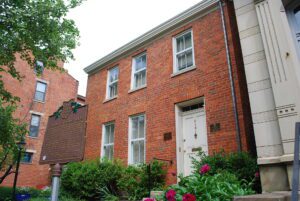
The oldest building in Cincinnati’s basin area, the Betts House exemplifies a national trend on the expanding frontier of impermanent log and frame structures giving way to more permanent brick architecture. It is the earliest surviving brick building in the city. During Cincinnati’s period of settlement in the early 1800s, the William and Phebe Betts family established a brickyard here that supplied building materials for the rapidly growing frontier city. The Betts House lends its name to the Betts-Longworth Historic District. Established in 1983, the district represents the last nineteenth century remnant of Cincinnati’s lower West End and surrounds the older Betts House with tall, narrow mid-and late-nineteenth century buildings. The Betts house is oriented to the cardinal directions, rather than to the city’s slightly skewed grid.
, OH
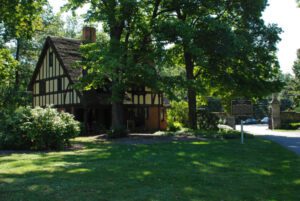
Completed in 1915, the Gate Lodge is one of several service buildings located at Stan Hywet Hall dedicated to the operations of the estate. Located at the front entrance gates, this two-story Tudor Revival structure was designed by the Seiberlings’ architect Charles S. Schneider. Originally, the Gate Lodge served as a residence for the estate’s superintendent. The first to fill this role was William Dennis who moved in with his family to the Gate Lodge after its completion and resided there until his death in 1923. Between 1923 and 1944, Fred, the eldest child of F.A. and Gertrude Seiberling, lived in the Gate Lodge with his wife Henrietta and their three children. In 1935, Henrietta brought here the two men who would formally found Alcoholics Anonymous, Bill Wilson of New York and Dr. Bob Smith of Akron.

, OH
The Hogan Family owned and operated what was known as the Hamilton Airport for over 52 years. Airplane owner and pilot, Carl “Pop” Muhlberger and aviation enthusiast and farmer, Joe Hogan, co-founded the airport in July 1929. Muhlberger taught Joe to fly and in return, Joe managed and maintained the field. During the Great Depression, Muhlberger could not afford to operate the airport, closing in July 1932. With financial backing from Joe’s older brother, Charles, and their father, William, the family purchased and reopened the airport. Running the airport was a family affair. Joe taught his brothers, Bill, Bernie, and Art to fly. They raised money to run the airport by barnstorming, sightseeing flights, and flying lessons. Sisters, Mary Ann, Katie, and Loretta (Sauer), also flew. They, along with their mother Emma, helped run the airport and its restaurant. (Continued on other side)
, OH
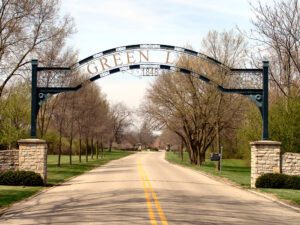
Landscape architect Howard Daniels designed the original portion of Green Lawn Cemetery in 1848. Noted Columbus architect Frank Packard designed Green Lawn’s Chapel mausoleum, the Hayden family mausoleum, and the Packard mausoleum. Spanning over 360 acres, the cemetery’s wooded setting provides a habitat for a variety of birds and other wildlife. The Chapel contains stunning stained glass windows and mosaic artwork by Tiffany & Company of New York. The monuments, obelisks, and memorials throughout the cemetery represent a wealth of artwork and a history of Columbus. As one of the oldest and largest cemeteries in Ohio, Green Lawn is the resting-place of many noted individuals who have made significant contributions to Columbus, Franklin County and the nation.
, OH
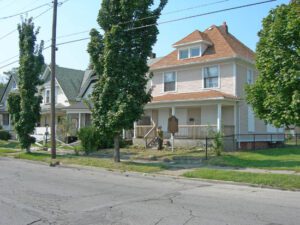
Art Tatum was born in Toledo on October 13, 1909, the son of Arthur Tatum, Sr. and Mildred Hoskins Tatum. Despite being blind in one eye and only partially sighted in the other, he became one of the greatest jazz pianists of his era. To deal with his sight disability, he attended the Ohio State School for the Blind in Columbus from 1918-1920. He came from a musical family and had some formal training at the Toledo School of Music, but was largely self-taught. Influenced by famed Fats Waller, Tatum began playing his music on a local radio station at age 18 and then lived in Chicago, New York City, Cleveland, and Los Angeles, playing and recording extensively both as a soloist and in small groups. His ability to improvise set him apart as a musical genius. Tatum died in November 1956 and was named to the Jazz Hall of Fame in 1983.