

, OH
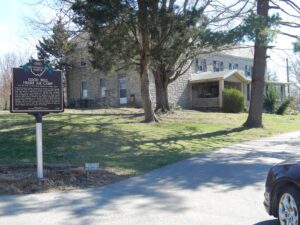
Reverend Richard E. Scully, founder of the Cincinnati Goodwill operated a Fresh Air Camp for women and children in the 1930s and 40s. The camp was part of a 100-acre site with vegetable fields, a swimming pool, tennis courts and horseshoe pits. The farm house on site was used as lodging for visitors. Men who worked at the camp received food and other forms of relief for their families. Vegetables produced on site were distributed at the Goodwill location at Ninth Street and Freeman Avenue in Cicinnati. According to family stories, Ruth Ann Eldridge, the frist child of Edison and Anna Eldridge, was buried on the site of the camp in 1933. Rev. Scully had officiated at Edison and Anna’s wedding and was a friend of the family.
, OH
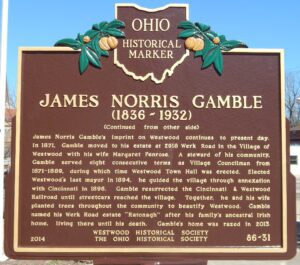
James Norris Gamble, entrepreneur, industrialist, philanthropist and civic leader, is best known for inventing Procter & Gamble’s Ivory Soap, the “soap that floats,” in 1878. Applying a scientific approach, Gamble transformed P&G into a nationally recognized corporate leader and creator of consumer products for a rapidly growing America. Beyond P&G, Gamble financed early efforts to educate freed southern slaves as an original sponsor of the Freedmen’s Aid Society. Later, he underwrote civil rights leader Mary McLeod Bethune’s work to educate poor African American women. In Cincinnati, Gamble’s philanthropy included endowment of Christ Hospital and the founding of its Institute of Medical Research. Gamble funded completion of University of Cincinnati’s Nippert Stadium in 1924 as a tribute to his late grandson.
, OH
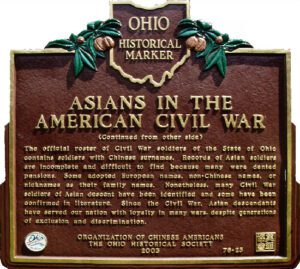
Despite exclusionary laws preventing U.S. citizenship, Asians served in the Union and Confederate armies and navies during the American Civil War (1861-1865). Many of these soldiers were denied citizenship following their services due to the anti-Asian sentiment, which culminated in the Naturalization Act of 1870 and the Chinese Exclusion Act of 1882. The exclusionary laws continued until 1943, and all restrictions on national origin or race were abolished in 1965. In April 2003, House Joint Resolution 45 was introduced to Congress to posthumously proclaim Civil War soldiers of Asian descent to be honorary citizens of the United States as recognition of their honorable services. (continued on other side)
, OH
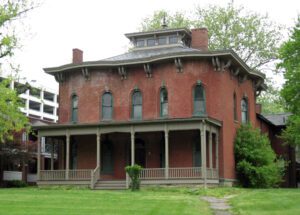
The Cozad-Bates House is one of the oldest remaining structures in Cleveland’s University Circle. The original section, built circa 1853, is the only pre-Civil War residential structure left in the neighborhood. Built by Samuel and Jane Cozad’s son, Andrew Cozad, the first section used locally made brick to form a simple two-story, one-room-deep, vernacular English-I house. The family owned a large portion of the land which is now occupied by University Circle. Justus Cozad, Andrew’s son, returning from the west where he worked as a railroad superintendent and civil engineer, built the later section on Mayfield Road for his larger family in 1872. It is a rare surviving example of Italianate-influenced residential architecture, including a hipped roof, curved bay windows, paired eave brackets, and prominent belvedere. The house was listed on the National Register of Historic Places in 1974 and designated as a Cleveland Landmark in 2006.
, OH
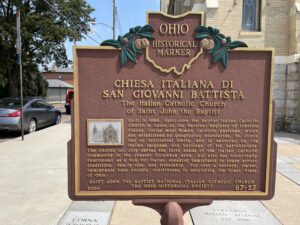
The National Italian Catholic parish of Saint John the Baptist was founded in October 1896 by the Reverend Father Alexander Cestelli, D.D. Father Cestelli was born in Fiesole, Italy and came to America in 1888 to serve as a professor at St. Paul’s Seminary in Minnesota. In January 1896, founding Rector Monsignor John Joseph Jessing invited Father Cestelli to serve at the Pontifical College Josephinum in Columbus, Ohio as a professor of moral theology. In October 1896, the Right Reverend John Ambrose Watterson, D.D., Bishop of Columbus, appointed Father Cestelli as pastor of the Italian Catholic community. Sunday Mass was celebrated in the baptistery of Saint Joseph Cathedral until September 18, 1898, when the Most Reverend Sebastiano Martinelli, Apostolic Delegate to the United States, dedicated this historic church.
, OH
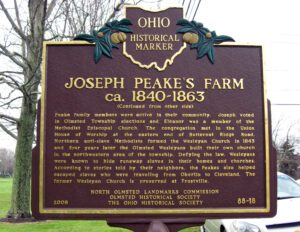
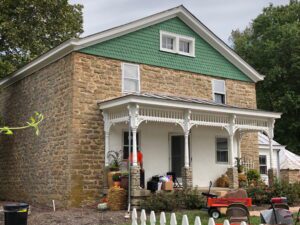
Joseph Peake was born in Pennsylvania in 1792 and came to Ohio in 1809 with his parents and brother. They were the first African Americans to settle permanently in the Cleveland area. He was the son of George Peake, a runaway slave from Maryland, who fought on the British side at the Battle of Quebec in 1759 during the French and Indian War. A man with some means and talent, George Peake invented a stone hand mill for grinding corn, a labor-saving device that endeared the Peakes to their neighbors in western Cuyahoga County. Joseph Peake and his wife Eleanor, an African American from Delaware, bought land in the 1840s on the Mastick Plank Road and built a home near this marker. [Continued on other side]
, OH
The Clark Stone House, constructed around 1801 by James Clark (1765-1852), is one of the oldest standing stone houses in Ohio. Clark, who served as a drummer in the Battle of Yorktown (1781), came with his family to Anderson Township in 1797 and bought this land along Clough Creek. Clark was a mathematician, taught school, ran a distillery, operated an orchard nursery and served as a justice of the peace, a judge, and a state legislator. The two-story dressed limestone house was sold to the Leuser family in 1864, was acquired by the related Messmer family in 1923, and sold to Anderson Township in 1995.
, OH
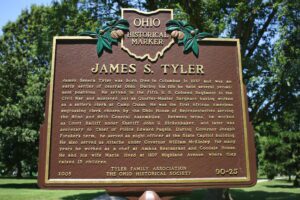
James Seneca Tyler was born free in Columbus in 1837 and was an early settler of central Ohio. During his life he held several prominent positions. He served in the Fifth U.S. Colored Regiment in the Civil War and mustered out as Quarter-Master Sergeant having worked as a sutler’s clerk at Camp Chase. He was the first African American engrossing clerk chosen by the Ohio House of Representatives serving the 62nd and 66th General Assemblies. Between terms, he worked as Court Bailiff under Sheriff John U. Rickenbaker, and later was secretary to Chief of Police Edward Pagels. During Governor Joseph Foraker’s term, he served as night officer at the State Capitol building. He also served as Attache under Governor William McKinley. For many years he worked as a chef at Ambos Restaurant and Goodale House. He and his wife Maria lived at 1107 Highland Avenue where they raised 13 children.