

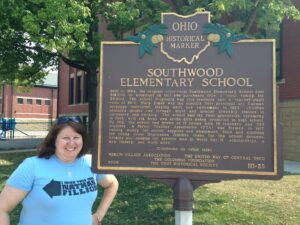
, OH
Built in 1894, the original eight-room Southwood Elementary School cost $16,000 to construct on this site purchased from a local family for $3,000. The school originally had five teachers and a teacher-pupil ratio of 50-1. Mary Esper was the school’s first principal and German language instructor, staying until her retirement in 1923. Children attended grades one through eight and special biweekly classes in carpentry and cooking. The school had its first graduation ceremony in 1896, with six boys and seven girls being promoted to high school. By 1912, the school had grown to 17 rooms with 16 teachers and 735 students. A Parent Teacher Association (PTA) was formed in 1917, raising money for school supplies and equipment, food and clothing for needy Great Depression families, trees for the school grounds, cookies and candies for service men in World War II, scholarships, a new library, and much more. [continued on other side]
, OH
Dr. Jared Potter Kirtland was a prominent nineteenth century professor, physician, naturalist and horticulturist. In 1837, Kirtland purchased land in Rockport Township that stretched from Madison Avenue to Lake Erie. Kirtland used that land as a natural laboratory and filled it with gardens, greenhouses and an arboretum where he developed fruit and grape varieties best suited for the region. His success with new varieties inspired area farmers to successfully concentrate on fruit and grape growing. In 1839, he built a home at Detroit and Bunts Roads and lived there unitl his death in 1877. (Continued on other side)
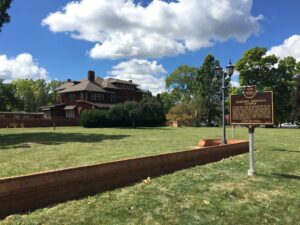
, OH
The Harding Hospital, initially called the Columbus Rural Rest Home, was founded in 1916 by George T. Harding II, MD (1878-1934) and his associates, many of whom shared his commitment to service and his Seventh-day Adventist Christian faith. The psychiatic treatment center moved to Worthington in 1920. The hospital’s goal was to provide treatment with attention to the person’s physical, mental, social and spiritual needs. The program, with its emphasis on relational issues and psychotherapy, drew patients from across Ohio and beyond. In 1936 a residency program in psychiatry for physicians was started and educational programs for other mental health professionals followed. The campus’ beauty contributed to its being a place of healing for many. Since 1999, Harding Hospital has been a part of The Ohio State University’s Wexner Medical Center.
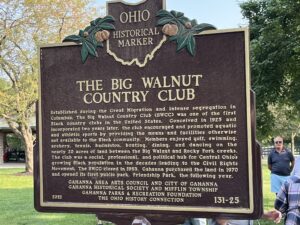
, OH
Established during the Great Migration and intense segregation in Columbus, The Big Walnut Country Club (BWCC) was one of the first Black country clubs in the United States. Conceived in 1925 and incorporated two years later, the club encouraged and promoted aquatic and athletic sports by providing the means and facilities otherwise not available to the Black community. Members enjoyed golf, swimming, archery, tennis, badminton, boating, dining, and dancing on the nearly 20 acres of land between the Big Walnut and Rocky Fork creeks. The club was a social, professional, and political hub for Central Ohio’s growing Black population in the decades leading to the Civil Rights Movement. The BWCC closed in 1963. Gahanna purchased the land in 1970 and opened its first public park, Friendship Park, the following year.
, OH
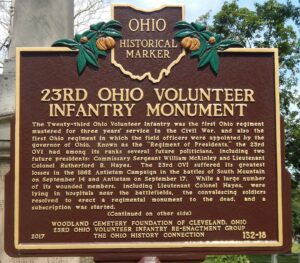
The Twenty-third Ohio Volunteer Infantry was the first Ohio regiment mustered for three years’ service in the Civil War, and also the first Ohio regiment in which the field officers were appointed by the governor of Ohio. Known as the “Regiment of Presidents,” the 23rd OVI had among its ranks several future politicians, including two future presidents: Commissary Sergeant William McKinley and Lieutenant Colonel Rutherford B. Hayes. The 23rd OVI suffered its greatest losses in the 1862 Antietam Campaign in the battles of South Mountain on September 14 and Antietam on September 17. While a large number of its wounded members, including Lieutenant Colonel Hayes, were lying in hospitals near the battlefields, the convalescing soldiers resolved to erect a regimental monument to the dead, and a subscription was started. (Continued on other side)
, OH
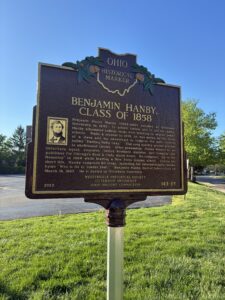
Benjamin Russel Hanby (1833-1867) enrolled at Otterbein University in 1849. To afford tuition and to aid his family, Hanby alternated college terms with teaching in nearby public schools. While a student in 1856, he was moved by the story of a slave and his sweetheart to compose the anti-slavery ballad “Darling Nelly Gray.” The song quickly proved popular in abolitionist circles. After graduation, Hanby worked as an Otterbein agent, educator, United Brethren minister, and compiler and publisher for Chicago’s Root & Cady music house. He composed “Up on the Housetop” in 1864 while leading a New Paris singing school. During his short life, Hanby composed 80 songs, including the internationally-known hymn “Who is He in Yonder Stall.” Benjamin Hanby died of tuberculosis on March 16, 1867. He is buried in Otterbein Cemetery.
, OH
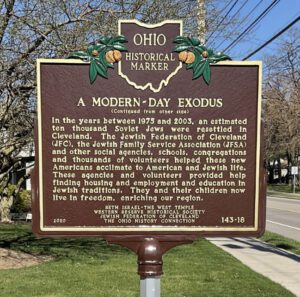
Here in 1963 congregants of Beth Israel-The West Temple, led by Louis Rosenblum, Herb Caron, and Rabbi Daniel Litt, founded the Cleveland Committee (later Council) on Soviet Anti-Semitism, the first American organization created to advocate for freedom for Soviet Jews. In 1970 this work led to the formation of the Union of Councils for Soviet Jews (UCSJ) under the leadership of Louis Rosenblum. The UCSJ, whose national office was located here 1970-1973, became the largest independent Soviet Jewry organization in the world. By the turn of the 21st century, the efforts begun here helped 1.6 million Jews leave the former Soviet Union. (Continued on other side)
, OH
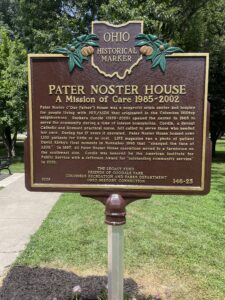
Pater Noster (“Our Father”) House was a nonprofit crisis center and hospice for people living with HIV/AIDS that originated in the Columbus Hilltop neighborhood. Barbara Cordle (1939-2020) opened the center in 1985 to serve the community during a time of intense homophobia. Cordle, a devout Catholic and licensed practical nurse, felt called to serve those who needed her care. During the 17 years it operated, Pater Noster housed over 1,100 patients for little or no cost. LIFE magazine ran a photo of patient David Kirby’s final moments in November 1990 that “changed the face of AIDS.” In 1997, all Pater Noster House operations moved to a farmhouse on the southwest side. Cordle was honored by the American Institute for Public Service with a Jefferson Award for “outstanding community service” in 2002.