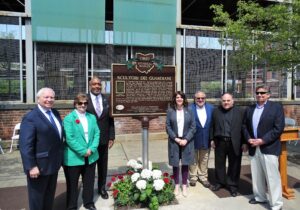
Guardians of Traffic,” four double-sided figural pylons towering over 40-feet above either end of the Hope Memorial Bridge, have connected Cleveland’s east and west side since 1932. They were designed by architect Frank R. Walker and lead sculptor Henry Hering. More than 20 immigrant stonemasons — many fromthe Italian village of Oratino — carved the figures at Ohio Cut Stone Company on Random Road from sandstone quarried in nearby Berea. The Italian sculptors lived or worshipped in Cleveland’s Little Italy. Each hand-carved Guardian holds a different vehicle, meant to portray the history of ground transportation. Voted “an outstanding architectural triumph” by the American Institute of Steel Construction in 1936, the bridge and its iconic Guardians were added to the National Register of Historic Places in 1976.
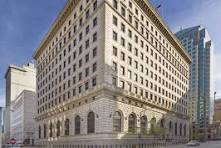
Cleveland was chosen as one of the country’s twelve Federal Reserve cities after a competitive selection process and opened its bank on November 16, 1914. The Federal Reserve Banks promote maximum employment and stable prices as part of the central banking system authorized by the 1913 Federal Reserve Act. Cleveland’s Bank serves the communities of the Fourth Federal Reserve District through supervision and regulation of financial institutions, analyzing and reporting on regional economic trends, and producing research on economic issues of importance to the nation and world. The first woman officer in any of the twelve banks was promoted to her role in 1956 by the Cleveland Fed. In 1982, the first woman in any of the nation’s Federal Reserve Banks served as the sixth President of the Federal Reserve Bank of Cleveland.
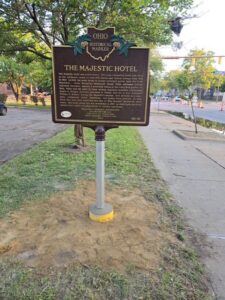
The Majestic Hotel was a five-story, 250-room residential hotel that stood on the northeast corner of East 55th Street and Central Avenue from 1902 to 1967. In 1924 the hotel began to accept overnight guests. Amid the Great Migration, owner Hungarian immigrant Joseph Weiss welcomed African American travelers, earning a perennial listing in the Green Book guides. In 1944, Weiss sold the hotel to three African American investors: businessman Alonzo G. Wright, attorney Lawrence O. Payne, and Call & Post publisher William O. Walker. During the Majestic’s heydey, such services as a pharmacy, restaurant, tailor, beautician, and barber were offered. Its Rose Room jazz club drew musicians and fans to “Blue Monday” parties for many years. The hotel closed and was demolished in 1967, as civil rights advances opened more public accommodations to African Americans.
Prominent architect William S. Lougee designed the Woodland Public Bath House that opened in 1915 at a cost of approximately $90,000. The first floor of the facility included separate shower baths for men and women, an office, waiting rooms, and a gymnasium with a 53-yard running track. The second story was divided into four rooms: a club room, a small city library branch, a baby dispensary, and clinic. The basement featured an indoor swimming pool popular among adults and children. Like other public bath houses in Cleveland, the Woodland Bath House was an invaluable social space for its diverse community of largely Hungarian, but also Slovak, Bohemian, Italian, Lithuanian, and Jewish residents. In 1918, the City estimated that 254,508 residents had used Woodland Bath House facilities, enjoying classes, camps, baths, and clinics.