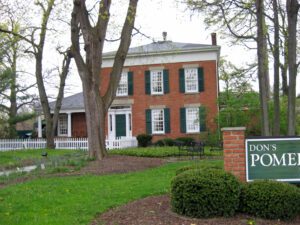
The Pomeroy House, built from 1847 to 1848, was the home of Alanson Pomeroy and his wife, Kezia. They continued the tradition, known as “Pomeroy Hospitality,” that began when Alanson’s parents established a tavern in Strongsville. Prominent in the community, Alanson served as township trustee and Justice of the Peace in Strongsville Township, and was a leader in the Congregational Church. Oral tradition holds that the Pomeroy House served as a stop on the Underground Railroad. Runaway slaves were brought from Oberlin, often concealed under bales of hay in wagons, and hidden in the cellar of the house until they could be safely taken to Rocky River. From there, the fugitives boarded ships headed to Canada. The Pomeroy House, listed on the National Register of Historic Places, was restored in 1979 and opened as Don’s Pomeroy House restaurant in 1980.
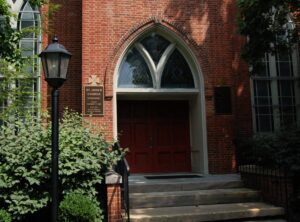
In October of 1803, members of The Scioto Company, led by James Kilbourne, came from Connecticut and founded Worthington. On February 6, 1804, the Articles of Agreement establishing St. John’s Church of Worthington were executed. St. John’s, which had been planned in Connecticut prior to the Company’s departure, became the first Episcopal church established in the Northwest Territory and served as the founding church for several Episcopal churches in Ohio. James Kilbourne served as the church’s first Deacon. Reverend Philander Chase, the first Rector of St. John’s, became the first Episcopal Bishop of Ohio and founded Kenyon College. St. John’s Church and graveyard are listed on the National Register of Historic Places.
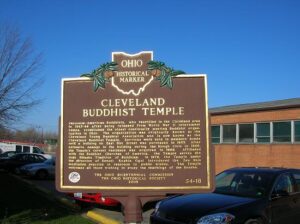
Japanese-American Buddhists, who resettled in the Cleveland area in 1943-44 after being released from World War II internment camps, established the oldest continually meeting Buddhist organization in Ohio. The organization was originally known as the Cleveland Young Buddhist Association and is now known as the Cleveland Buddhist Temple. Services were held in members’ homes until a building on East 81st Street was purchased in 1955. After extensive damage to the building during the Hough riots in 1966, the Temple’s current residence was acquired in 1968. Affiliated with the Buddhist Churches of America, the Temple serves the Jodo Shinshu Tradition of Buddhism. In 1979, the Temple under the direction of Sensei Koshin Ogui introduced the Zen Shin meditation practice in response to public wishes. The Temple welcomes all those wishing to study the teachings of the Buddha.
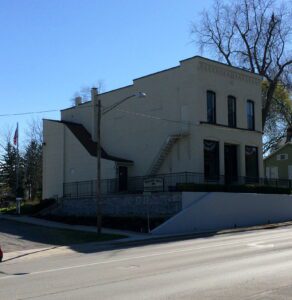
Henry Hanford Wakeman (1840-1879) of New York came to Waterville and became a successful businessman. He conceived the idea of a local Masonic Lodge, which became Wakeman Lodge No. 522 Free and Accepted Masons in 1879, and bequeathed $1,000 toward the construction of a meeting place. In 1880, a cornerstone was laid and this building was dedicated on October 21, 1881. For over 100 years, the Masons held their meetings upstairs while the lower floor was often rented out to a succession of businesses or used for public gatherings. Rising maintenance expenses and lower membership numbers caused the Masons to put Wakeman Hall up for sale in 1995. The Waterville Historical Society purchased the building in 1997 and spent several years rehabilitating it to serve as a local history archive and the Historical Society’s meeting place.
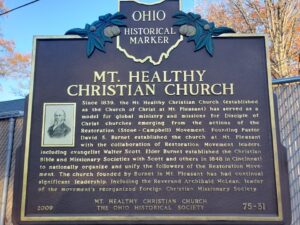
Since 1839, the Mt. Healthy Christian Church (established as the Church of Christ at Mt. Pleasant) has served as a model for global ministry and missions for Disciple of Christ churches emerging from the actions of the Restoration (Stone-Campbell) Movement. Founding Pastor David S. Burnet established the church at Mt. Pleasant with the collaboration of Restoration Movement leaders, including evangelist Walter Scott. Elder Burnet established the Christian Bible and Missionary Societies with Scott and others in 1848 in Cincinnati to nationally organize and unify the followers of the Restoration Movement. The church founded by Burnet in Mt. Pleasant has had continual significant leadership, including the Reverend Archibald McLean, leader of the movement’s reorganized Foreign Christian Missionary Society.
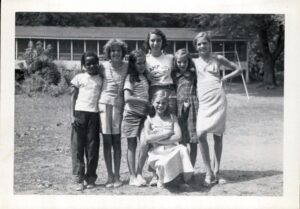
Camp Joy was born at the site of Seven Hills Neighborhood House and original location of St. Barnabas Episcopal Mission Church. Displacement and loss caused by Ohio River flood of 1937 inspired St. Barnabas’ rector and his wife, Laurence “Cap” and Sadie Hall, to act on behalf of the children of Cincinnati’s West End. The Halls conceived of Camp Joy as a haven where kids could find a respite from impoverished surroundings in the city and its sweltering summer heat. The camp was a success and continued after the Halls’ assignment to another parish. From 1940-1944, Rev J. Brooke and Mrs. Betty Mosley continued to nurture the people of the West End through St. Barnabas and Camp Joy. (Continued on other side)
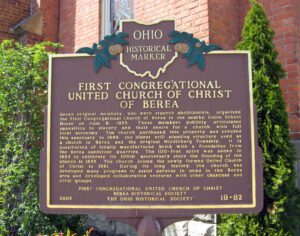
Seven original members, who were staunch abolitionists, organized the First Congregational Church of Berea in the nearby Union School House on June 9, 1855. These members publicly articulated opposition to slavery and their desire for a church with full local autonomy. The church purchased this property and erected this sanctuary in 1869, the oldest still standing structure used as a church in Berea and the original Middleburg Township. It is constructed of locally manufactured brick with a foundation from the Berea sandstone quarries. The 100-foot spire was added in 1954 to celebrate its 100th anniversary since the founding of the church in 1855. The church joined the newly formed United Church of Christ in 1961. During its long history, the church has developed many programs to assist persons in need in the Berea area and developed collaborative ventures with other churches and civic groups.
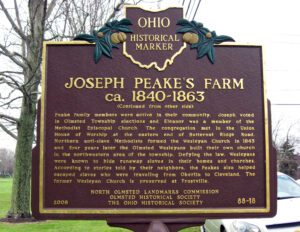
Joseph Peake was born in Pennsylvania in 1792 and came to Ohio in 1809 with his parents and brother. They were the first African Americans to settle permanently in the Cleveland area. He was the son of George Peake, a runaway slave from Maryland, who fought on the British side at the Battle of Quebec in 1759 during the French and Indian War. A man with some means and talent, George Peake invented a stone hand mill for grinding corn, a labor-saving device that endeared the Peakes to their neighbors in western Cuyahoga County. Joseph Peake and his wife Eleanor, an African American from Delaware, bought land in the 1840s on the Mastick Plank Road and built a home near this marker. [Continued on other side]