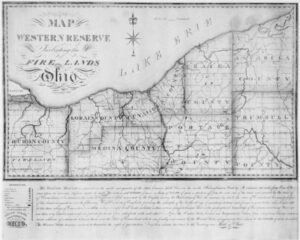
On July 4, 1796, Moses Cleaveland and his survey party landed at the mouth of Conneaut Creek on the southern shore of Lake Erie in what is today Conneaut, Ohio. The Connecticut Land Company, a private land speculation enterprise, had hired General Cleaveland as its agent to survey the Connecticut Western Reserve lands and to found a settlement along the Cuyahoga River, later named Cleveland. Group members pitched tents and erected a crude shelter to protect the provisions and survey equipment before celebrating the independence of the new country with toasts and salutes. The next day they organized into field groups to begin the historic survey of measuring the townships and ranges of the Western Reserve.
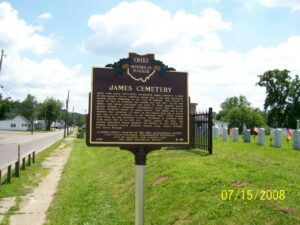
Major John James (1772-1854) established James Cemetery in 1828 on and around a Native American mound that is the only significant ancient mound remaining in the city of Jackson. The mound is about 70 feet in diameter and nearly six feet tall. In the late 1800s, this mound comprised one point of three ancient mound groups forming a triangular configuration along East Broadway Street, formerly known as James Street. One group was a few hundred feet northeast of here on the Watson farm and a second was just to the northwest on the Warnicke farm. These mounds were built by the Hopewell Culture, prominent in southern Ohio from about 100 BC to 400 AD. Major James, his wife, and several immediate family members are buried on the mound including Jackson County pioneers Andrew Long, Daniel Hoffman, and David Mitchell.
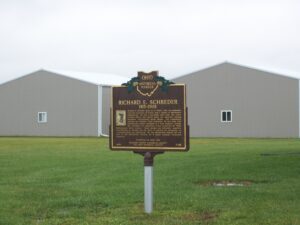
Richard E. Schreder grew up in Toledo, Ohio and graduated from the University of Toledo with a degree in Mechanical Engineering. He was a decorated navy pilot and iconic aviation figure who helped shape the American soaring movement, international glider design, and competitive soaring and piloting flight strategies. He also made high performance gliders available to a wide audience through the affordable kit production of his distinctive HP (High Performance) glider designs. These designs and Schreder’s numerous contributions to aviation and the sport of soaring are recognized as “groundbreaking and pioneering” by the Smithsonian Museum and are part of the Smithsonian National Air & Space Museum’s permanent collection. (continued on other side)
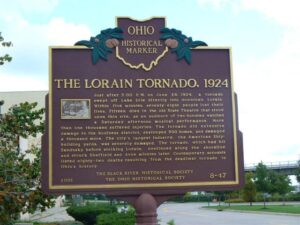
Just after 5:00 P.M on June 28, 1924, a tornado swept off Lake Erie directly into downtown Lorain. Within five minutes, seventy-eight people lost their lives. Fifteen died in the old State Theatre that stood upon this site, as an audience of two hundred watched a Saturday afternoon musical performance. More than one thousand suffered injuries. The tornado did extensive damage to the business district, destroyed 500 homes, and damaged a thousand more. The city’s largest industry, the American Shipbuilding yards, was severely damaged. The tornado, which had hit Sandusky before striking Lorain, continued along the shoreline and struck Sheffield and Avon minutes later. Contemporary accounts listed eighty-two deaths resulting from the deadliest tornado in Ohio’s history.
William McKinley was the 25th President of the United States. Following McKinley’s assassination in 1901, the Village of Jackson dedicated this triangle of land as a park in his honor. Earlier in the nineteenth century, a small school had occupied the plot. In 1902, a local commission was appointed to oversee the development of a park. It was not, however, until 2012 that the Jackson Garden Lovers Club finished the commission’s long overdue work. The park was dedicated in 2013, 111 years after it began.
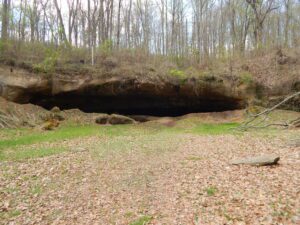
On a forested hillside south of New Straitsville, the spacious 1000 square foot Robinson’s Cave offered a secluded location with great acoustics where large groups of Hocking Valley coal miners could meet in secret. Beginning in about 1870, labor-organizing meetings were held at the cave by various emerging unions including the Knights of Labor. New Straitsville resident Christopher Evans, a well-known union organizer, used Robinson’s Cave to lead miners throughout the long Hocking Valley Coal Strike of 1884-1885. These meetings gave the miners a voice in the formation of a national organization called the National Federation of Miners and Mine Laborers, later renamed the National Progressive Union. The cave was also where non-union miners met to plan to set the Columbus & Hocking Coal & Iron Company mines on fire in a desperate attempt to end the Hocking Valley Strike. [continued on other side]
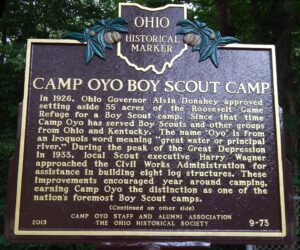
In 1926, Ohio Governor Alvin Donahey approved setting aside 55 acres of the Roosevelt Game Refuge for a Boy Scout camp. Since that time Camp Oyo has served Boy Scouts and other groups from Ohio and Kentucky. The name ‘Oyo’ is from an Iroquois word meaning “great water or principal river.” During the peak of the Great Depression in 1933, local Scout executive Harry Wagner approached the Civil Works Administration for assistance in building eight log structures. These improvements encouraged year around camping, earning Camp Oyo the distinction as one of the nation’s foremost Boy Scout camps. (Continued on other side)
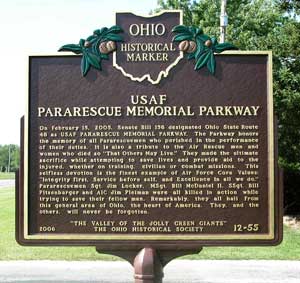
On February 15, 2005, Senate Bill 156 designated Ohio State Route 48 as USAF PARARESCUE MEMORIAL PARKWAY. The Parkway honors the memory of all Pararescuemen who perished in the performance of their duties. It is also a tribute to the Air Rescue men and women who died so “That Others May Live.” They made the ultimate sacrifice while attempting to save lives and provide aid to the injured, whether on training, civilian or combat missions. This selfless devotion is the finest example of Air Force Core Values: ” Integrity first, Service before self, and Excellence in all we do.” Pararescuemen Sgt. Jim Locker, MSgt. Bill McDaniel, SSgt Bill Pitsenbarger and AIC Jim Pleiman were all killed in action while trying to save their fellow man. Remarkably, they all hail from this general area of Ohio, the heart of America. They, and the others, will never be forgotten.