

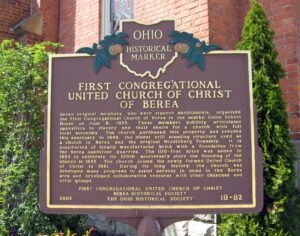
, OH
Seven original members, who were staunch abolitionists, organized the First Congregational Church of Berea in the nearby Union School House on June 9, 1855. These members publicly articulated opposition to slavery and their desire for a church with full local autonomy. The church purchased this property and erected this sanctuary in 1869, the oldest still standing structure used as a church in Berea and the original Middleburg Township. It is constructed of locally manufactured brick with a foundation from the Berea sandstone quarries. The 100-foot spire was added in 1954 to celebrate its 100th anniversary since the founding of the church in 1855. The church joined the newly formed United Church of Christ in 1961. During its long history, the church has developed many programs to assist persons in need in the Berea area and developed collaborative ventures with other churches and civic groups.
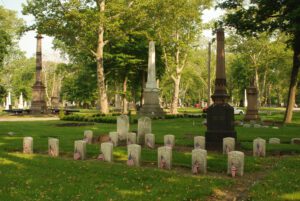
, OH
Howard Daniels, who lived from 1815-1863, was a noted architect and landscape gardener. Over the course of his life, he designed six Ohio and New York cemeteries, including Woodland that began in 1852 when he laid out 20 of its 60 acres into fashionable “rural cemetery” style. Later acreage in the cemetery adapted his curvilinear design. “As beautifully prepared for a burial place as fancy and taste could desire,” Woodland was dedicated on June 14, 1853, and became Cleveland’s primary cemetery. An ornate gatehouse, chapel, and fountains came later. Generations of Clevelanders, pioneering and prominent, as well as veterans onward from the War of 1812, are buried here. For more than a century, Woodland, in its original and newly platted sections, has embraced people from every race, the rich and poor, natives and immigrants, and the famous and obscure. It has truly become a community cemetery. [continued on other side]
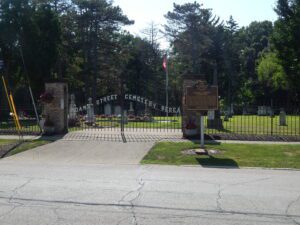
, OH
Known as the “Village Cemetery,” this was Berea’s main burial ground from 1834 to the 1880s. However, in 1886, the Cleveland Stone Co. purchased quarries adjacent to the cemetery, where Coe Lake is today. Quarrying had already caused flooding and landslides in the area. Local stories say that the company operated too near to the edge of cemetery, causing a landslide in the northwest corner that exposed some graves. Worried families moved their loved ones’ remains to other cemeteries, including those of five Civil War veterans. Pioneering families, 16 Civil War veterans, 3 mayors of Berea, several quarry owners, and many ordinary people still rest here. Of the original 589 burials, 40% were children. (Continued on other side)
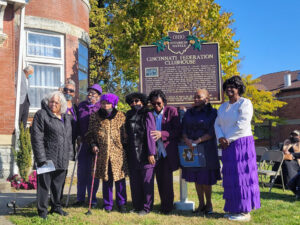
, OH
“Lifting As We Climb”: The Cincinnati Federation of Colored Women’s Clubs (CFCWC) was organized May 6, 1904, during a meeting called by Mary Fletcher Ross at the Allen Temple A.M.E. Church. Gathering together eight existing African-American women’s clubs, the CFCWC sought to unite in their work promoting “the betterment of the community.” At a time when both government and private philanthropies overlooked the needs of Black Americans, CFCWC members helped to organize the city’s first kindergartens for Black children, taught in Cincinnati African-American public schools –including the Walnut Hills Douglass and Stowe schools—and raised money for the Home of Aged Colored Women. Since 1904, the Cincinnati Federation of Colored Women’s Clubs has ensured the civic and constitutional rights of all African Americans while meeting the needs of their city.
, OH
In 1792, Captain Jacob White claimed land traditionally home to the Shawnee, Delaware (Lenni Lenape), Potawatomi, Miami, Wyandot, Seneca, Chippewa (Ojibwe or Anishinaabeg), Ottawa, and Wapakoneta indigenous nations. Located at the third crossing of Mill Creek, White’s Station, with a blockhouse and six cabins, served as a supply depot to nearby Cincinnati. On October 18, 1793, indigenous groups attacked the settlement in an effort to defend their ancestral lands. During the conflict, five people died: three members of David Flin’s family – Andrew Gobel and two of the Pryer children — as well as a tribal leader and his son whose names were not recorded. Andrew Pryer rushed to Fort Washington 10 miles away and returned with infantrymen who remained while a stockade was built to fortify the settlement.
, OH
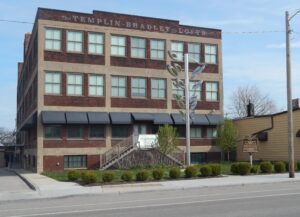
In 1907, the Templin-Bradley Company’s Children’s Flower Mission was developed in response to the Cleveland Public Schools Horticulture Program, supplying seed packets for 1 cent each–commonly referred to as Penny Packet Seeds. This earned the company a reputation for being the nation’s largest distributor of seeds for school garden programs. Although only nine varieties of plants were offered, interest was so great that nearly 50,000 packages were sold during the first year with no expense to the public-school teachers. With great success realized in the local school gardening program, interest grew exponentially across the nation and programs began in other cities. For fifty years, the Templin-Bradley Company sold flower and vegetable seeds at low costs to student members of garden groups throughout the country, cultivating many generations of gardeners.
, OH
In 1907, the Templin-Bradley Company’s Children’s Flower Mission was developed in response to the Cleveland Public Schools Horticulture Program, supplying seed packets for 1 cent each–commonly referred to as Penny Packet Seeds. This earned the company a reputation for being the nation’s largest distributor of seeds for school garden programs. Although only nine varieties of plants were offered, interest was so great that nearly 50,000 packages were sold during the first year with no expense to the public-school teachers. With great success realized in the local school gardening program, interest grew exponentially across the nation and programs began in other cities. For fifty years, the Templin-Bradley Company sold flower and vegetable seeds at low costs to student members of garden groups throughout the country, cultivating many generations of gardeners.
, OH
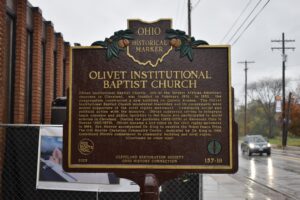
Olivet Institutional Baptist Church, one of the largest African American churches in Cleveland, was founded in February 1931. In 1950, the congregation constructed a new building on Quincy Avenue. The Olivet Institutional Baptist Church ministerial leadership and its congregants were ardent supporters of the civil rights movement. Combining social and political action with the ministry, Olivet supported sit-ins to integrate lunch counters and public facilities in the South and participated in social activism in Cleveland. During the pastorate (1952-1973) of Reverend Odie M. Hoover (1921-1973), Olivet became a key voice in the civil rights movement. In 1964, Rev. Hoover accompanied Dr. King to receive the Nobel Peace Prize. The O.M. Hoover Christian Community Center, dedicated by Dr. King in 1966, symbolized Olivet’s commitment to community building and civil rights. (Continued on other side)