

, OH
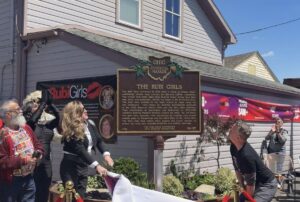
The Rubi Girls originated in 1984 when a group of friends began performing comedy drag routines for Dayton’s LGBTQ+ community. The troupe took their name from Rubicon Street where they first met, lived, and performed. During the height of the HIV/AIDS crisis, The Rubi Girls decided to use their talents to raise funds for the community. They began by donating performance proceeds to the Ohio AIDS Coalition and volunteering as performers and facilitators at the Ohio AIDS Coalition Healing Weekend Retreats. By the 1990s, The Rubi Girls expanded their fundraising efforts to include such annual benefit galas as Kweenz with Kause, Masquerage, and The Show Must Go On. For almost four decades, the Rubi Girls have shared their comedy while raising millions of dollars for local and regional HIV/AIDS and LGBTQ+ charities.
, OH
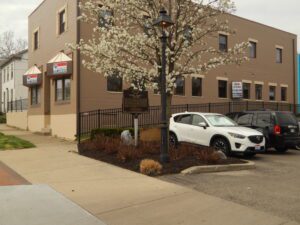
Raised and educated in St. Louis, author Fannie Hurst (1885-1968) was born in Hamilton at 918 Central Avenue, the home of her maternal grandparents. She was the daughter of Rose Koppel and Samuel Hurst. Already a writer as a student at Washington University (Class of 1909), Fannie moved to New York in 1910 to begin her career. Success came after repeated rejection. Stories for popular magazines brought her attention in the mid-1910s; by the mid-1920s she had become a best-selling, highly-regarded, and well-paid author. Between 1912 and 1964, Hurst wrote 18 novels, eight short story collections, and many other pieces. Hurst’s short story “Humoresque” (1919) and the novels Back Street (1931) and Imitation of Life (1933) were three of 32 films based on her writings. The film adaption of Imitation of Life received an Oscar nomination for Best Picture in 1934. (Continued on other side)
, OH
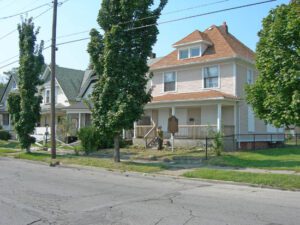
Art Tatum was born in Toledo on October 13, 1909, the son of Arthur Tatum, Sr. and Mildred Hoskins Tatum. Despite being blind in one eye and only partially sighted in the other, he became one of the greatest jazz pianists of his era. To deal with his sight disability, he attended the Ohio State School for the Blind in Columbus from 1918-1920. He came from a musical family and had some formal training at the Toledo School of Music, but was largely self-taught. Influenced by famed Fats Waller, Tatum began playing his music on a local radio station at age 18 and then lived in Chicago, New York City, Cleveland, and Los Angeles, playing and recording extensively both as a soloist and in small groups. His ability to improvise set him apart as a musical genius. Tatum died in November 1956 and was named to the Jazz Hall of Fame in 1983.
, OH
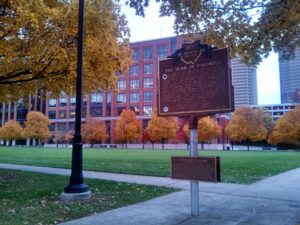
Thousands of Irish immigrants came to Columbus to seek personal and religious freedom. With the “Great Hunger” in Ireland and the completion of the Ohio and Erie Canal and the National Road, immigration to Columbus increased in the mid nineteenth century. They initially settled in the north side of the city in the swamp flats, where inexpensive land was available and work could be had on the railroads. Settlement spread to Franklinton, on Naghten Street, later known as “Irish Broadway”- part of which is now Nationwide Boulevard, and to nearby Flytown. The immigrants became domestic workers, civil servants, entrepreneurs, and served the city in police and fire departments. Others were leaders in government, law, medicine, and education. Their legacy continues today in the Irish-American population of Columbus, Ohio.
, OH
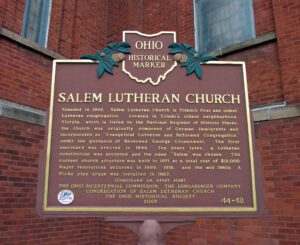
Founded in 1842, Salem Lutheran Church is Toledo’s first and oldest Lutheran congregation. Located in Toledo’s oldest neighborhood, Vistula, which is listed on the National Register of Historic Places, the church was originally composed of German immigrants and incorporated as “Evangelical Lutheran and Reformed Congregation” under the guidance of Reverend George Cronenwett. The first sanctuary was erected in 1844. Ten years later, a Lutheran constitution was accepted and the name “Salem” was chosen. The current church structure was built in 1871at a total cost of $12,000. Major renovations occurred in 1889, 1916, and the mid 1960s. A Wicks pipe organ was installed in 1967. (continued on other side)
, OH
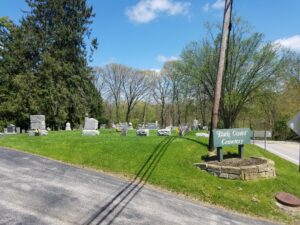
Settlers from New England purchased this land in 1817 for use as a burying ground and to build a meeting house. Located in the center of Bath Township, a part of the Connecticut Western Reserve, the site provided a convenient place for public and religious gatherings and for a cemetery. Out of need, the cemetery was established before the township was founded in 1818. Many of Bath Township’s farming families, as well as both owners and operators of businesses of Bath, are interred in the cemetery. In a tradition originating with Civil War veteran Perry Alexander, the graves of all veterans are marked with an American flag on Memorial Day as a tribute to their service.
, OH
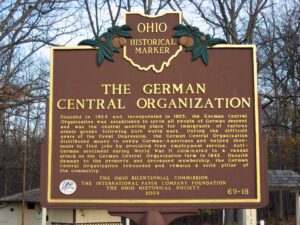
Founded in 1924 and incorporated in 1925, the German Central Organization was established to serve all people of German descent and was the central meeting place for immigrants of various ethnic groups following both world wars. During the difficult years of the Great Depression, the German Central Organization distributed money to needy German-Americans and helped thousands to find jobs by providing free employment service. Anti-German sentiment during World War II culminated in a vandal attack on the German Central Organization farm in 1942. Despite damage to the property and decreased membership, the German Central Organization rebounded and remains a solid pillar of the community.
, OH
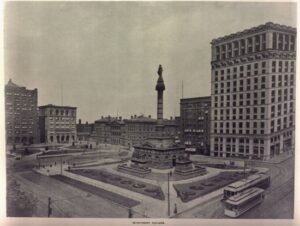
This monument, dedicated July 4, 1894, honors Cuyahoga County men and women, who performed military and patriotic duties during the Civil War (1861-1865). William J. Gleason (1846-1905), army veteran and local businessman, proposed its creation in 1879. Captain Levi Tucker Scofield (1842-1917), Cleveland architect and sculptor, designed the structure and supervised its 19-month construction by contractors, A. McAllister and Andrew Dall. George T. Brewster of Boston and George Wagner of New York, professional artists, assisted Scofield as sculptors. A 12-member Monument Commission, appointed by Governor Joseph B. Foraker in 1888, oversaw the project, which included the removal of William Walcutt’s 1860 marble statue of Commodore Oliver Hazard Perry from the site. The monument’s cost of $280,000 was raised by a countywide property tax levy. An 11-member commission maintains the monument funded by the county. (continued on other side)