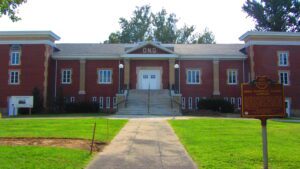
With a mission to protect citizens at home and aboard, the Ohio National Guard was originally established as the Northwest Territory Militia in Marietta on July 25, 1788, and has fought in every war since the War of 1812. Built in 1914, this Ohio National Guard Armory served both as Regimental and Company B, 7th Infantry, O.N.G. Headquarters. Later Company A, 166th Infantry, 37th Division, occupied the dual-purpose armory. The armory served Washington County as a departure point for soldiers leaving for service in World War I, World War II, and Korea. The armory also served the area in times of crisis and celebration, often used by the Red Cross, Marietta College, and other civic groups.
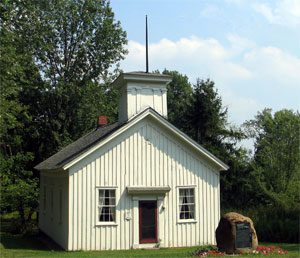
Called the “Cradle of Equal Suffrage” and “Free Speech Chapel,” Union Chapel was to be “…open and free for all denominations, but to be monopolized by no one or to the exclusion of anyone.” Built in 1858 or 1859 on land donated by Anson Matthews, the chapel reputedly exists in response to incident triggered by James A. Garfield, then principal of the Western Reserve Eclectic Institute (now Hiram College) and later president of the United States. He was scheduled to speak at the Congregationists’ “Brick Church” in December 1857. Because of the supposed controversial nature of Garfield’s speech, however, the invitation was withdrawn. (Continued on other side)
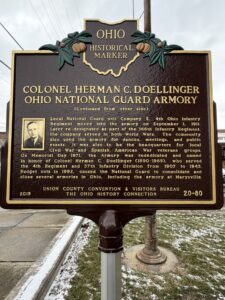
The Marysville Ohio National Guard Armory was the first such armory constructed in the state after the recognition of the Guard in 1909. The new armory and others like it were built in response to federalization of National Guard units after the passage of the Militia Act of 1903. Armory buildings served as the headquarters for local companies and provided drill rooms and arsenals for the storage of military equipment and supplies. Architect Charles Insco Williams designed Marysville’s armory and it was built by James Laughlin, both of Dayton, Ohio. Marysville contractor George W. Fox provided the brickwork for the structure. Construction began in 1910 and was completed in 1911 at a cost of $19,886. (Continued on other side)
801 E. Pete Rose Way, Bicentennial Commons at Sawyer Point
Cincinnati
, OH
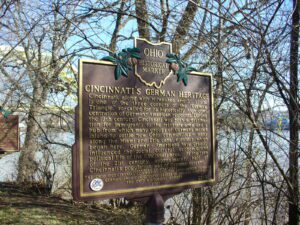
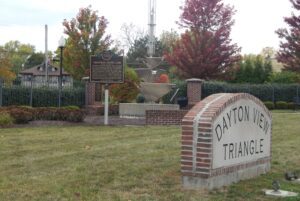
Cincinnati, along with Milwaukee and St. Louis, is one of the three corners of the “German Triangle,” so-called for its historically high concentration of German-American residents. During the 19th century, Cincinnati was both a destination for immigrants to the tri-state area and a hub from which many groups of Germans moved inland to settle new Ohio communities-many along the Miami and Erie canal corridor which began here. German-Americans have greatly influenced the social, cultural, economic and political life of the Cincinnati area. At the turn of the 21st century, approximately half of Cincinnati’s population was of German descent. (Continued on other side)
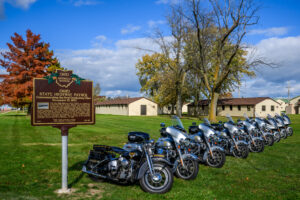
The Ohio State Highway Patrol (OSHP) was created by Ohio House Bill 270 in 1933. Over 5,000 applications to join the newly formed Division were trimmed and approximately 125 individuals — between the ages of 24 and 40 years — were admitted into the inaugural cadet class. The Ohio National Guard graciously volunteered the use of their facilities on Lake Erie’s shores. Colonel Lynn Black, the first OSHP superintendent, opened “Camp Perry School” on October 3, 1933. Although 54 new motorcycles were purchased for patrol duties, many of the cadets lacked motorcycle experience and had to be trained quickly. Severe weather shortened the training as cadets endured frigid temperatures and unheated facilities. The first class of 60 uniformed patrolmen were sworn in on November 15, 1933.
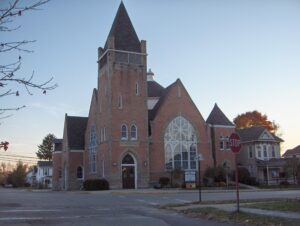
The Mechanicsburg United Methodist congregation was founded in the early nineteenth century and met first in open-air camp meetings before moving into a small log school building. In 1820 the congregation built a wood framed church on East Sandusky Street and that building was replaced with a brick structure in 1838. The congregation split in 1853 into Trinity Methodist and First Methodist with both groups serving the village of Mechanicsburg for 103 years before coming back together in 1956. The current United Methodist Church was built in the early 1890s and dedicated in 1894 on the corner of Main and Race Streets. The Gothic Revival style church was placed on the National Register of Historic Places in 1985.
“…this was the area that supported us, which made us…” –Roger Troutman (1951-1999). Hits by Roger and Zapp, such as “More Bounce to the Ounce” (1980) and the albums Zapp (1980), The Many Facets of Roger (1981), and Zapp II (1982) made Troutman Sound Labs possible. The studio was finished in 1983. The music produced here included the Gold-selling album New Zapp IV U (1985), Shirley Murdock’s self-titled Gold album (1987), and Roger’s “I Want to Be Your Man,” which was #1 on Billboard’s Hot R&B/Hip Hop chart and #3 on the Pop chart in late 1987. (Continued on other side)
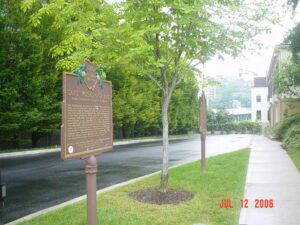
The first African American artist to achieve international acclaim, painter Robert S. Duncanson (1821-1872) was born in New York and settled in Cincinnati in 1840. He pursued his artistic career during a time of tremendous racial prejudice and was acknowledged as the “best landscape painter in the West.” Arts patron Nicholas Longworth commissioned murals from Duncanson around 1850 for his home Belmont, now the Taft Museum of Art; these paintings are regarded as one of the finest pre-Civil War domestic decoration schemes in the United States. Sponsored by anti-slavery groups, he traveled widely during the 1860s in Europe. Duncanson rose above oppression to create expressions of African American cultural identity, leading the way for other people of color to pursue careers in the arts.