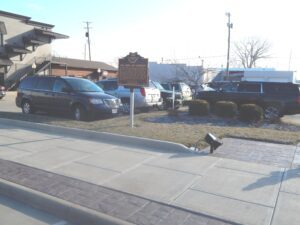
Henry Simon Winzeler, founder of The Ohio Art Company, was born in 1876 in the Winzeler family home just north of this site in Burlington. As a young man, he opened a dental practice in 1900 in the Murbach Building in Archbold on the corner of North Defiance and East Holland streets. Making a dramatic career change eight years later, Winzeler, inspired by an oval mirror in his aunt’s clothing store, started a company to manufacture picture frames. Calling it The Ohio Art Company, venture capital came from Winzeler’s Hub Grocery that he opened in August 1908 located on North Defiance Street. His picture frame company was opened in the Spoerle and Baer Building, a few doors down on the same street. [Continued on other side]
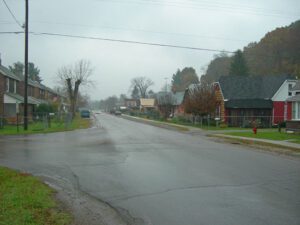
Originally known as Hocking Furnace, Haydenville was founded by and named for Columbus industrialist Peter Hayden (1806-1888), who energetically developed the coal, iron, sandstone, and fire clay deposits found in abundance in this area. Here he operated an iron furnace, coal mines and sandstone quarries, shipping products on the Hocking Canal and, later, the Hocking Valley Railroad he helped build. The incorporation of the Haydenville Mining and Manufacturing Company in 1882 initiated the manufacture of brick and ceramic tile from fire clay. Business boomed in the late 19th century as cities paved their streets with brick and fireproof construction became popular in the wake of widely publicized and tragic fires.
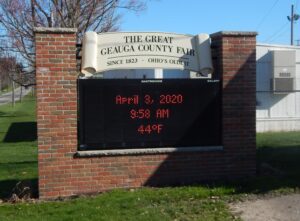
The Great Geauga County Fair is the longest continuously operating county fair in Ohio. The fair is a major county gathering event each year, pulling together people from the whole county. Geauga’s settlers imported the idea of the county fair with them from New England. The fair’s parent organization, the Geauga County Agricultural and Manufacturing Society, began holding fairs on Chardon Square in 1823. Since then, the Geauga County Fair has served as a gathering place and form of education to promote local agriculture and introduce farmers to new farming developments and each other. Controversy arose between 1840 and 1854 after Lake County ceded and Chardon, Claridon, and Burton vied for the permanent fair grounds. Burton’s proposal was accepted, improvements began immediately, and the fair grew quickly. The Great Geauga County Fair continues as a time-honored tradition.
Zenas King (1818-1892) was a 19th century bridge builder whose iron bridges received wide acceptance throughout the country. He developed his tubular bowstring bridge in 1859, patented the design in 1861, renewed the patent in 1867, and founded King Iron Bridge & Manufacturing Company in 1871. Based on an arch’s inherent strength, King’s design used less raw materials than wooden bridges and the square tubes were simple to fabricate and ship for on-site assembly. His Cleveland-based company soon built so many patent bowstrings across Ohio that it set a design standard. (Continued on other side)
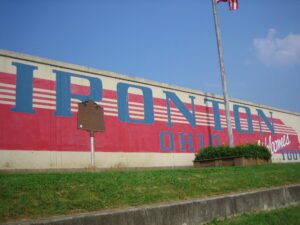
In 1849, the city of Ironton was founded by local ironmasters, railroaders, and financiers associated with the Ohio Iron and Coal Company. They saw the city as a manufacturing and shipping point for their products. As a young industrial city, Ironton prospered when river transportation facilitated the development and export of Lawrence County’s natural resources and manufactured items. The Iron Railroad Company was also established to transport pig iron and manufactured goods from nearby towns to Ironton, to awaiting steamboats on the Ohio River. Steamboats, in the form of towboats, packet boats, and showboats, traveled the river providing the city with goods, services, and entertainment. The Ironton wharf and boat landing once served the community as a gathering place to greet incoming passengers, receive mail, and hear the latest news.
Seba Bronson Jr. left Columbia Township in early 1810 and followed the Rocky River to an area one and a half miles north of here. He built a cabin and planted a crop and thus started what became known as the village of Hardscrabble in Liverpool Township. The village was centered around the Columbia/Grafton Road area, and the township is the oldest continuously inhabited township in Medina County. The Potawatami Indians occupied this area and camped annually along the Rocky River. For five silver dollars, they showed Seba and a partner a hidden salt springs which they sought to exploit. Other men also scrabbled to own it and Justus Warner succeeded. Seba was turned out. Warner operated the Liverpool Salt Works beginning in 1811. The first industry in the county, salt was a necessity and eagerly sought by setters in the area.
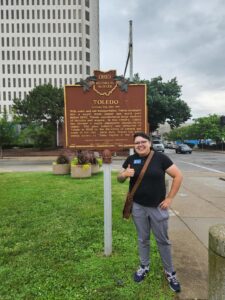
After consolidation of the villages of Fort Lawrence and Vistula, the City of Toledo was incorporated in 1837. Originally named “Toledo” in 1833, the site became part of Ohio when the “Toledo War,” a bloodless boundary conflict with Michigan, was resolved by Congress in 1836. Settlers were attracted by the commercial potential of the Maumee River, called “Miami of the Lake,” and later the Miami-Erie Canal. (Continued on other side)
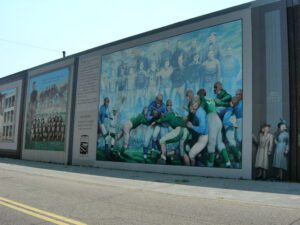
The Ohio River floodwaters account for Portsmouth’s settlement. Alexandria, the county’s first town, was laid out in 1799 on the west bank of the Scioto at its confluence with the Ohio. Early settlers in Alexandria were forced to higher ground across the river in Portsmouth because of frequent flooding. As a result, Portsmouth, platted in 1803, became Scioto County’s seat and business center by 1814. Prominent local industries included brick, stone, steel, wood products, and shoe manufacturing. As of 2003, the Ohio River is the cornerstone of Portsmouth’s transportation system, providing a means for materials to reach destinations throughout the region. It also serves as a recreation hub. The three-mile long levy, first built in 1908, failed in the 1937 flood and was subsequently improved.