


, OH
In 1918, Charles Young made a desperate attempt to convince the U.S. Army that he was fit for duty. The Army’s highest-ranking Black officer, he had been medically retired and not given a command during World War I. To demonstrate his fitness, he rode 497 miles from his home in Wilberforce, Ohio, to Washington, D.C. Leaving on June 6 he made the journey in 17 days, 16 on horseback and 1 resting. Averaging 31 miles each day, he rode 45 minutes and walked 15 minutes every hour. Upon his arrival, Young met with Secretary of War Newton Baker. Pressured by the Black press and the White House, Baker hedged. He recalled Young to active duty a year later and assigned him to Camp Grant, Illinois, just five days before the end of the war.
, OH
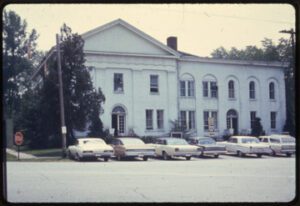
Mahoning County was created in 1846 by combining townships from southern Trumbull and northern Columbiana counties. Canfield engaged in competition with several surrounding communities for the new county seat, and its success was attributed to its central location along with the state and local political influence of Judge Eben Newton and Elisha Whittlesey, Esq., Comptroller of the United States Treasury from 1849-1857. To become the county seat, the State of Ohio required “a suitable lot and $5,000 toward public buildings” Judge Newton donated the land and spearheaded the subscription of the state required bond. Once attained, construction progressed rapidly on the Classical Revival style courthouse, completed in June 1848. The Italianate style West wing was added in 1862, but its government status was challenged when in the early 1870s, Youngstown, by now a city, resumed its earlier challenge for the county seat. (continued on other side)
, OH
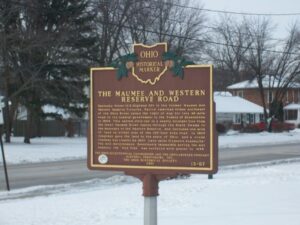
Sandusky Street (U.S. Highway 20) is the former Maumee and Western Reserve Turnpike. Native American tribes northwest of the Ohio River ceded the right of way for this 46-mile road to the federal government in the Treaty of Brownstown in 1808. This narrow strip ran in a nearly straight line from the lower Maumee River rapids through the Black Swamp to the boundary of the Western Reserve, and included one mile of land on either side of the 120-foot wide road. In 1823 Congress gave the land to the state of Ohio, and a crude roadway was cleared by 1827. Land sales financed roadbuilding and maintenance. Notoriously impassible during the wet seasons, the “Mud Pike” was surfaced with gravel in 1838.
, OH
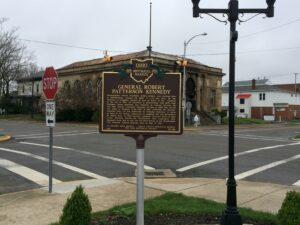
Distinguished citizen, legislator, public servant, and historian born in Bellefontaine, January 23, 1840. A Civil War hero, he was promoted to brigadier general at only 25 years of age. Admitted to the bar in 1866, he practiced in Bellefontaine until 1878 when President Hayes appointed him Collector of Internal Revenue. He was then elected Lieutenant Governor of Ohio in 1885 then served two terms in Congress from 1887 to 1891. Following the Spanish-American War, he was appointed by President McKinley to serve as head of the Insular Commission to establish the new government of Puerto Rico. In 1903 Kennedy published Historical Review of Logan County. Kennedy started the Bellefontaine Tree Commission. Gen. Kennedy’s home was on this site and later served as the Bellefontaine City Building. General Kennedy died on May 6, 1918.
, OH
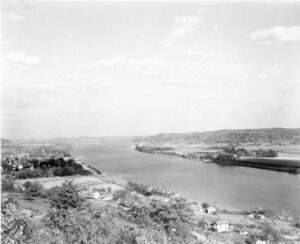
On April 1, 1818, six families from the Cilcennin area of Mid-Wales sailed from Aberaeron, Wales to Baltimore. The group of 36 people was led by John Jones Tirbach. From Baltimore they traveled to Pittsburgh and then by flatboats down the Ohio River toward their destination-Paddy’s Run in Butler County in the southwest corner of Ohio. They stopped in Gallipolis for provisions where their boats were cut loose by either travel-weary women or citizens of Gallipolis who wanted them to stay. The men found work on the Gallipolis to Chillicothe road that was under construction. The terrain reminded them of Mid-Wales, so they purchased land near Centerville and remained. These Welsh prospered and wrote home to Wales with news of their success, prompting others to come. (continued on other side)
, OH
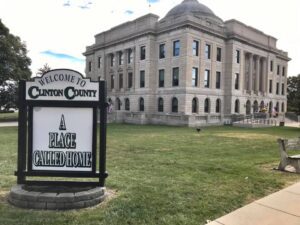
The Clinton County Courthouse was dedicated October 22, 1919. The Cincinnati firm of Weber, Werner and Adkins designed the edifice and it is a local masterpiece that fuses the Beaux-Arts and Neo-Classical architectural styles. A grand marble staircase rises from the basement to the second floor. At the center of the cruciform plan is a dome 32 feet in diameter with a stained-glass window. The murals of four women beneath the dome represent Agriculture, Education, Medicine, and Industry, and are known as the Guardians of the Courthouse. The county built courthouse and former jail for a combined cost of nearly $370,000.
, OH
“I thought of the great bandits of the old West [like] the James Brothers…They knocked over trains, and I was going to pull the same stunt,” exclaimed notorious gangster Alvin “Creepy” Karpis. On November 7, 1935, Karpis and his bandits held up Erie Train #626 at this former location of the Garrettsville Train Depot, escaping with over $46,000 in cash and securities. Because of this last great train heist in American history, FBI Director J. Edgar Hoover and his Government Men (G-Men) improved their surveillance methods to capture Karpis. Once labeled “Public Enemy Number One,” Alvin Karpis became Hoover’s first arrest on May 1, 1936. Local legend holds that FBI agents flooded this town searching for Karpis and his accomplices, and this led the James A. Garfield School District to adopt the G-Men as the mascot for its athletic teams.
, OH
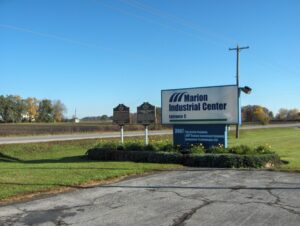
This site was once a twenty-four acre camp for Prisoners of War established on the grounds of the Marion Engineer Depot. The Depot was a major supply and logistics site of the U.S. Army Engineers during World War II. The first contingent of POWs arrived in December 1944, consisting of two hundred and fifty men, many of them Germans who had served in the Afrika Korps Panzer Division. POWs served in many capacities during their time at Camp Marion. Some worked in construction, others cooked, cleaned, and performed maintenance and office tasks around the depot. Many worked on local farms, where farmers provided food to supplement their sometimes inadequate rations so that they would have energy to be able to work a full day. By 1946 five hundred Prisoners of War could be held at Camp Marion. (Continued on other side)