

, OH
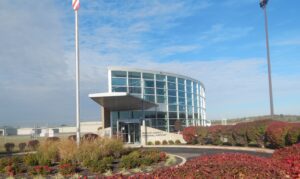
The Hogan Family owned and operated what was known as the Hamilton Airport for over 52 years. Airplane owner and pilot, Carl “Pop” Muhlberger and aviation enthusiast and farmer, Joe Hogan, co-founded the airport in July 1929. Muhlberger taught Joe to fly and in return, Joe managed and maintained the field. During the Great Depression, Muhlberger could not afford to operate the airport, closing in July 1932. With financial backing from Joe’s older brother, Charles, and their father, William, the family purchased and reopened the airport. Running the airport was a family affair. Joe taught his brothers, Bill, Bernie, and Art to fly. They raised money to run the airport by barnstorming, sightseeing flights, and flying lessons. Sisters, Mary Ann, Katie, and Loretta (Sauer), also flew. They, along with their mother Emma, helped run the airport and its restaurant. (Continued on other side)
, OH
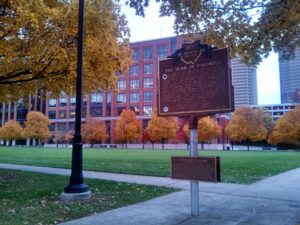
Thousands of Irish immigrants came to Columbus to seek personal and religious freedom. With the “Great Hunger” in Ireland and the completion of the Ohio and Erie Canal and the National Road, immigration to Columbus increased in the mid nineteenth century. They initially settled in the north side of the city in the swamp flats, where inexpensive land was available and work could be had on the railroads. Settlement spread to Franklinton, on Naghten Street, later known as “Irish Broadway”- part of which is now Nationwide Boulevard, and to nearby Flytown. The immigrants became domestic workers, civil servants, entrepreneurs, and served the city in police and fire departments. Others were leaders in government, law, medicine, and education. Their legacy continues today in the Irish-American population of Columbus, Ohio.
, OH
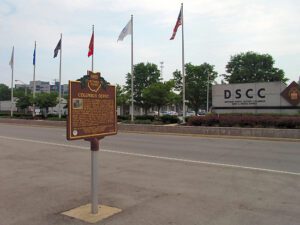
Since 1918, this installation, currently known as the Defense Supply Center, Columbus, has served the federal government as a procurement and distribution point for military supplies and equipment. Originally named the Columbus Quartermaster Reserve Depot, this location was chosen because of its immediate access to three railroad lines. Expansion of the center continued after World War I, and in the years immediately prior to World War II, the center’s mission changed to reconditioning war material for resale. During World War II, the center became the largest military supply installation in the world, employing more than 10,000 civilians and holding over 400 Axis prisoners of war in secured barracks. The installation continues to provide a variety of parts and supplies to all branches of the Armed Forces and other Federal agencies.
, OH
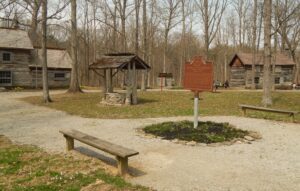
Edward Bebb, father of William Bebb and first Welshman to settle in Paddy’s Run, Morgan Township, Butler County purchased this cabin in 1801. Originally the cabin stood four miles southeast of this site on the Dry Fork of the Whitewater River. It was here that William Bebb was born on December 8, 1802, the first white child born in Butler County west of the Great Miami River. At the age of twenty, after attending district schools, William Bebb became a teacher. In 1826 he became the first teacher at Paddy’s Run School. Two years later Bebb and his wife opened a boarding school on his father’s farm. While teaching school he began the study of law and in 1831 passed the state bar examination. A year later he began to practice law in Hamilton, where he soon became an active politician. In 1840 he stumped the state for Harrison and Tyler and in 1846 he was nominated for Governor by the Whig party. He was elected on the slogan “Wm. Bebb and a Home Currency against David Tod and Pot Metal.” After his term as governor, Bebb served in a number of government positions until his retirement to his farm near Rockford, Illinois. He died on October 23, 1873.
, OH
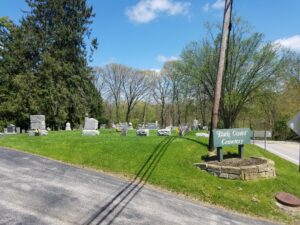
Settlers from New England purchased this land in 1817 for use as a burying ground and to build a meeting house. Located in the center of Bath Township, a part of the Connecticut Western Reserve, the site provided a convenient place for public and religious gatherings and for a cemetery. Out of need, the cemetery was established before the township was founded in 1818. Many of Bath Township’s farming families, as well as both owners and operators of businesses of Bath, are interred in the cemetery. In a tradition originating with Civil War veteran Perry Alexander, the graves of all veterans are marked with an American flag on Memorial Day as a tribute to their service.
, OH
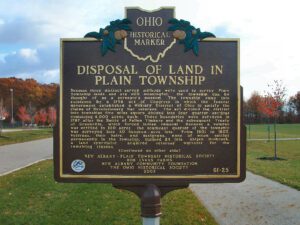
Because three distinct survey methods were used to survey Plain Township lands and are still meaningful, the township can be thought of as a surveyor’s museum. The township came into existence by a 1796 act of Congress in which the federal government established a Military District of Ohio to satisfy the claims of Revolutionary War veterans. The act divided the district into townships five miles square divided into four quarter-sections containing 4,000 acres each. These boundaries were surveyed in 1797 after the Battle of Fallen Timbers and the subsequent Treaty of Greenville, which forced Indian removal. Because a veteran was entitled to 100 acres, the southeast quarter of the township was surveyed into 40 hundred-acre lots. From 1801 to 1805, veterans, their heirs, and assignees, none of whom settled permanently in the township, claimed 24 lots. Abijah Holbrook, a land speculator, acquired veterans’ warrants for the remaining sixteen. (continued on other side)
, OH
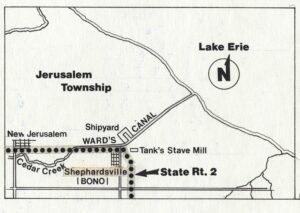
To utilize the area’s rich timber stands, Detroit industrialist Eber Brock Ward (1811-1875) built a canal around 1870 in what was then Oregon Township, Lucas County. Known as Ward’s Canal, it stretched approximately 2-3/4 miles through wetlands to Lake Erie. Through the canal passed timber sawn at Ward’s mills and ships from his boatyards. Two settlements formed to house workers: Shepherdsville, renamed Bono in 1898, and New Jerusalem. (Continued on other side)
, OH
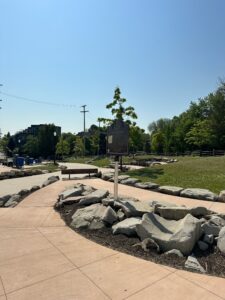
Opened in July 1862, the 35 1/2-acre site here in Brooklyn Township’s University Heights served as the largest Civil War army camp of rendezvous, organization, and training in northeast Ohio. It was bordered by Hershel (now West 5th) and University (now West 7th) streets and Railway and Marquard avenues. A wartime high of 4,151 volunteers occupied the barracks here on December 5, 1862. Lieutenant William Dustin of the 19th Ohio Volunteer Artillery wrote, “It was a table land above the city and admirably suited to the use of a camp of instruction. It was as level as a floor and carpeted with grass. The capacious pine barracks held about 25 each of the battery’s men.” A total of 15,230 men trained here during the war–4.9 percent of the 310,646 enlistments in Ohio. More than 11,000 soldiers were discharged here at war’s end. It closed in August 1865. (continued on other side)